
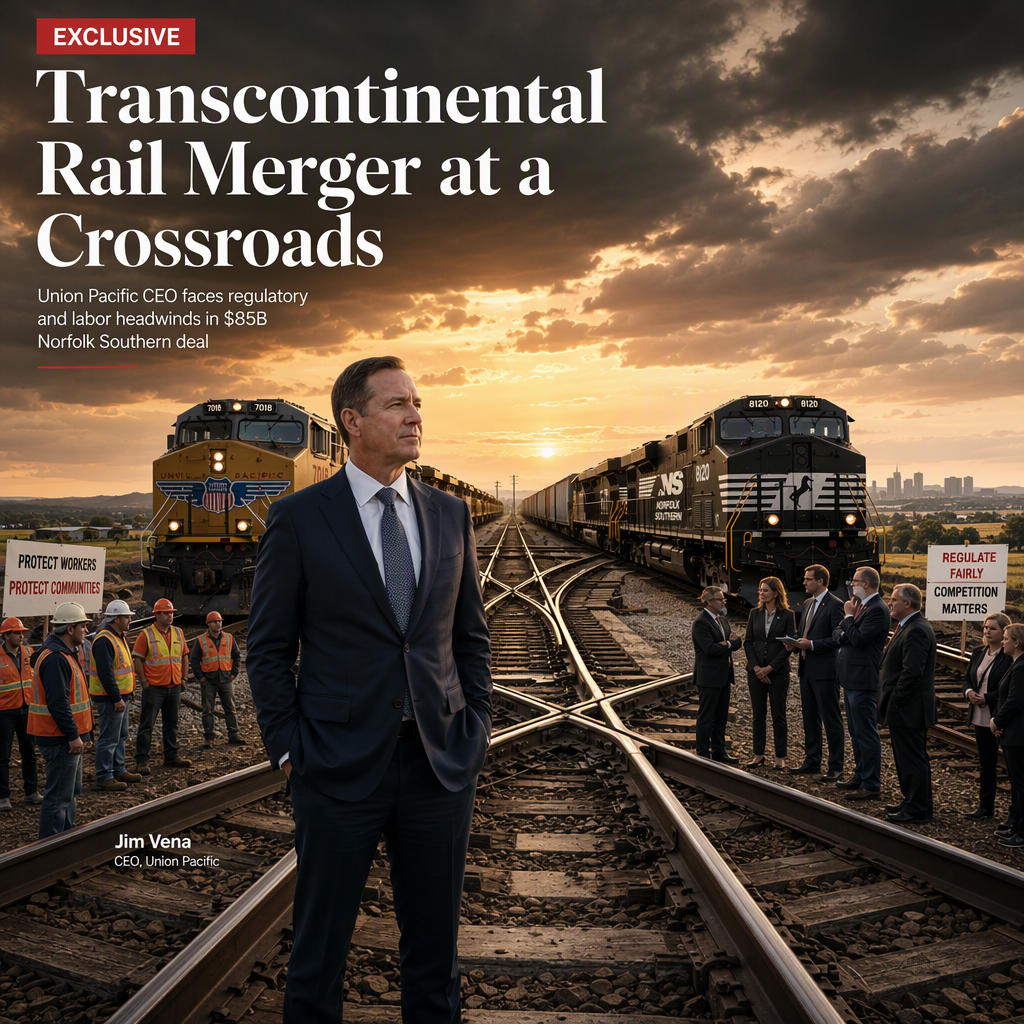
Union Pacific CEO Jim Vena is advocating for an $85 billion merger with Norfolk Southern, which would create the nation's first transcontinental railroad, covering 50,000 miles of track across nearly every state [1]. The proposed deal is currently awaiting approval from the Surface Transportation Board (STB), the federal agency responsible for regulating the rail industry [1]. Vena emphasized the potential benefits of the merger, including lower prices, increased jobs, and improved efficiency, arguing that the combined network could save customers 24 to 48 hours on shipments between the West and East Coasts by eliminating interchange delays [1].
Despite these assurances, the merger faces significant opposition from labor unions, farm groups, and competitors. The Stop the Rail Merger Coalition expressed concerns in a letter to the Trump administration, warning that the merger would place nearly half of the nation's rail traffic under one company's control, potentially harming farmers, manufacturers, energy producers, and railroad workers, while increasing costs for consumers and jeopardizing supply chains [1].
In response to fears about job losses, Union Pacific has pledged that all unionized employees at the time of the deal's closing will have a 'job for life.' Karl Joost, a conductor at a Union Pacific rail yard, noted that while roles might change, employees would not have to worry about losing their positions due to the merger [1]. Vena countered critics by stating that the opposition stems from concerns about Union Pacific's potential to offer a superior product and win in the marketplace, not from illogical business decisions [1].
The market implications are significant, as the merger would reshape the competitive landscape of the U.S. freight rail industry and could impact pricing, service efficiency, and supply chain dynamics [1]. The outcome now hinges on the STB's regulatory review, with both sides presenting strong arguments regarding the merger's potential benefits and risks [1].
CONCLUSION
Union Pacific's proposed $85 billion merger with Norfolk Southern is positioned as a transformative move for the U.S. rail industry, promising efficiency gains and job security for unionized workers. However, the deal faces strong opposition from various stakeholders concerned about market concentration and supply chain risks. The final decision rests with federal regulators, whose ruling will have significant implications for the industry.