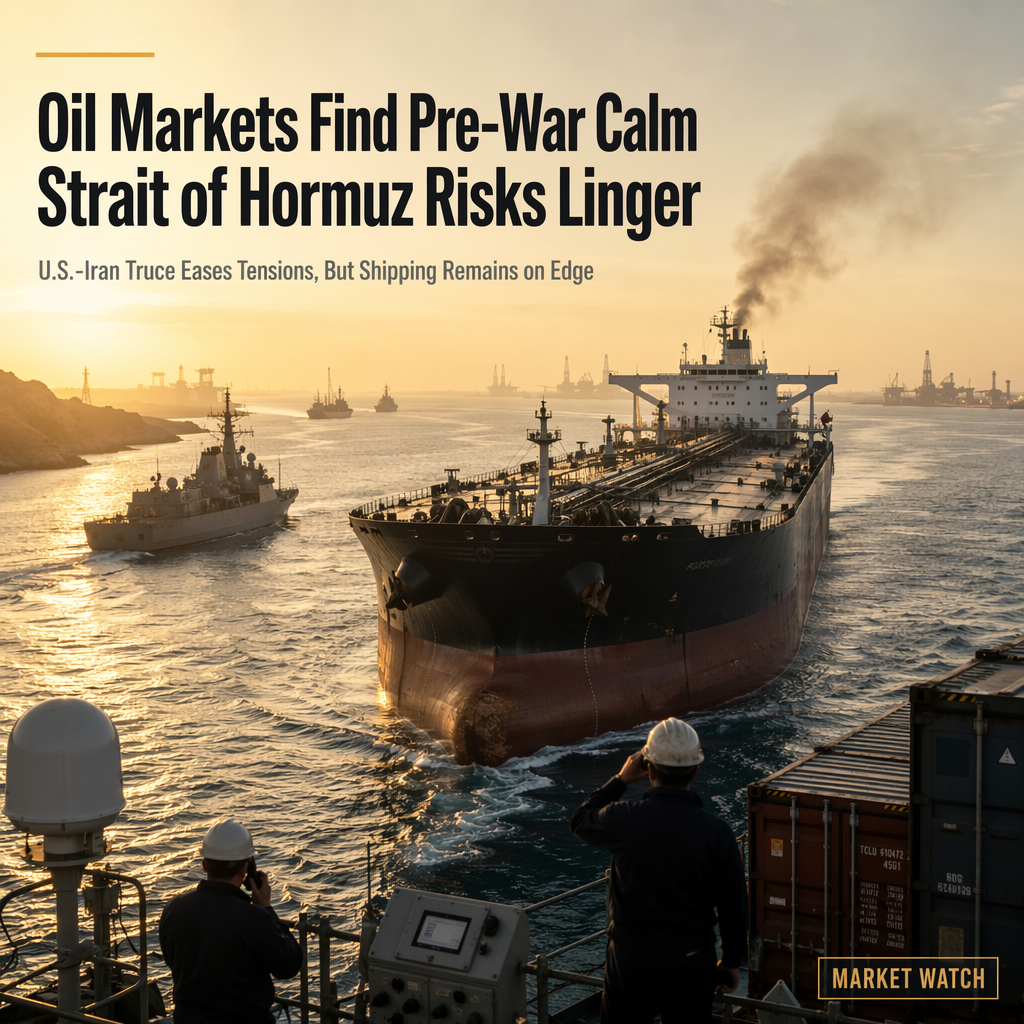
The oil market is responding to a fragile de-escalation between the U.S. and Iran, with both sides agreeing to halt mutual attacks and resume talks on the Strait of Hormuz, a critical energy chokepoint. This agreement has allowed shipping to move more freely, easing immediate supply fears after a series of retaliatory strikes had threatened a fragile interim truce [1][2]. However, the status of the Strait remains unclear, with Iranian authorities asserting that ships can sail freely only with their clearance, and both the U.S. and UK raising threat levels for vessels in the region due to recent attacks [2].
Oil prices have stabilized near pre-war levels, with Brent crude rising 0.903% to $72.64, WTI up 1.228% to $70.08, and Omani crude up 3.847% to $66.69, while Dubai crude slipped 0.575% to $79.214 [1]. WTI oil prices had depreciated by almost 25% over the previous three weeks, retracing most prior gains as hopes for a swift reopening of Hormuz grew, but the decline has now stalled as markets await clarity on the peace deal [2][4]. International benchmark Brent crude futures were trading at $72.45 per barrel as of Monday, compared to a wartime high of over $188 per barrel in late April [4].
Despite the easing of oil-driven inflation pressures, analysts and central banks remain cautious. Commerzbank notes that while lower oil prices reduce tail risks for growth, inflation, and rate volatility in the euro area, inflation is not falling quickly enough to dispel European Central Bank (ECB) hawkishness. The ECB continues to emphasize that price pressures, especially in services, persist, and the coming days will provide further clarity with new inflation data [3]. BNY also warns that any relief for central banks may be short-lived, as new supply-side constraints linked to the global artificial intelligence investment cycle are emerging, potentially making inflation more persistent [1].
Market participants and analysts warn that the market may be underestimating persistent supply-side risks. Shipping through the Strait of Hormuz is unlikely to rebound quickly to pre-war levels due to unclear ceasefire terms, higher insurance costs, and mine risks. Many shipping companies remain wary of returning, and shipping costs remain elevated [4]. Analysts argue that while some vessels are now transiting the Strait, persuading shippers to return remains a significant challenge, and arrangements with Iran are largely ad hoc due to sanctions risk [4].
There are also discrepancies in the outlook for peace talks: while some U.S. officials report that talks are scheduled for this week, Iranian Deputy Foreign Minister Kazem Gharibabadi stated there is no current plan to meet U.S. technical teams [2].
CONCLUSION
Oil prices have stabilized near pre-war levels following a fragile truce between the U.S. and Iran, but persistent risks in the Strait of Hormuz and ongoing inflation concerns are keeping markets cautious. Analysts warn that shipping normalization will be slow, and central banks remain wary of inflationary pressures. The market impact remains high as participants await further clarity on both geopolitical developments and inflation trends.