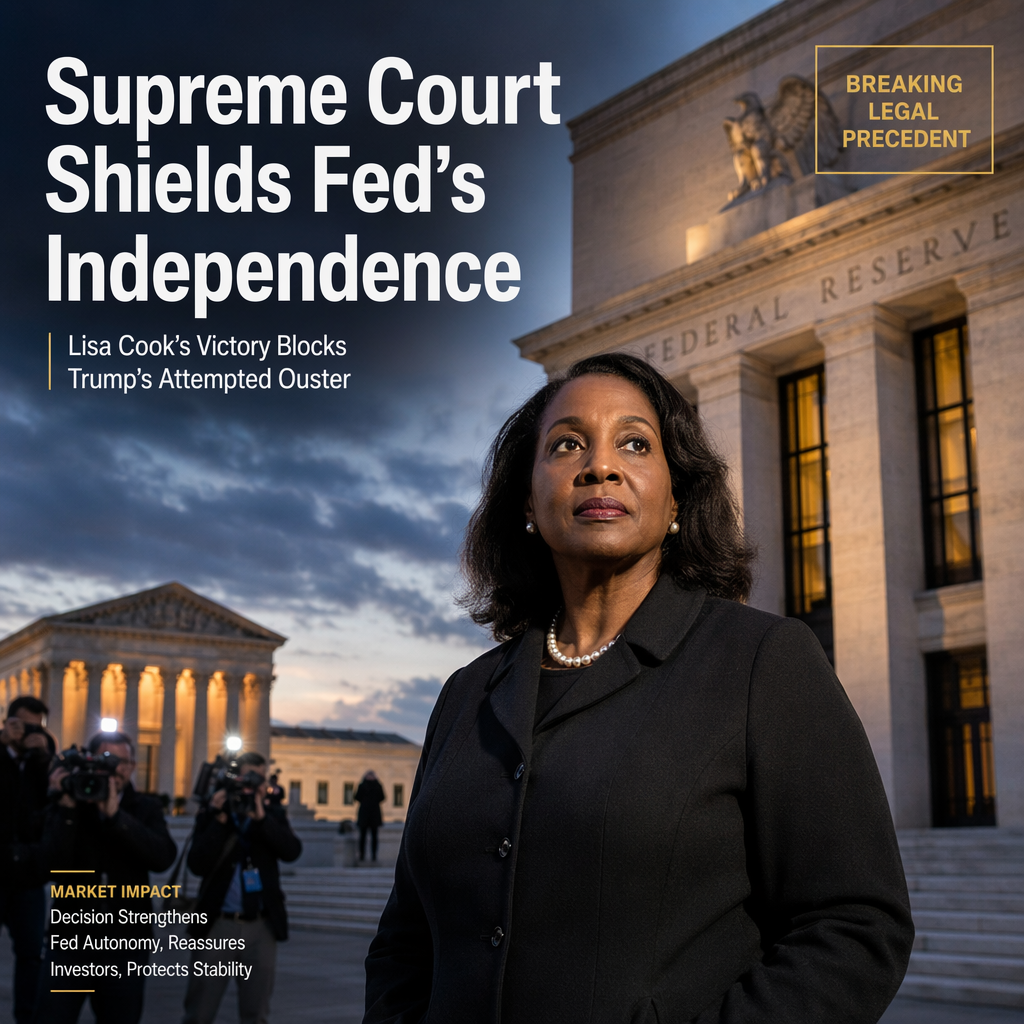
The Supreme Court ruled on Monday against President Donald Trump’s attempt to remove Federal Reserve Governor Lisa Cook, upholding longstanding protections for the central bank’s independence and preventing her dismissal while her legal challenge proceeds [1][2][3][4][5]. The decision, delivered in a 5-4 vote with Chief Justice John Roberts authoring the majority opinion, was joined by Justice Brett Kavanaugh and the court’s three liberal justices—Elena Kagan, Sonia Sotomayor, and Ketanji Brown Jackson. Justices Clarence Thomas, Samuel Alito, Neil Gorsuch, and Amy Coney Barrett dissented [2][4][5].
The case originated after Trump announced Cook’s firing in late August, alleging she misrepresented information related to mortgages obtained before her Fed appointment—a claim Cook has denied, and for which she has not been charged with a crime [1][5]. Cook sued to block her removal, and lower courts sided with her, a stance now affirmed by the Supreme Court [1][2][5]. The ruling emphasized that the Federal Reserve’s unique structure, history, and role in the financial system warrant special constitutional protections, distinguishing it from other independent agencies [2][3][4][5].
In a related but separate decision, the Court expanded presidential authority over other independent agencies by overturning the 1935 Humphrey’s Executor v. United States precedent, allowing Trump to remove Federal Trade Commission Commissioner Rebecca Slaughter [2][3][4][5]. However, the Court carved out an exception for the Federal Reserve, maintaining that its governors can only be removed by the president “for cause,” and not at will [2][4][5].
Lisa Cook, the first Black woman to serve as a Fed governor, welcomed the decision, stating that Trump’s actions were “an attempt to remove me on a manufactured pretext because I refused to bow to political pressure and continued to set interest rates based only on what would best serve the American people” [4][5]. Legal and financial analysts noted that the ruling reassures markets by preserving the Fed’s autonomy, which is seen as crucial for monetary policy stability and investor confidence [3]. Critics warned that increased presidential control over the Fed could politicize interest rate decisions, but the Court’s decision was viewed as a stabilizing force for financial markets [2][3].
The Supreme Court heard oral arguments in Cook’s case on January 21, with several justices expressing skepticism toward the administration’s arguments for her removal [5]. The White House, Federal Reserve, and Cook’s lawyer did not immediately comment following the ruling [2]. The decision comes as the Fed enters a new era under Chair Kevin Warsh, heightening attention on the balance between White House influence and central bank autonomy [2].
CONCLUSION
The Supreme Court’s decision to block President Trump’s attempt to fire Fed Governor Lisa Cook preserves the Federal Reserve’s independence and reassures markets that monetary policy will remain insulated from political pressures. While the ruling limits presidential power over the Fed, it simultaneously expands executive authority over other independent agencies, marking a significant shift in the balance of power in federal governance.