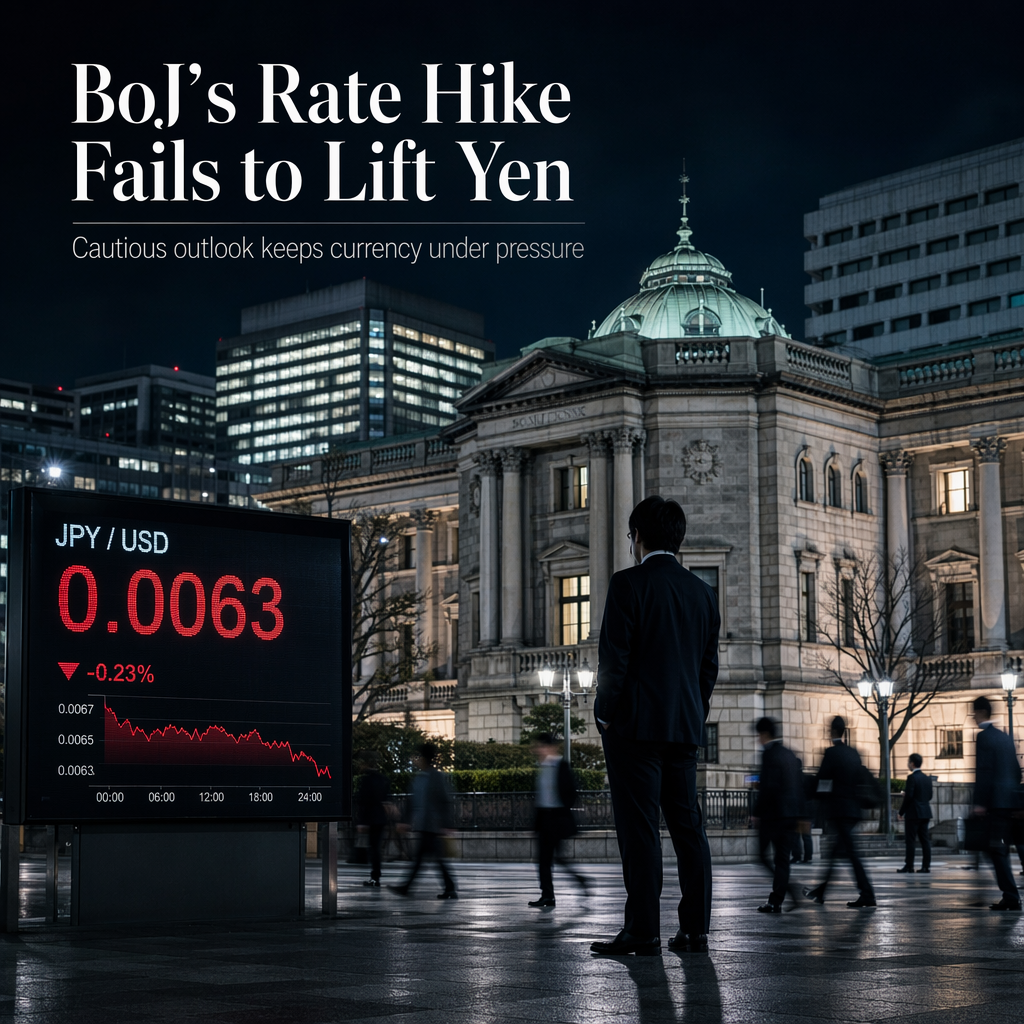
The Bank of Japan (BoJ) has raised its policy rate by 25 basis points to 1.0%, marking a move to a 30-year high. Despite this widely anticipated rate hike, the Japanese Yen (JPY) continues to face downward pressure, with analysts noting that the increase has not been sufficient to trigger a sustained recovery for the currency [1].
Societe Generale highlights that the BoJ's hike, along with other recent G10 central bank decisions, has not resulted in significant foreign exchange market moves. The bank suggests that the next major catalyst for USD/JPY will likely come from the Federal Reserve. If the Fed adopts a dovish stance, Societe Generale sees short USD/JPY positions as attractive, implying that the Yen could strengthen if US monetary policy turns more accommodative [1].
OCBC points out that the BoJ's cautious approach to tightening limits near-term support for the Yen. Although the policy bias remains tilted toward further hikes, the central bank has not signaled an accelerated tightening cycle. As a result, the Yen may struggle to gain sustained traction unless the BoJ adopts a more clearly hawkish stance. OCBC also notes that, despite the policy rate reaching a 30-year high, Japan still offers the lowest real rate among G10 economies, making the JPY attractive as a funding currency and capping potential rallies even after rate hikes [1].
Both Societe Generale and OCBC agree that the Japanese Yen's next significant move will depend on a decisive shift in policy expectations, either from the BoJ or the Federal Reserve. Until such a shift occurs, the Yen is likely to remain under pressure, with intervention risk remaining in focus [1].
CONCLUSION
The BoJ's 1.0% rate hike has not provided the Japanese Yen with meaningful support, as analysts cite the central bank's cautious tightening path and Japan's low real rates. Market participants are now looking to the Federal Reserve or a more hawkish BoJ stance as potential catalysts for a stronger Yen. In the near term, the Yen is expected to remain subdued unless policy expectations shift significantly.