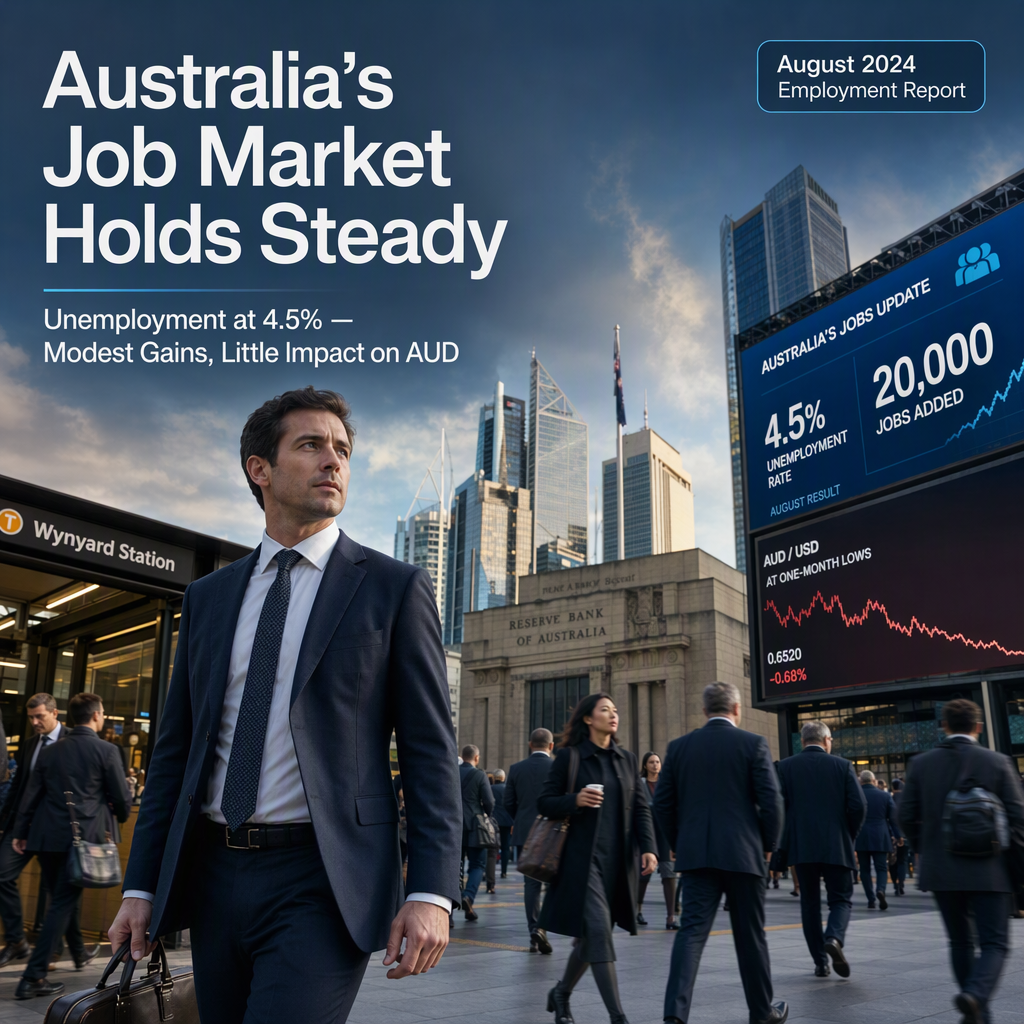
Australia is set to release its August monthly employment report, with analysts forecasting the unemployment rate to remain unchanged at 4.5% and the participation rate steady at 66.9% [1]. The country is expected to have added 20,000 new jobs in August, marking a modest improvement compared to July, when Australia lost 32,200 part-time positions but gained 16,300 full-time jobs [1]. Despite these figures, the employment report is anticipated to have little to no sustainable effect on the Australian Dollar (AUD), as market participants remain focused on other factors [1].
The employment data comes just ahead of the Reserve Bank of Australia (RBA) monetary policy meeting. In its previous meeting, the RBA left the Official Cash Rate unchanged at 4.35%, citing a softer-than-anticipated impact of the Middle East conflict on inflation, but continued to express concerns about persistently high headline inflation [1]. The RBA noted that labor market conditions have eased slightly more than expected in recent months, but leading indicators suggest only limited further easing in the near term [1]. The central bank's mandate prioritizes price stability and full employment, but officials are currently more focused on preventing high inflation from becoming entrenched, indicating that the upcoming employment figures are unlikely to influence the next policy decision [1].
Meanwhile, the US Dollar (USD) has strengthened across the FX board, pushing AUD/USD to one-month lows below the 0.7100 mark. This move is attributed to hawkish comments from Federal Reserve officials and a recent Fed rate hike, which raised the benchmark rate to a 3.75%–4.00% range [1]. Despite hopes for de-escalation in the Middle East, the Greenback's surge has overshadowed the Australian employment data in terms of market impact [1].
CONCLUSION
Australia's August employment report is expected to show steady unemployment and modest job gains, but is unlikely to significantly influence the Australian Dollar or the RBA's upcoming policy decision. Market attention remains focused on global factors, particularly US monetary policy and currency movements, which are exerting greater influence on AUD/USD levels.