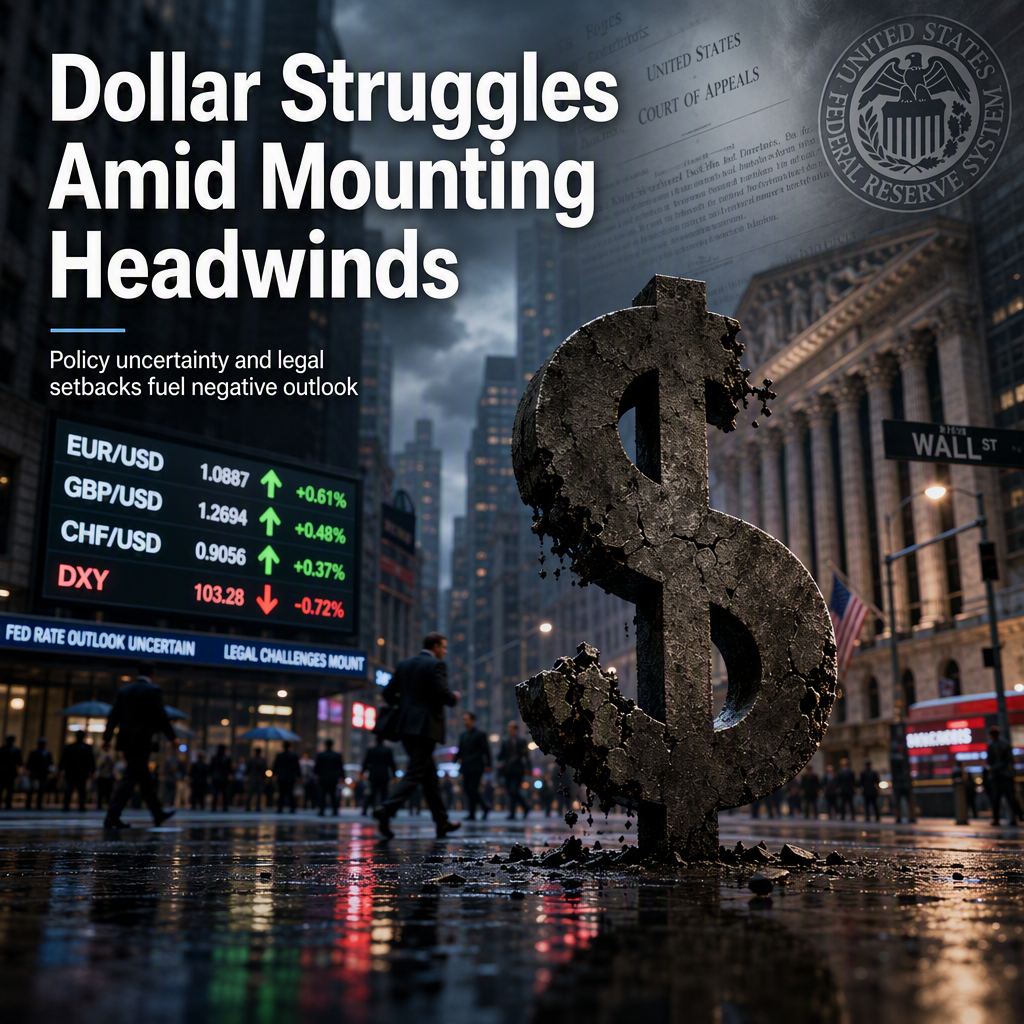
The US Dollar Index (DXY) is exhibiting a growing negative bias, with the index struggling to reclaim the psychological 100 threshold after four failed attempts, according to DBS Group Research strategist Philip Wee [1]. The underlying weakness of the US dollar is more accurately reflected in the performance of European currencies, with the euro (EUR) rising by 0.19%, the British pound (GBP) by 0.14%, and the Swiss franc (CHF) by 0.14%, once the volatility of the Japanese yen (JPY) is excluded. The JPY had corrected by -0.36% on Tuesday following a sharp rebound attributed to joint US-Japan interventions [1].
Market sentiment towards the dollar has been further dampened by reduced expectations for a Federal Reserve rate hike in September. After last week’s underwhelming FOMC meeting, futures markets lowered the probability of a September hike to 58%, down from 72% previously [1]. In addition to monetary policy uncertainty, US trade policy remains a significant headwind. The US Court of International Trade reported that the Trump administration refunded approximately $100 billion, or 60%, of the Liberation Day tariffs collected, following a US Supreme Court ruling in February that found the tariffs violated the International Emergency Economic Powers Act [1].
These developments underscore the multiple policy-related challenges facing the US dollar, including legal setbacks on tariffs and shifting expectations for monetary tightening. The combination of these factors has contributed to the dollar’s inability to regain momentum and has reinforced the negative outlook for the DXY in the near term [1].
CONCLUSION
The US Dollar Index is under pressure from policy uncertainty, legal challenges to tariffs, and waning expectations for a Fed rate hike. European currencies are strengthening against the dollar, highlighting its underlying weakness. Market sentiment remains negative, with the outlook for the DXY clouded by persistent headwinds.