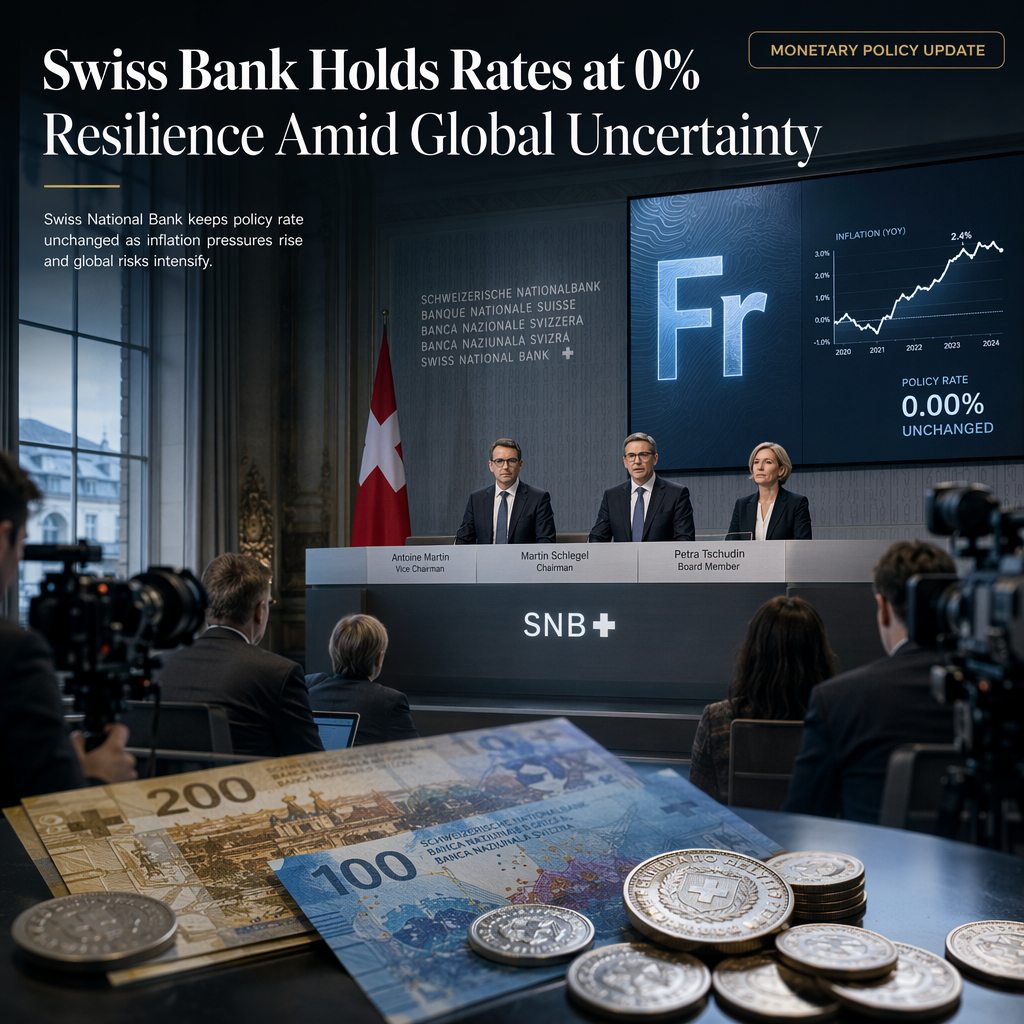
The Swiss National Bank (SNB) decided to keep its benchmark interest rate unchanged at 0% during its June monetary policy assessment, marking the twelfth consecutive time the rate has been held steady [2][3][4]. This decision was widely anticipated by the market [3]. SNB officials, including Chairman Martin Schlegel, Vice Chairman Antoine Martin, and Governing Board member Petra Tschudin, addressed the press following the announcement, highlighting both resilience and emerging risks in the Swiss economy [1][2][4].
Petra Tschudin noted that economic activity in Switzerland remains resilient, with solid GDP growth recorded in the first quarter. However, she acknowledged a slight rise in unemployment and cautioned that moderate global economic development could dampen Swiss growth in the coming quarters. Tschudin also warned that upward pressure on the Swiss Franc could increase again, with the main risk to the Swiss outlook stemming from global economic developments [1].
Antoine Martin stated that inflation is expected to remain elevated in the coming quarters, primarily due to higher raw material and energy prices. He noted that business and household sentiment has deteriorated as a result of rising energy costs, and that the baseline scenario is subject to high uncertainty, particularly due to the fragile situation in the Middle East and ongoing trade policy uncertainties. Martin suggested these factors are likely to weigh on consumers' purchasing power and result in more moderate global economic growth [2].
Martin Schlegel echoed these concerns, stating that while Swiss inflation has risen in recent months due to higher energy prices, medium-term inflationary pressures remain unchanged and inflation is still within the SNB's target range. Schlegel emphasized the SNB's increased willingness to intervene in the foreign exchange market if necessary, given persistent risks of strong upward pressure on the Franc and elevated geopolitical uncertainty. He projected that inflation would continue to rise slightly in the coming quarters before declining in the first half of 2027 [4].
Market reaction to the SNB's decision was modestly negative for the Swiss Franc. The USD/CHF pair rose above 0.8000, approaching two-and-a-half-month highs at 0.8015, and was trading 0.09% higher on the day at 0.8006 [2][3][4]. The Swiss Franc was the weakest against the Australian Dollar among major currencies, and it dropped more than 0.8% against the US Dollar the previous day following a hawkish Federal Reserve statement [2][3]. Swiss customs data showed the trade balance surplus widened to CHF 6.11 billion in May from CHF 3.05 billion in April, providing mild support to the currency earlier in the session [3].
Looking ahead, SNB officials indicated that monetary policy is likely to remain unchanged in the coming months unless there is a significant shift in inflationary pressures or global risks. The SNB reiterated its readiness to intervene in the forex market if necessary, with future developments highly dependent on geopolitical events, particularly in the Middle East [4].
CONCLUSION
The SNB's decision to keep rates unchanged at 0% reflects a cautious stance amid resilient domestic growth but rising inflation and global uncertainties. The Swiss Franc weakened modestly following the announcement, with officials signaling a continued readiness to intervene in currency markets if needed. Forward guidance suggests policy stability unless inflation or geopolitical risks escalate further.