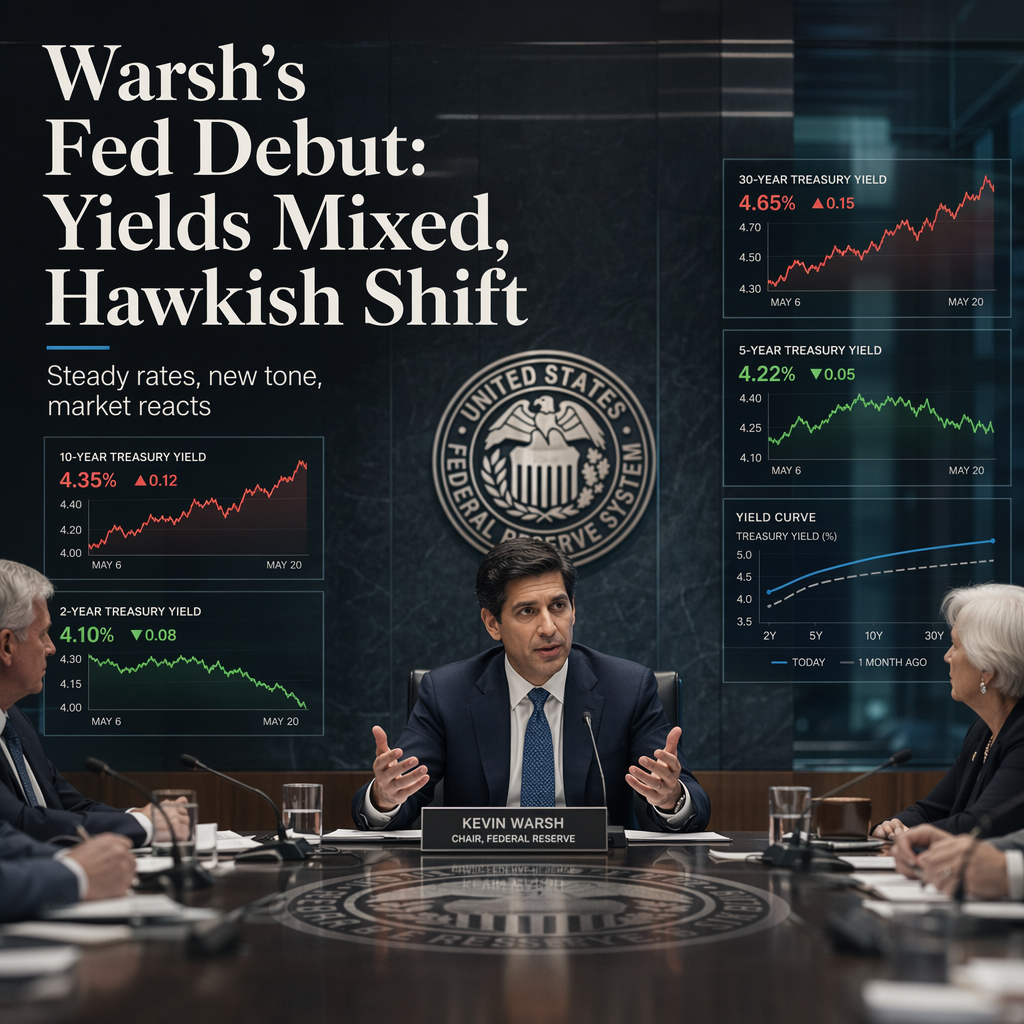
On June 18, 2026, U.S. Treasury yields were mixed as investors digested the outcome of Kevin Warsh's first meeting as chair of the Federal Reserve, which concluded with no change in interest rates and a notable shift in policy communication [1]. The yield on the 10-year U.S. Treasury note remained largely flat at 4.457%, while the 2-year note yield, closely tied to short-term Fed policy, rose over two basis points to 4.189%. In contrast, the 30-year Treasury bond yield fell more than four basis points to 4.885% [1]. The Federal Reserve kept its benchmark federal funds rate unchanged at 3.5%-3.75% [1].
A significant development from the meeting was the removal of language indicating a bias toward future rate cuts in the Fed's policy statement, replaced by a more concise communication and a nod to possible rate hikes ahead [1]. Kevin Warsh, in his first press conference as chair, confirmed he did not submit a rate forecast, stating, "I did not submit a dot for me. It's not helpful in the conduct of policy," and announced the formation of task forces to overhaul major Fed operations [1].
Market commentators responded positively to Warsh's approach. ING's rates analysts noted that Warsh sent a clear message that the Federal Reserve is focused on addressing inflation and is prepared to act if inflation becomes problematic, which they described as adding credibility to Warsh's FOMC leadership [1]. Byron Anderson of Laffer Tengler Investments remarked that the market environment is shifting back to a time when markets react to the Fed, rather than the Fed reacting to markets [1].
Looking ahead, traders are monitoring upcoming economic data releases, including May's leading indicators, June's Philadelphia Fed Index, and initial jobless claims for the week ended June 13, for further market direction [1].
CONCLUSION
Kevin Warsh's first meeting as Federal Reserve chair was marked by a steady policy stance, a more hawkish tone, and operational changes, leading to mixed Treasury yield movements. Market participants interpreted the Fed's messaging as credible and inflation-focused, with attention now turning to upcoming economic data for further signals.