
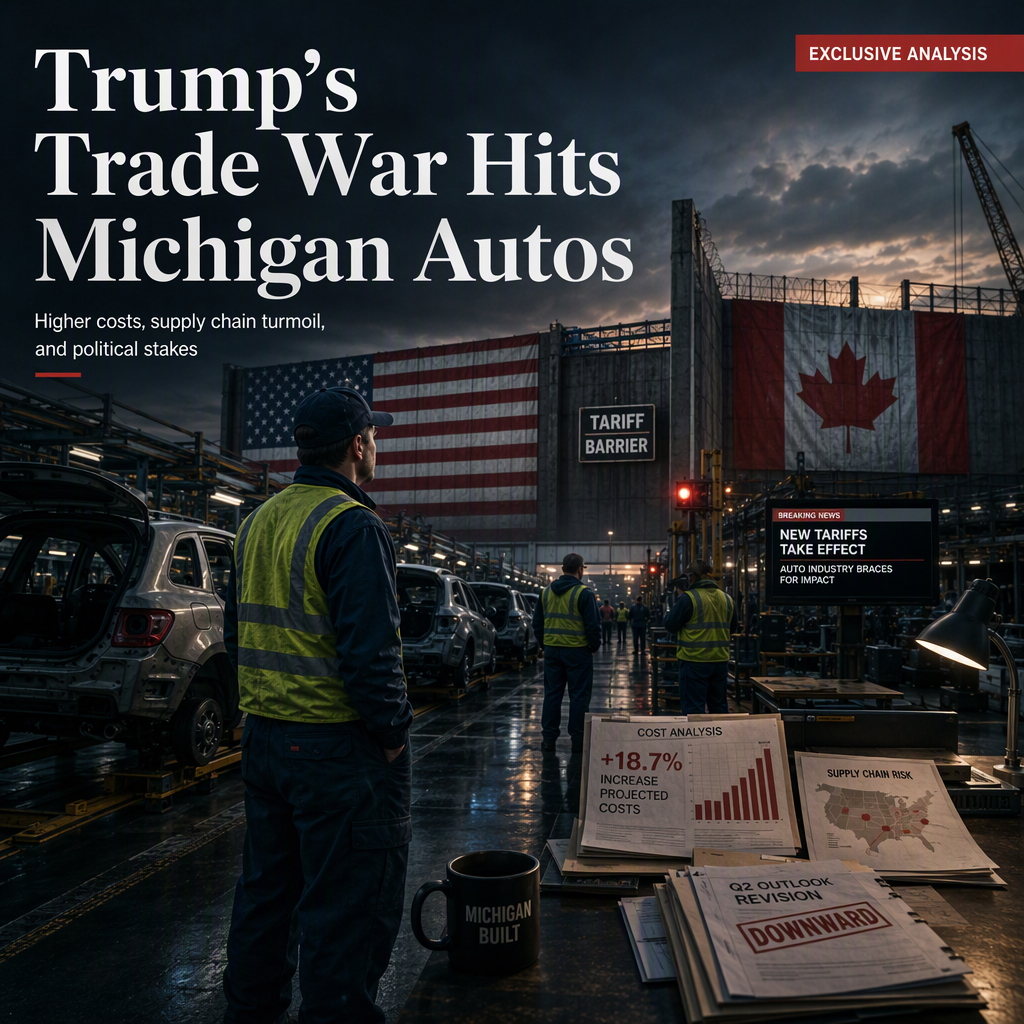
President Donald Trump's escalating trade dispute with Canada is poised to deliver a significant economic blow to Michigan, a key battleground state with a deeply intertwined auto industry supply chain [1]. Trade expert David Clement, policy director at Consumer Choice Center, warns that Michigan manufacturers could face higher costs as a result of the tariff fight, which threatens to raise prices for both automakers and consumers [1]. Michigan exported approximately $21.2 billion worth of goods to Canada in 2025, accounting for about 36% of the state's total exports, mainly vehicles and parts, according to the Michigan Department of Transportation [1].
Clement highlighted that Michigan ranks seventh among U.S. states in terms of export vulnerability to the trade war, with equipment, machinery, and the auto industry being particularly exposed [1]. He explained that auto parts often cross the border multiple times—upwards of eight times—before a vehicle is completed, meaning tariffs imposed on these parts can significantly disrupt the supply chain between Michigan and Ontario [1]. Trump imposed an additional 50% tariff on certain Canadian products earlier this year, and the administration has barred some Canadian products from entering the U.S. starting September 29 [1].
The trade fight has intensified under Trump and Canadian Prime Minister Mark Carney, with negotiations breaking down and both countries imposing new measures targeting each other's goods [1]. Clement warned that these tariffs, combined with already-elevated living costs, could result in a "double whammy" for Michigan consumers, leading to higher prices at dealership lots [1].
The economic stakes are heightened by the ongoing U.S. Senate race in Michigan, with Democrat Abdul El-Sayed and Republican Mike Rogers vying for the seat being vacated by retiring Democratic Sen. Gary Peters [1]. Despite the potential political risks, the Trump administration has defended its actions as necessary to protect American business interests [1].
CONCLUSION
Trump's trade war with Canada is causing significant concern for Michigan's auto industry, with experts warning of higher costs and disrupted supply chains. The state's heavy reliance on cross-border exports makes it particularly vulnerable, and the political implications are amplified by an upcoming Senate race. Market participants should expect continued volatility and elevated costs in Michigan's auto sector as the dispute persists.