
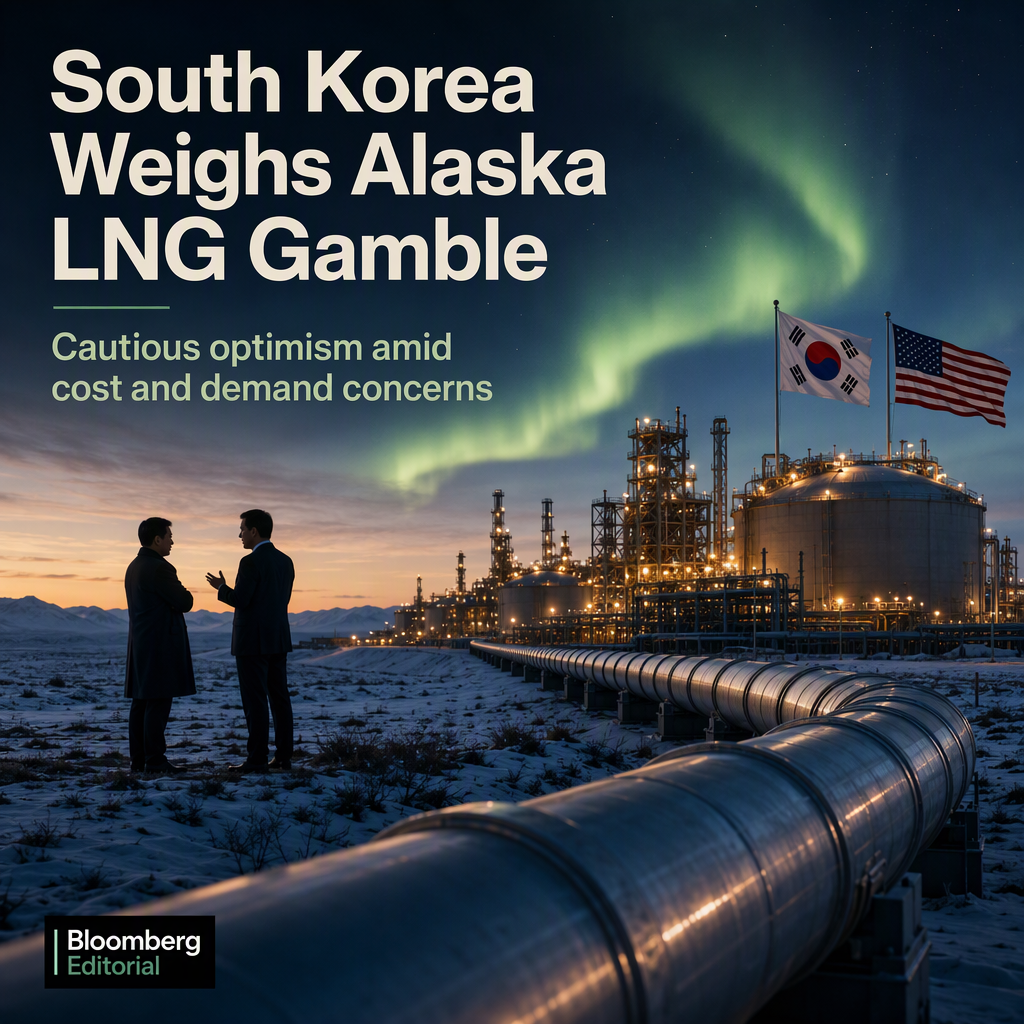
U.S. President Donald Trump announced that South Korea and the United States had agreed to work on the $50 billion Alaska LNG project, positioning it as part of Seoul's $200 billion investment package in the U.S. However, South Korean President Lee Jae Myung responded with caution, emphasizing that South Korea's participation would depend on the project's financial viability and legal compliance [1].
The Alaska LNG project aims to transport natural gas through an approximately 800-mile pipeline from Prudhoe Bay in Alaska's North Slope to an LNG facility in Nikiski, with a planned annual production capacity of 20 million metric tons. The estimated cost for the integrated project ranges between $44.5 billion and $54.5 billion, according to Go Katayama, principal insight analyst at Kpler [1].
Shipping LNG from Nikiski to South Korea would take seven to nine days, significantly shorter than the 20 to 30 days required from the U.S. Gulf Coast. This shorter route could reduce transportation costs and avoid geopolitical chokepoints such as the Strait of Hormuz, according to Seung Hoon Yoo, professor at Seoul National University of Science and Technology [1].
Despite these logistical advantages, experts highlight concerns about the project's massive pipeline and development costs, which could undermine its price competitiveness. Kit Ling Wong, head of business intelligence for Asia Pacific at Poten & Partners, stated that the economics of Alaska LNG are expensive due to the long pipeline, making it less competitive compared to supplies from Australia, the U.S. Gulf Coast, and Qatar. Wong noted that the project's capital expenditure could fund three U.S. Gulf projects, raising questions about whether the shorter shipping route can offset higher development costs for South Korean buyers [1].
South Korea's cautious stance is also influenced by worries about potential cost overruns and the risk of committing to long-term LNG contracts amid slowing domestic gas demand. Experts suggest that greater certainty around project financing, U.S. government support, and opportunities for South Korean companies to participate beyond simply buying LNG could be crucial for broader involvement [1].
CONCLUSION
While the Alaska LNG project offers logistical advantages for South Korea, significant concerns about cost competitiveness and long-term demand are prompting a cautious approach. The project's future participation by South Korea will depend on financial viability, legal compliance, and broader opportunities for involvement. Market sentiment remains neutral to slightly positive, with medium impact as stakeholders await further clarity on project financing and government support.