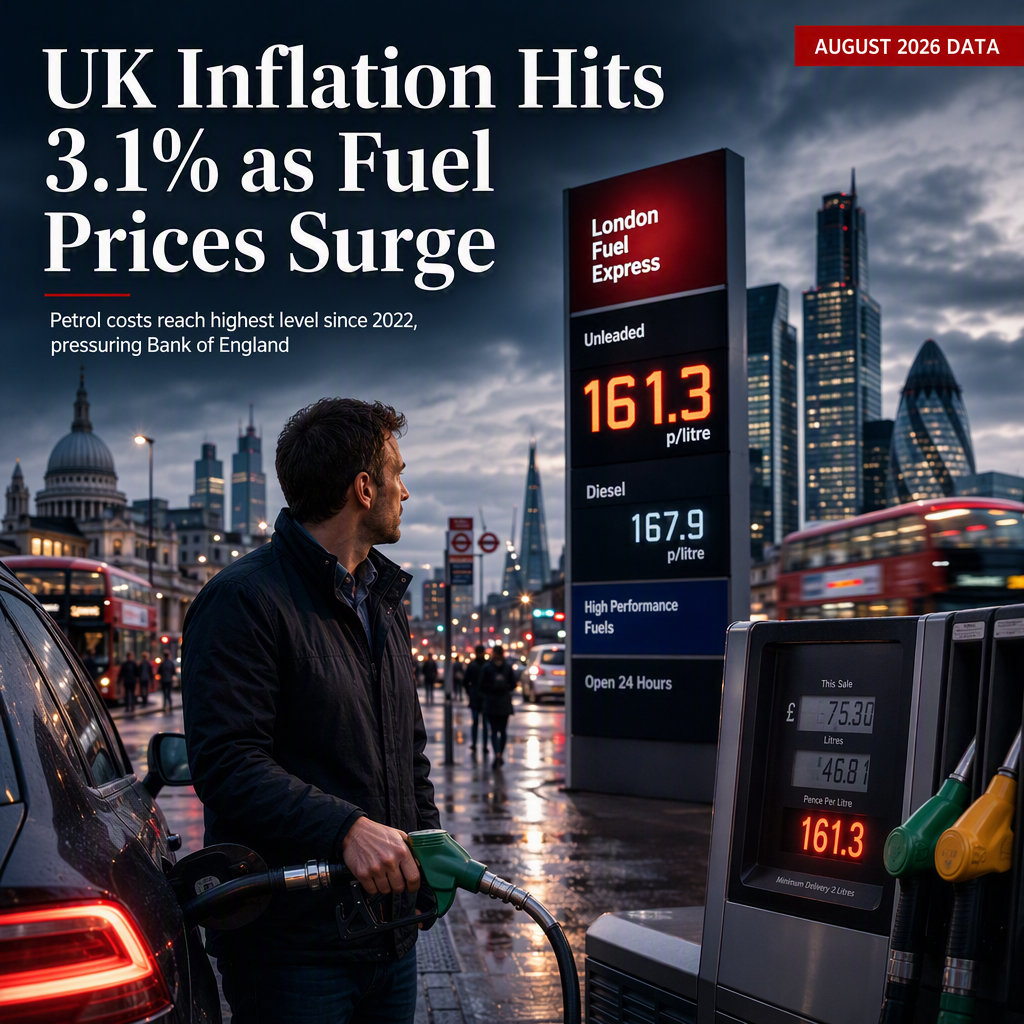
UK consumer price inflation rose to 3.1% year-over-year in August 2026, up from 2.9% in July, matching economists' forecasts and marking the highest reading in five months [1]. On a monthly basis, the Consumer Price Index (CPI) increased by 0.5%, the fastest pace in four months [1]. The broader CPIH measure, which includes housing costs, rose 3.3% over the year [1].
The main driver of the inflation uptick was transport costs, particularly motor fuels, which surged 23.0% year-over-year compared to 15.5% in July [1]. Petrol prices reached 161.3 pence per litre in August, the highest level since November 2022, with drivers paying about 9 pence more per litre than in July [1]. The article attributes this spike to higher oil prices, influenced by ongoing conflict in the Middle East since early 2026, which has kept global energy markets tense [1].
Other notable contributors included housing and household services inflation, which rose to 4.9%, and household energy prices, which climbed 6.0% over the year [1]. In contrast, food inflation remained subdued at 1.3%, its lowest level since 2021 [1]. Core CPI, which excludes volatile items such as energy and food, held steady at 2.6%, defying market expectations for a small rise and suggesting that the inflation increase was concentrated in fuel rather than being broad-based [1]. Services inflation also remained flat at 3.4%, a key metric monitored by the Bank of England [1].
The inflation data arrives just ahead of the Bank of England's rate decision, scheduled for September 17, 2026 [1]. The steady core and services inflation figures may provide some relief, but the sharp rise in headline inflation and fuel prices could influence the central bank's policy stance [1].
CONCLUSION
UK inflation accelerated to a five-month high in August 2026, primarily due to a sharp increase in fuel prices. While core and services inflation remained steady, the headline figure's rise puts additional pressure on the Bank of England ahead of its upcoming rate decision. Market participants are closely watching for the central bank's response to these inflation dynamics.