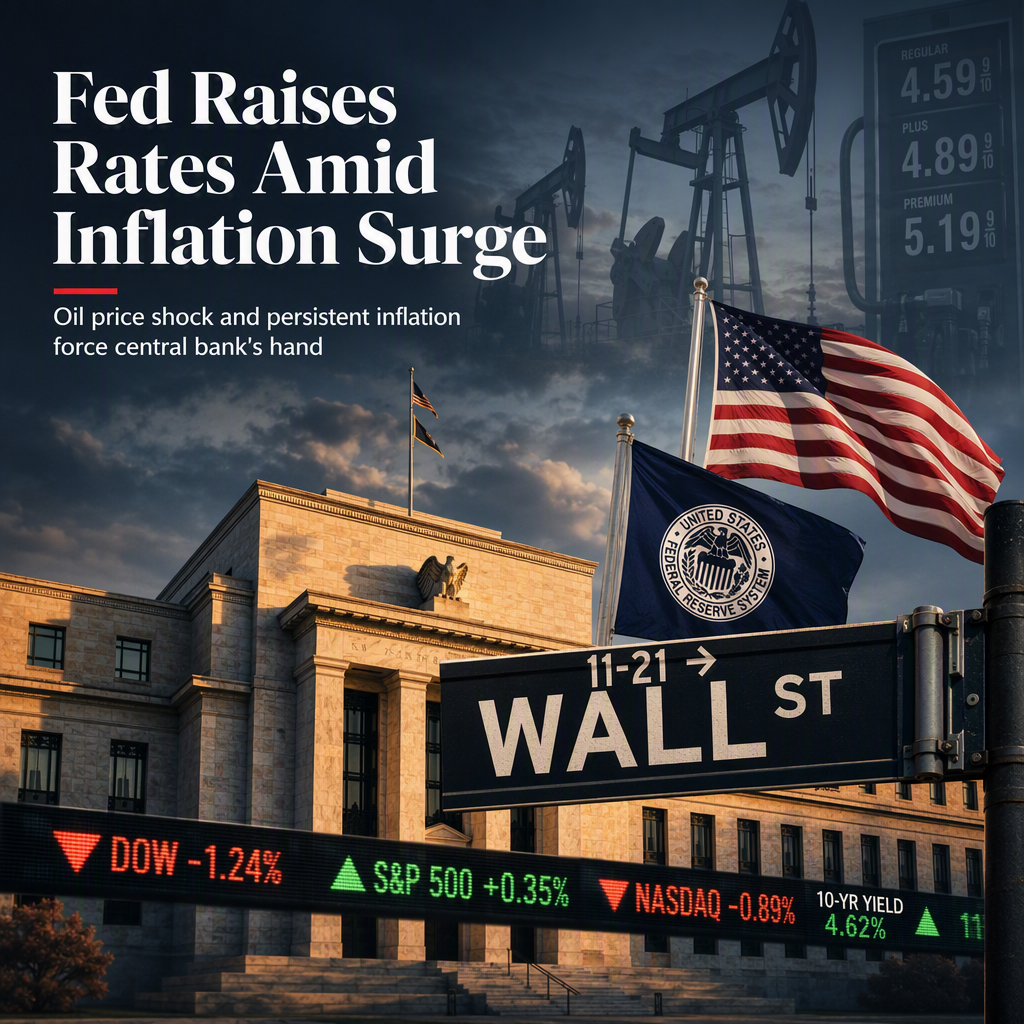
The Federal Reserve raised its benchmark interest rate by 25 basis points on Wednesday, marking its first rate hike since July 2023 and ending a period of unchanged rates at its first five meetings this year [1][2][3]. The Federal Open Market Committee (FOMC) voted unanimously, 12-0, to increase the federal funds rate from a range of 3.5%-3.75% to a new target of 3.75%-4% [1][2][3]. This move comes amid persistent inflation, which has been exacerbated by a more than 75% surge in oil prices this year and a 45% increase in gas prices since the onset of the war with Iran in late February [2][3]. As a result, inflation reached 3.4% in August, outpacing average U.S. wage growth of 3.1% [2].
The FOMC stated, "Economic activity is expanding at a solid pace. While uncertainty remains elevated owing, in part, to geopolitical developments, domestic spending has been resilient. Productivity growth is strong, and capital investment is robust. Job gains have kept pace with the workforce, and the unemployment rate has changed little. Inflation remains elevated. Today's policy action will support a timelier return to the Committee's 2% goal" [1][2][3].
The Fed's decision defied calls from President Donald Trump for lower interest rates, with the central bank instead prioritizing inflation control in the wake of geopolitical tensions and rising energy costs [2]. Fed Chair Kevin Warsh, who will hold a press conference at 2:30 p.m. ET, has not submitted a dot in the committee's projections since taking the position [1][3]. Updated economic projections released alongside the rate decision show that all but two FOMC members forecast another rate increase later this year, with 16 of 18 participants expecting at least one more hike and four seeing the possibility of two [2][3].
The Fed's inflation outlook has also shifted, with officials now expecting the headline personal consumption expenditures (PCE) price index to reach 3.7% and core PCE (excluding food and energy) at 3.4% for the year, both 0.1 percentage point higher than the previous June update [3]. The Fed does not anticipate reaching its 2% inflation target until 2029, though it expects both measures to drop sharply in 2027 [3]. While the Fed rarely raises rates only once in such circumstances, the committee signaled that no further increases are penciled in for subsequent years, with one cut each indicated for 2028 and at least one for 2029 [3].
Markets had widely anticipated the rate hike, with a better than 90% chance priced in prior to the announcement [3]. The rationale for the hike was described as unusual, as the Fed typically looks through inflation driven by energy shocks, but recent discussions among officials weighed the risks of ignoring persistent price increases [3].
CONCLUSION
The Federal Reserve's first rate hike since 2023 signals a renewed commitment to combating persistent inflation, driven largely by surging oil and gas prices amid geopolitical tensions. With most policymakers expecting at least one more increase this year and inflation forecasts remaining elevated, the market impact is significant and suggests a more hawkish stance from the central bank in the near term.