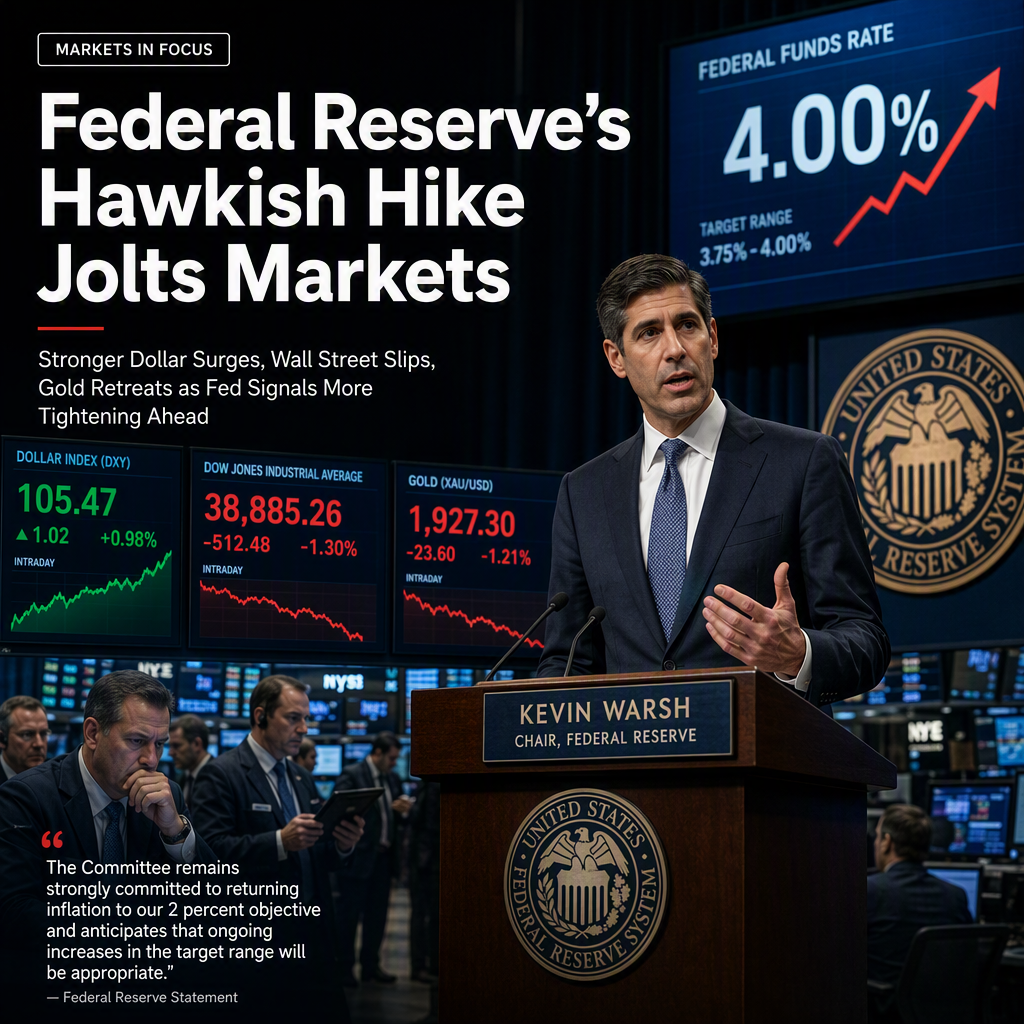
The Federal Reserve (Fed) raised its federal funds target range by 25 basis points to 3.75%-4.00% in a unanimous 12-0 decision, marking its first rate hike since July 2023 and its first move since the cut in December 2025 [1][3][4][5][7][9][10][12][13]. Chair Kevin Warsh emphasized persistent inflation concerns, stating, 'Inflation trends were not passing the test,' and that the FOMC must be confident inflation is moving toward 2% on a timely basis, which has not been met [1][3]. The accompanying Summary of Economic Projections (SEP) showed that 16 of 18 Fed officials expect at least one more rate hike this year, with the median year-end rate projection rising to 4.1% from 3.8% in June [2][3][4][8][12]. For 2027, the federal funds rate is projected at 4.1%, up from 3.6%, and expected to ease to 3.9% in 2028 [2][3]. The longer-run rate rises to 3.2% from 3.1% [2]. The Fed also revised its economic outlook, projecting US GDP growth at 2.3% for 2026 (up from 2.2%), and a 4.1% unemployment rate (down from 4.3%) [2][3][8]. PCE inflation is forecast to rise to 3.7% by end-2026, slightly above the previous 3.6% estimate, with core PCE inflation at 3.4% [2][3][8][12].
The market reaction was swift: the US Dollar Index (DXY) surged above the psychological 100.00 mark, with USD strengthening against all major currencies, most notably the New Zealand Dollar and British Pound [1][6][9][11]. EUR/USD dropped below 1.1500, GBP/USD fell beneath 1.3400, and USD/JPY hit fresh weekly highs near 155.55 [4][7][8][11]. AUD/USD slid below 0.7100, and USD/CAD reached a six-week high just under 1.4000 [3][5][11]. The Dow Jones Industrial Average dropped about 152 points post-announcement, reflecting higher borrowing costs for its 30 corporate constituents, while the 10-year Treasury yield briefly dipped to 4.94% before rebounding to 4.96%, with the day's high above 5%—the highest since 2007 [10][13].
Commodity markets also responded: Gold retreated to $4,328.92, marking its third consecutive day of losses and six-week lows, as the stronger dollar and higher rates weighed on the metal [11][12]. WTI crude oil held near daily lows around $97.50 per barrel, down 3.3%, with muted reaction to the Fed decision as the hike was largely priced in; however, ongoing Middle East supply risks and partial restoration of Saudi Aramco's pipeline contributed to price movements [6][11].
Forward-looking statements from the Fed indicate a hawkish stance, with projections showing no rate reductions through 2027 and inflation risks tilted to the upside [1][2][3][4][5][7][8][12]. Analysts note that the Fed's decision to remove accommodation and maintain a higher terminal rate signals continued tightening, which could further strengthen the US Dollar and impact global financial conditions [1][2][3][4][5][7][9][10][11][12][13].
CONCLUSION
The Federal Reserve's hawkish rate hike and upward revisions to its economic projections have reinforced market expectations for further tightening, driving the US Dollar higher and pressuring risk assets. With no rate cuts anticipated through 2027 and inflation risks remaining elevated, investors should prepare for continued volatility across currencies, equities, and commodities. The Fed's stance signals a strong commitment to price stability, even as global markets adjust to higher US rates.