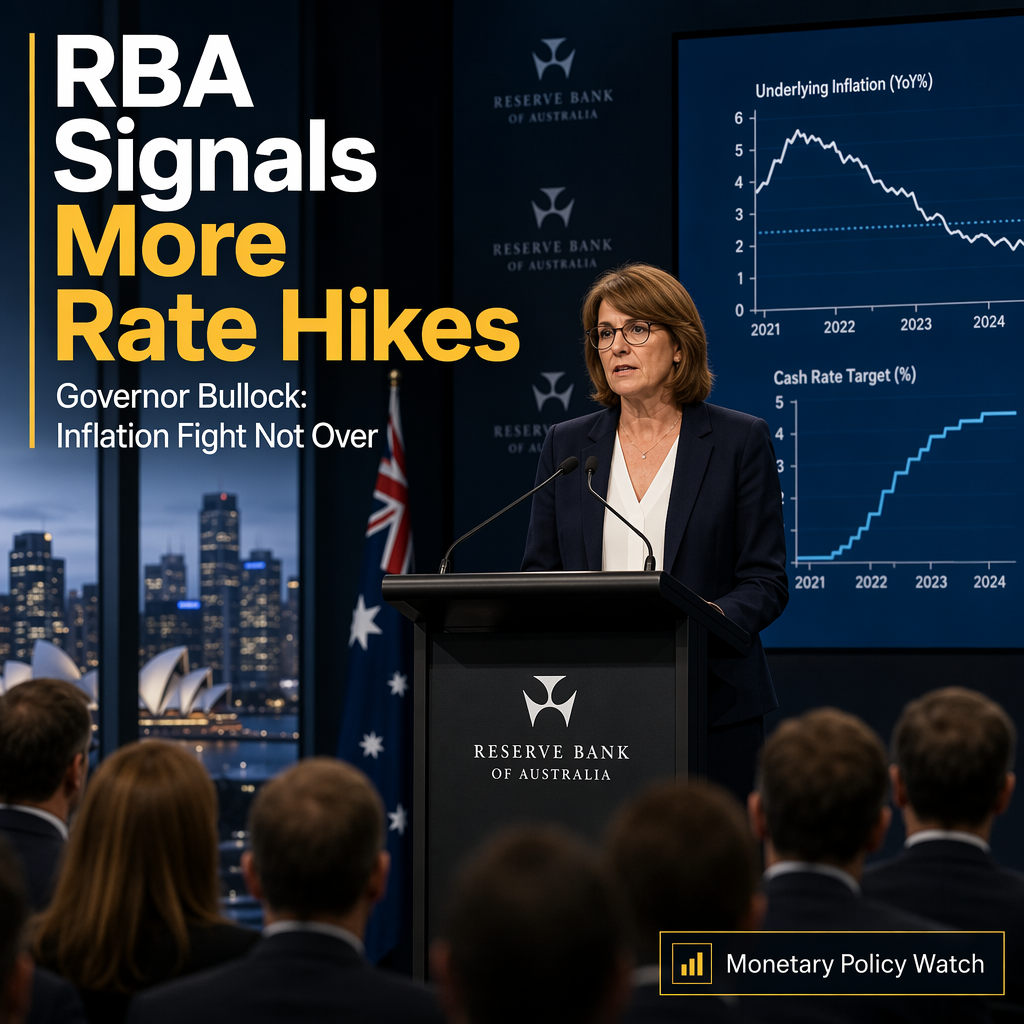
Reserve Bank of Australia (RBA) Governor Michele Bullock addressed the Anika Foundation Fundraising Lunch in Sydney, emphasizing that the central question facing the RBA is whether the monetary tightening already implemented will be sufficient to slow inflation [1]. Bullock stated that the board is prepared to raise the cash rate further if necessary, noting that monetary policy operates with a lag and the full effects of this year's rate increases have yet to be felt [1]. She highlighted that underlying inflation has evolved as expected but remains too high, and that non-labour cost pressures continue to rise according to business feedback [1].
Bullock also remarked that the housing market has eased more than anticipated and that demand growth appears to be moderating in line with May baseline forecasts [1]. She acknowledged that some further easing in both demand growth and the labor market will likely be required to bring inflation down [1]. The governor noted that the economy has adjusted gradually and broadly as expected, but policy cannot address the slow productivity growth in the economy [1].
Regarding the outlook, Bullock said it is too early to assess the full economic effects of the recent oil shock and that the board's decision at the next meeting remains uncertain, depending on whether policy is deemed restrictive and if inflation is not coming down as expected [1]. She warned that the board faces tough choices if inflation does not ease, reiterating that inflation is largely in line with expectations but still too high [1].
In terms of market reaction, the Australian Dollar (AUD) showed little response to Bullock's comments, with AUD/USD trading listlessly below 0.7000 at the time of writing [1].
CONCLUSION
RBA Governor Bullock's remarks underscore ongoing concerns about persistent inflation and signal the possibility of further rate hikes if necessary. Despite these comments, the Australian Dollar remained largely unchanged, reflecting market uncertainty about the central bank's next steps. The board's upcoming decision will hinge on inflation trends and the perceived restrictiveness of current policy.