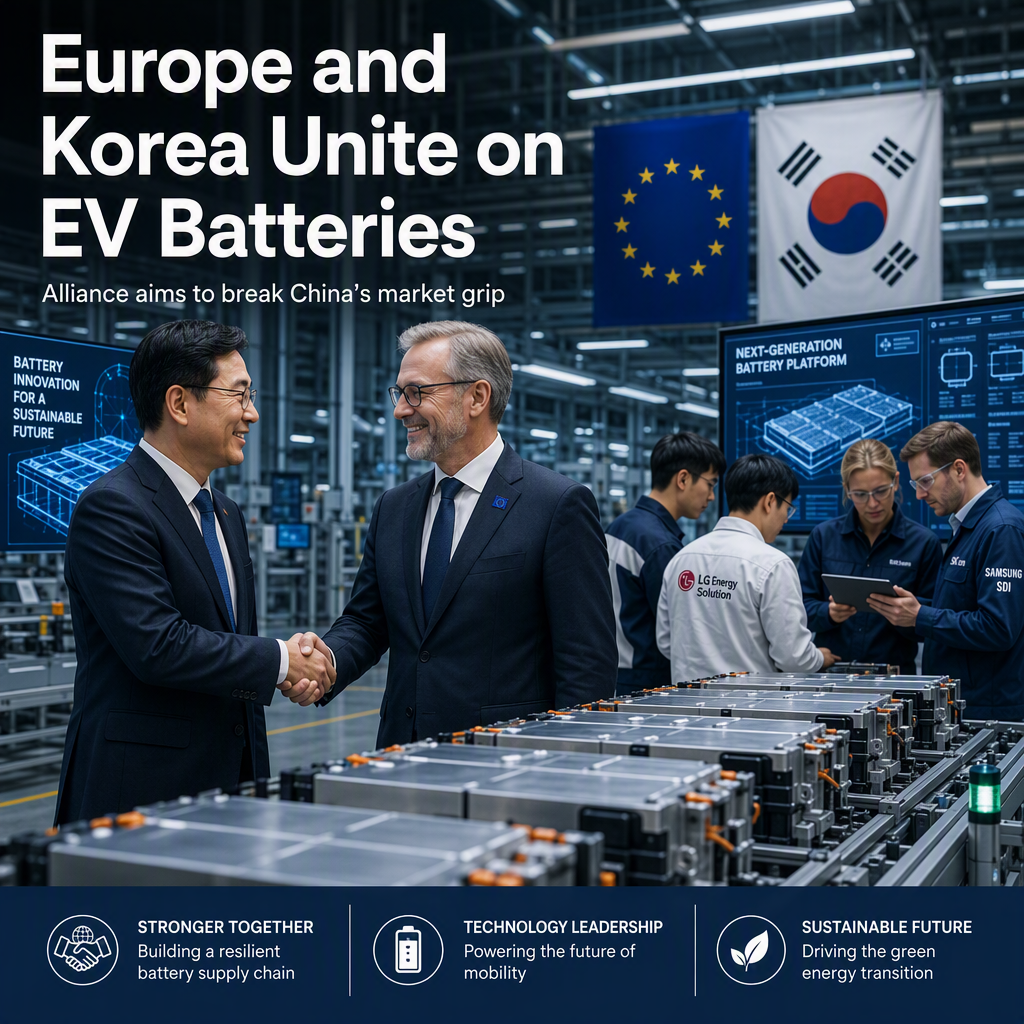
Experts are calling for the European Union to intensify collaboration with South Korean electric vehicle battery manufacturers in order to reduce the bloc’s heavy reliance on Chinese suppliers, who currently dominate the EU’s EV battery market [1]. South Korean companies such as LG Energy Solution, SK On, and Samsung SDI are advancing toward the production of more cost-effective lithium iron phosphate (LFP) batteries, a shift seen as crucial for diversifying supply chains and lessening dependence on materials controlled by China [1].
Industry analysts emphasize that partnerships between the EU and South Korean firms are essential for ramping up battery production and introducing alternative battery chemistries like LFP, which offer a more secure supply chain [1]. One expert stated, “The EU needs to accelerate its collaboration with South Korean battery makers if it is serious about mitigating the supply chain risks posed by overreliance on China,” highlighting the mutual benefits of technology sharing and investment in new European production facilities [1].
Market analysis indicates that while Chinese battery companies continue to expand their footprint in Europe, South Korean manufacturers possess the technological expertise and manufacturing capacity to challenge this dominance, provided they receive adequate support and regulatory clarity from the EU [1]. The EU’s recent policy initiatives targeting strategic vulnerabilities in critical sectors, including EV batteries, underscore the urgency of these diversification efforts [1].
However, industry observers caution that the window for effective action is narrowing as Chinese firms continue to invest heavily in the European market. The ultimate success of the EU’s diversification strategy will depend on the speed and scale of cooperation between European stakeholders and South Korean battery makers [1].
CONCLUSION
The EU faces a critical juncture in its efforts to reduce dependence on Chinese EV battery suppliers. Accelerated collaboration with South Korean manufacturers and swift policy action are seen as essential to strengthening the bloc’s supply chain security and market position.