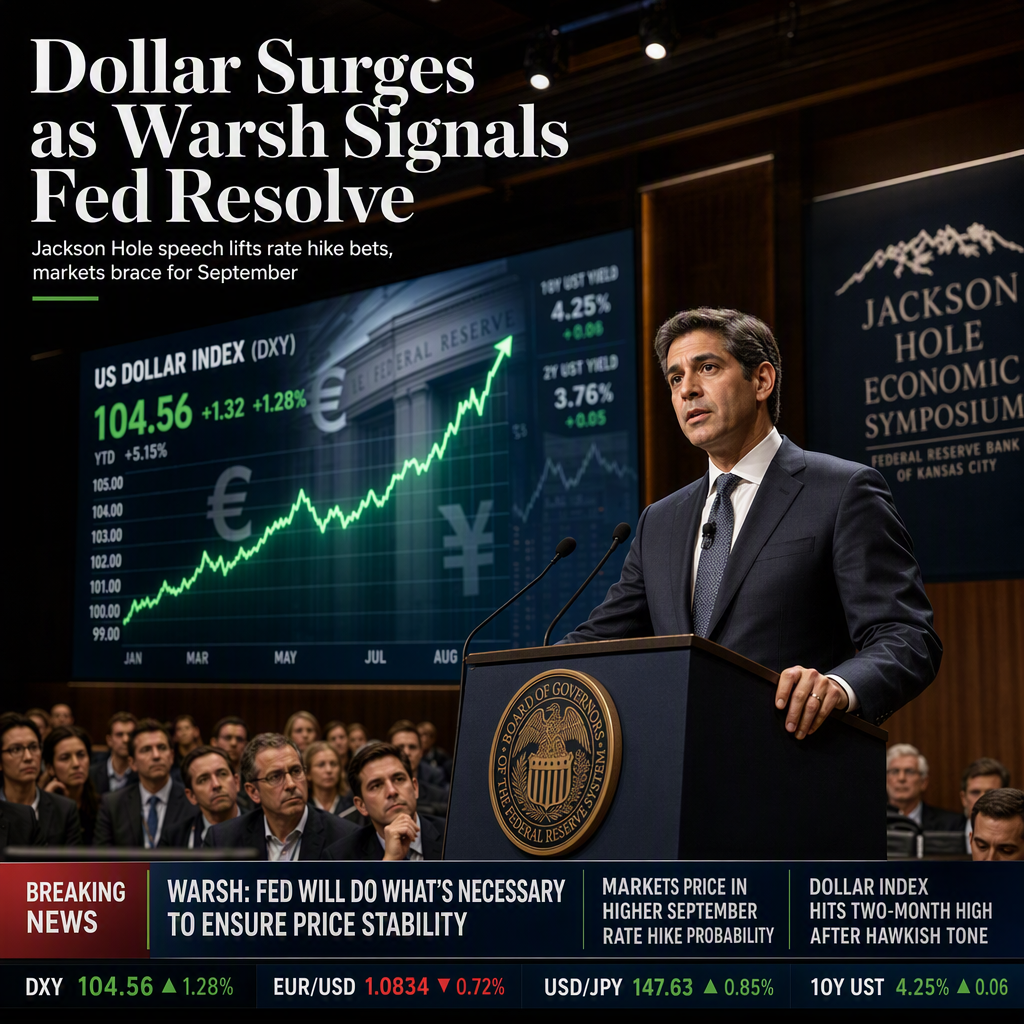
Federal Reserve Chair Kevin Warsh delivered a notably hawkish speech at the Jackson Hole Symposium, emphasizing that the Fed still has 'work to do' to bring inflation convincingly toward its 2% target, and describing financial conditions as far from restrictive, which signaled a bias toward maintaining or tightening policy if inflation progress stalls [1][2][3][4]. Warsh’s remarks, with an FXS Speechtracker score of 7.4 versus a 6.5 historical average, and a steady FXS Fed Sentiment Index at 129.70, reinforced a vigilant Fed stance and supported the US Dollar [1].
Following Warsh’s speech, the US Dollar Index gained more than 0.5% on Friday, reaching its highest level in two weeks above 99.70 [1]. The Dollar was the strongest against the New Zealand Dollar over the past week, appreciating by 0.93%, and also posted gains against other major currencies such as the Euro (+0.70%), British Pound (+0.67%), and Japanese Yen (+0.48%) [1]. DBS Group Research noted that futures markets restored a meaningful probability (58%) of a September FOMC rate hike, with yields rising across the Treasury curve, including the 2Y, 10Y, and 30Y maturities [2]. The so-called 'Bessent Put'—the Treasury’s plan to double long-end buyback operations from $2 billion to $4 billion per operation starting September 9—was also highlighted as a factor cushioning the Dollar in the near term [2].
However, not all analysts see an imminent rate hike. Goldman Sachs chief economist Jan Hatzius reiterated his forecast that the Fed will hold rates steady in September, arguing that Warsh’s hawkish tone is unlikely to trigger immediate action unless August CPI and PPI data show an unexpected inflation spike, which Goldman Sachs views as unlikely [3]. Fed’s Goolsbee also delivered a moderately hawkish tone but expressed comfort with steady rates, with the FXS Fed Sentiment Index slipping slightly to 129.29, indicating a modest pullback in perceived hawkishness [3].
Market reactions were evident in currency pairs and bond yields. The risk-off mood, driven by rising Middle East tensions and higher crude prices, capped rallies in the Euro and other risk assets [1][4]. EUR/GBP retreated sharply on Friday after Warsh’s comments, with the pair trading near 0.8556 and technical indicators suggesting modest bearish momentum [4]. Meanwhile, the Indonesian Rupiah weakened against the Dollar, despite broader Greenback softness, as markets focused on upcoming domestic economic indicators [3].
Looking ahead, markets are closely watching the August nonfarm payrolls report (consensus +55k vs. -23k previous) due September 4, which could influence Treasury yields and test the 'Bessent Put' if results surprise to the upside [2]. The economic calendar also features preliminary August inflation data from Germany [1].
CONCLUSION
Fed Chair Warsh’s hawkish Jackson Hole speech has reinforced expectations of a vigilant Fed stance on inflation, boosting the US Dollar and raising the probability of a September rate hike in market pricing. However, some analysts, including Goldman Sachs, remain skeptical of an imminent hike absent a significant inflation surprise. The market impact is high, with currency and bond markets reacting to both Fed signals and global risk factors.