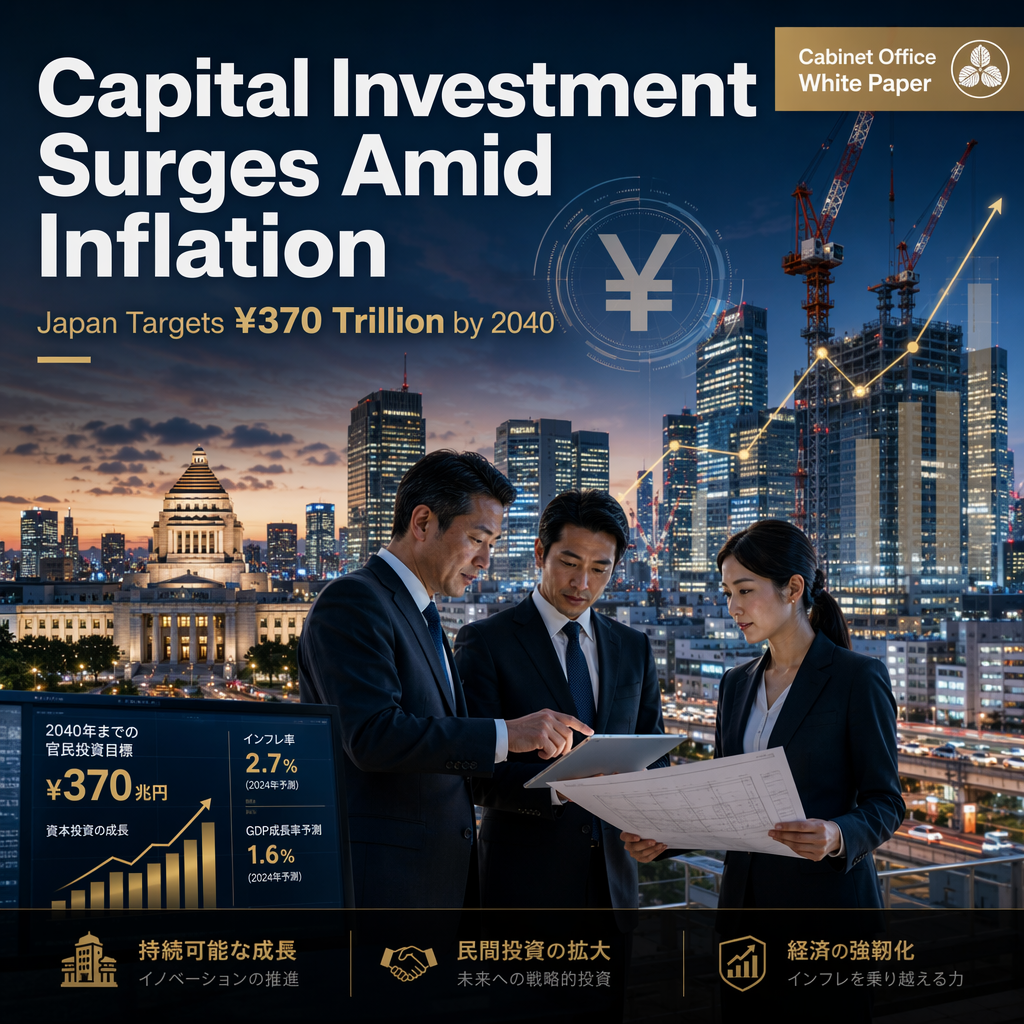
A Cabinet Office white paper for fiscal 2026, released on Friday, reports that rising prices and an increased ability for businesses to pass on costs are boosting capital investment in Japan [1]. The report underscores that companies are responding to inflation and cost pressures by raising their capital expenditure, signaling a shift in corporate behavior amid the current economic environment [1].
Japanese Prime Minister Sanae Takaichi has outlined an ambitious investment strategy, targeting more than 370 trillion yen in spending by fiscal 2040 [1]. The annual report stresses the importance of clear public and private investment strategies to support this goal, highlighting the government's focus on fostering a conducive environment for sustained capital investment [1].
While the report does not provide specific figures on recent capital expenditure increases, it emphasizes the positive impact of inflation and cost pass-through on business investment decisions [1]. No immediate market reactions or analyst opinions are mentioned in the source article [1].
CONCLUSION
The Cabinet Office's white paper indicates that inflation and improved cost pass-through are driving increased capital expenditure among Japanese businesses. With a government target of over 370 trillion yen in investment by 2040, the report highlights the need for strategic planning to sustain this momentum.