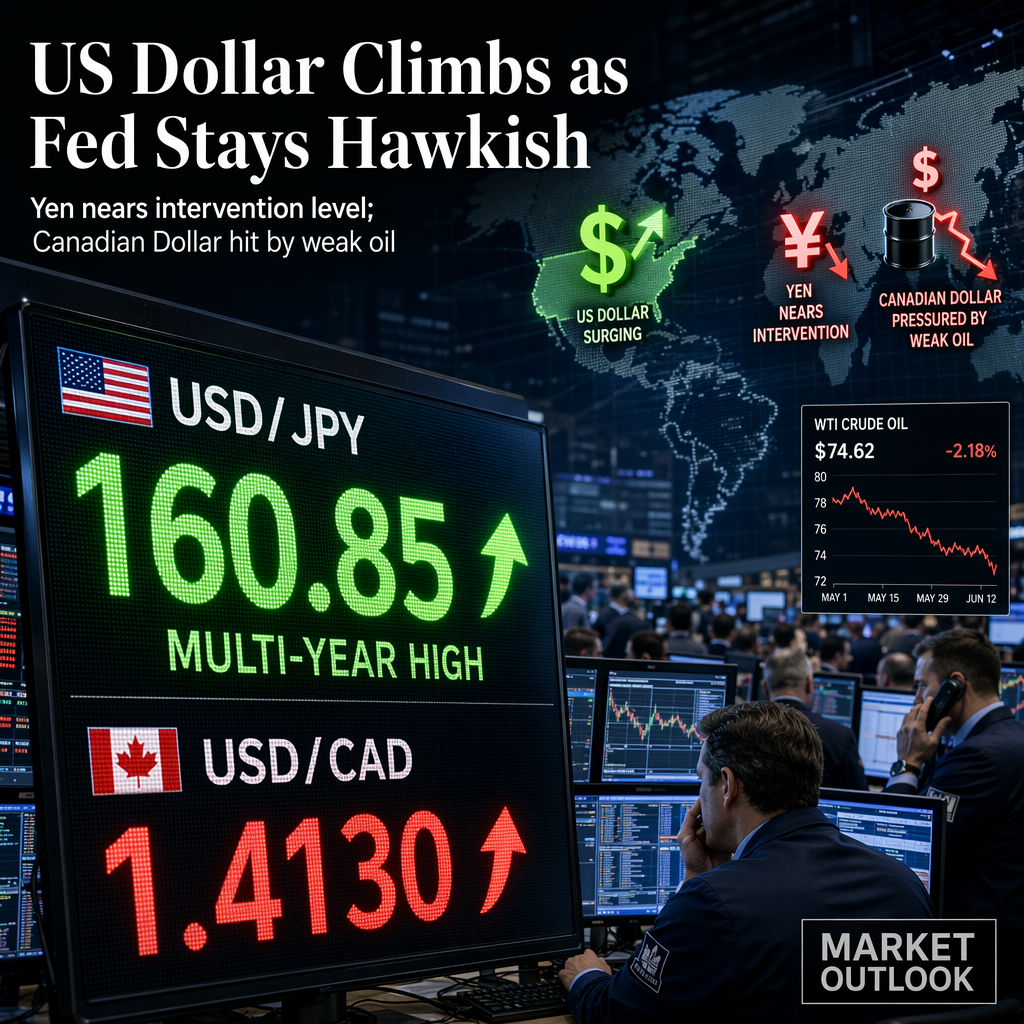
The US Dollar (USD) advanced against major currencies following the Federal Reserve's decision to keep its benchmark interest rate unchanged within the 3.5%-3.75% range, a move that was widely anticipated by markets. However, updated economic projections revealed that approximately half of Federal Open Market Committee (FOMC) members foresee at least one additional rate hike in 2024. During his inaugural press conference as Fed Chair, Kevin Warsh emphasized the central bank's commitment to restoring price stability, citing a resilient labor market and persistent underlying inflation pressures as justification for maintaining a restrictive policy outlook [1][2].
This hawkish stance has bolstered the US Dollar, with USD/JPY trading around 160.85 on Thursday, up 0.12% for the day after reaching 160.95, its highest level since July 2024. The persistent divergence between US and Japanese monetary policy continues to support the Greenback, despite ongoing warnings from Japanese officials about excessive Yen weakness. Chief Cabinet Secretary Minoru Kihara reiterated that Tokyo is prepared to respond appropriately to currency moves if necessary. Deutsche Bank noted that the Yen is now trading near levels that previously triggered official intervention in 2024, which has helped to limit the most aggressive selling pressure on the JPY [1].
On the Canadian front, the USD/CAD pair traded around 1.4130, up 0.21% on the day, as the Canadian Dollar (CAD) faced additional headwinds from declining oil prices. West Texas Intermediate (WTI) crude hovered below $75 per barrel, down more than 0.90% on Thursday, negatively impacting the commodity-linked CAD. The combination of the Fed's hawkish outlook and weaker oil prices has kept the USD/CAD pair above the 1.4100 level [2].
Recent US economic data further reinforced the narrative of economic resilience, with Initial Jobless Claims falling to 226,000 for the week ending June 13, down from a revised 230,000 previously, while Continuing Jobless Claims rose to 1.81 million. These figures support expectations that the labor market remains robust enough for the Fed to maintain its restrictive policy bias [1].
Both articles note that safe-haven demand for the US Dollar has eased somewhat following the announcement of a preliminary memorandum of understanding between the US and Iran aimed at ending hostilities in the Middle East. However, Rabobank analysts argue that the Fed’s hawkish shift is currently the dominant factor driving the US Dollar, outweighing improving geopolitical prospects and the potential reopening of the Strait of Hormuz [1][2].
CONCLUSION
The Federal Reserve's hawkish policy outlook has driven the US Dollar higher against both the Japanese Yen and Canadian Dollar, with the Yen nearing intervention levels and the CAD pressured by weak oil prices. Despite some easing in safe-haven demand due to geopolitical developments, the Fed's stance remains the primary market driver. Investors are likely to remain focused on US monetary policy signals and key economic data for further direction.