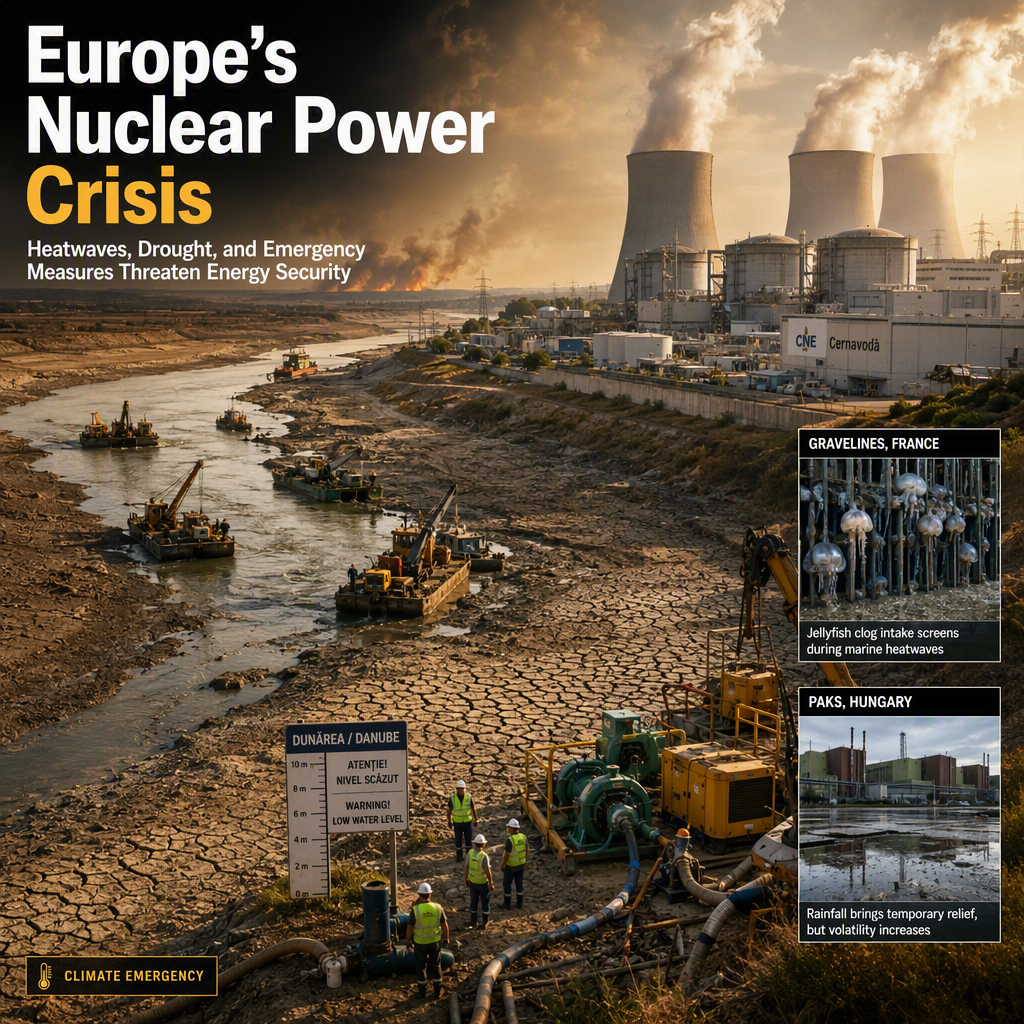
Extreme heat and drought conditions across Europe are severely disrupting the operation of nuclear power plants, raising concerns about energy supplies and economic growth in the region [1]. In Romania, the state-owned nuclear power producer Nuclearelectrica has warned that it may be forced to shut down its last working reactor as soon as Thursday due to falling water levels on the Danube River, which is essential for cooling the Cernavoda power plant [1]. The Romanian government has declared an energy emergency through August and has implemented unprecedented measures such as dredging the river channel, sinking rock-filled barges, and conducting a controlled underwater explosion to improve water flow to the plant's cooling systems [1]. The two reactors at Cernavoda typically supply about 20% of Romania's electricity [1].
Hungary has experienced some relief after rainfall increased Danube water levels, allowing the government to restart another turbine at the Paks nuclear power plant. According to Hungarian Prime Minister Péter Magyar, two of the plant's eight turbines are now operational, providing some respite for a facility that supplies nearly half of Hungary's electricity [1].
In France, where nuclear energy accounts for approximately 70% of the country's electricity, utility provider EDF reported reducing output at multiple reactors due to environmental issues. Additionally, three reactors at the Gravelines nuclear power plant were shut down earlier in the week following a massive influx of jellyfish, marking the second consecutive year such an event has occurred at the facility [1]. France has reportedly had to shut down a record number of nuclear power plants this summer due to extreme heat, wildfires, and droughts [1].
European governments are actively exploring solutions to mitigate the vulnerability of nuclear power plants to heat waves and low water levels. These include upgrading cooling systems and adjusting maintenance schedules to avoid periods of extreme heat [1]. Triodos estimates that heat-related disruptions could cost the EU 180 billion euros ($207.7 billion), equivalent to roughly 1% of GDP [1].
CONCLUSION
Europe's nuclear power sector is facing significant operational challenges due to extreme weather, with immediate impacts on energy supply and potential economic costs. Governments are responding with emergency measures and exploring long-term solutions to enhance resilience. The situation underscores the vulnerability of critical infrastructure to climate-related disruptions.