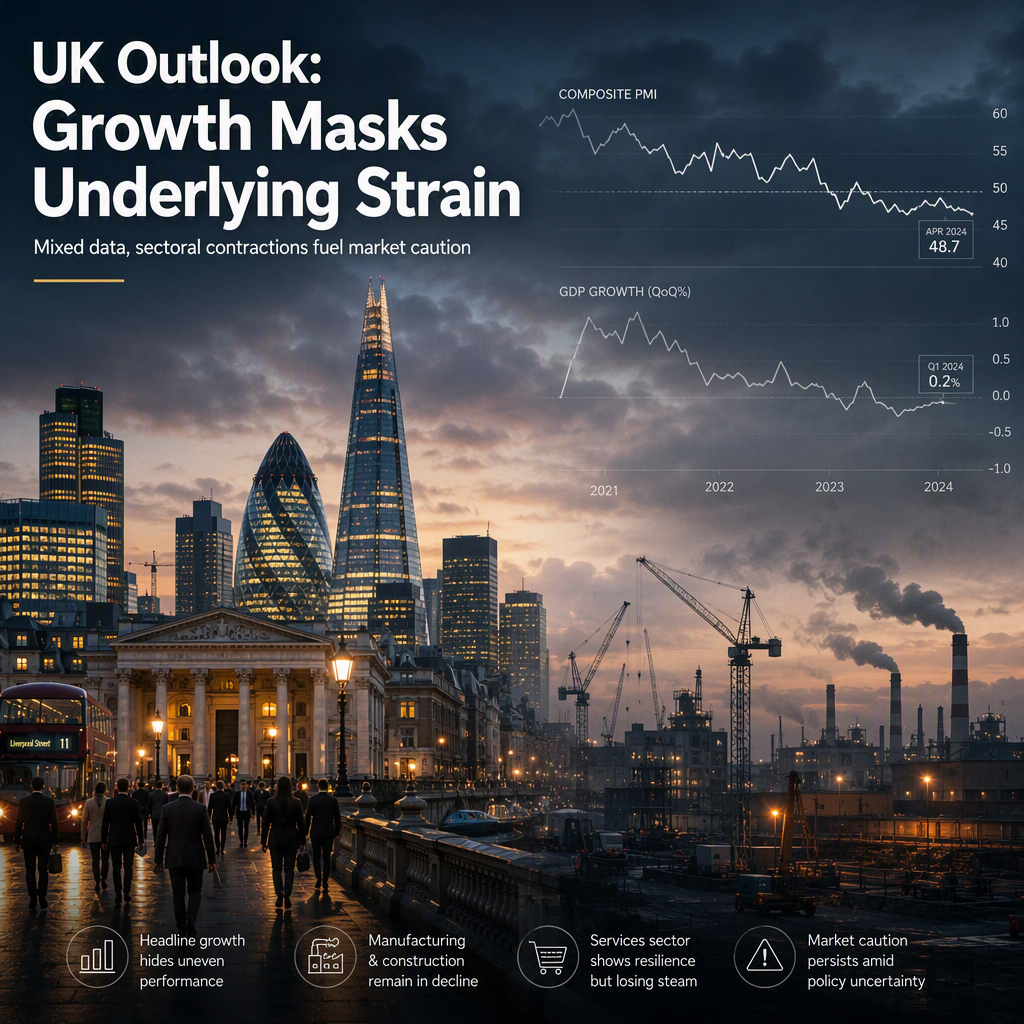
Rabobank's Senior FX Strategist Jane Foley has highlighted the mixed signals emerging from recent United Kingdom economic data, especially when compared to the Eurozone's performance. The Eurozone's Q2 Gross Domestic Product (GDP) posted a better-than-expected 0.4% quarter-on-quarter increase, while the UK economy saw a 0.7% upturn in the three months to May compared to the previous three months ending in February [1].
Despite this headline growth, the underlying UK monthly data for May revealed a more nuanced picture. The overall growth rate was 0.1% month-on-month, with the services sector rising by 0.3% m/m. However, both the production and construction sectors contracted during the same period, indicating sectoral weaknesses beneath the surface [1].
Further compounding concerns, the UK composite Purchasing Managers' Index (PMI) data for both May and June signaled contraction, which may reflect declining business confidence, potentially influenced by geopolitical tensions such as the Iran war [1]. This combination of positive headline growth and underlying sectoral contractions has resulted in a confusing economic backdrop, leading to a wide dispersion in economists’ forecasts ahead of the upcoming GDP release [1].
CONCLUSION
The UK economy is exhibiting mixed signals, with headline growth masking underlying sectoral contractions and weakening business confidence. This uncertainty has led to a broad range of GDP forecasts, highlighting the market's cautious stance ahead of new data releases.