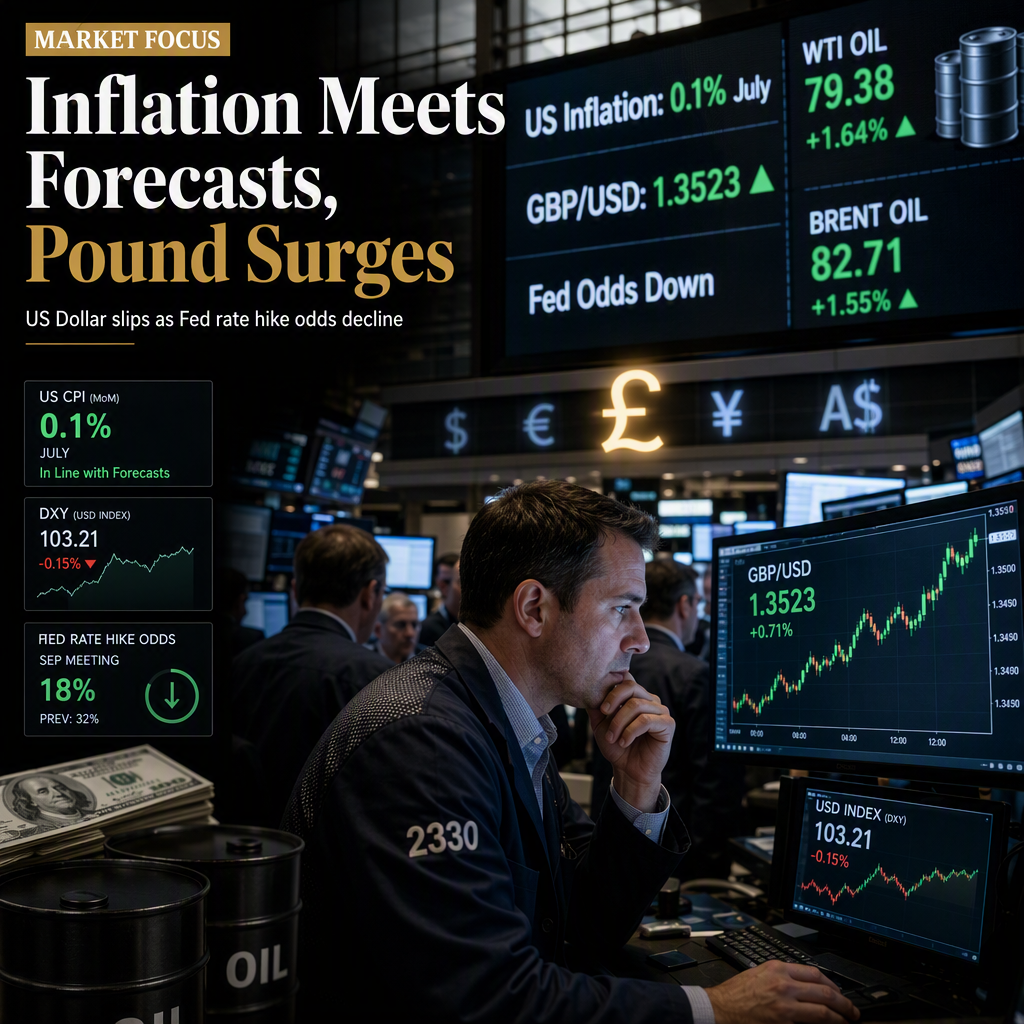
US inflation data released on Wednesday showed the Consumer Price Index (CPI) rising 0.1% in July after a 0.4% decline in June, with the annual rate easing to 3.4% from 3.5% [1][2]. Core CPI increased 0.2% month-on-month and 2.5% year-on-year, both matching market expectations [1][2]. The data led to a muted reaction in the US Dollar, with the US Dollar Index (DXY) edging slightly lower—down 0.15% to 99.67—and US Treasury yields also declining, as the figures provided no significant surprise to alter the Federal Reserve's monetary policy outlook [1][2].
In currency markets, GBP/USD traded modestly higher around 1.3523, near its highest level since July 16, as the Pound outperformed G10 peers on improving sentiment and bullish technicals [2][3]. Scotiabank strategists highlighted that the Pound is showing fractional gains versus the US Dollar, with short-term technicals indicating upside targets in the mid-1.35s to mid-1.36s and support at 1.3400 [3]. The near-term range is expected between 1.3480 and 1.3580 [3].
For the Canadian Dollar, USD/CAD traded around 1.3915, virtually unchanged with a modest decline of 0.06% on the day [1]. Oil prices, a key driver for the CAD, saw West Texas Intermediate (WTI) trading around $81.60 per barrel, up more than 6% so far this week, though WTI declined on Wednesday after two days of gains [1][2]. Geopolitical uncertainty in the Middle East, particularly renewed tensions between the US and Iran and ongoing attacks on vessels in key shipping straits, maintained a risk premium in oil markets and limited downside for the Canadian Dollar [1][2].
The probability of a Federal Reserve rate hike at the September meeting fell to 38% from 44% before the inflation data release, according to the CME FedWatch Tool [2]. Market participants are now focused on upcoming data releases, including preliminary UK Q2 GDP and US Producer Price Index (PPI), which could provide further direction for currency pairs [2][3].
CONCLUSION
US inflation data matched expectations, resulting in limited market reaction and a slight decline in the US Dollar. The British Pound outperformed G10 peers on improving sentiment and bullish technicals, while the Canadian Dollar remained steady, supported by oil market dynamics and geopolitical risks. Attention now shifts to upcoming economic data for further market cues.