
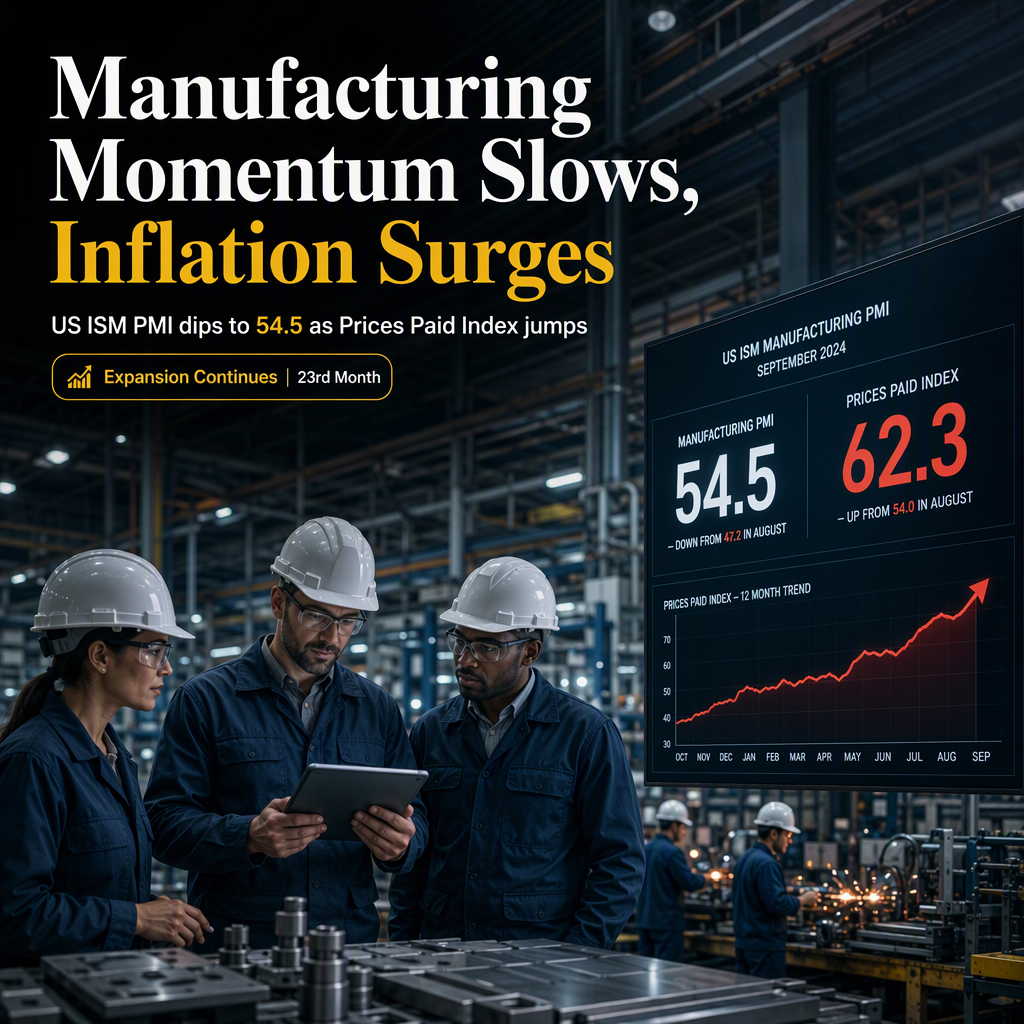
The US manufacturing sector showed signs of slowing momentum in September, as the ISM Manufacturing Purchasing Managers' Index (PMI) declined slightly to 54.5 from 54.6 in August, falling short of analysts' expectations of 55 [1]. Despite the modest dip in the headline PMI, the sector continued its expansion for the 23rd consecutive month [1].
Key data points from the report include a rise in the Employment Index to 52.7 from 51.2, indicating ongoing strength in manufacturing payrolls [1]. The New Orders Index also improved, climbing to 55.3 from 53.7, marking its ninth straight month of expansion after a previous period of contraction [1]. However, the Production Index fell to 56.7 from 58.3, suggesting a slight slowdown in output growth [1].
A notable development was the sharp increase in the Prices Paid Index, which jumped to 77.9 from 71.1, signaling heightened inflationary pressures within the manufacturing sector [1]. According to Susan Spence, Chair of the ISM Manufacturing Business Survey Committee, the Prices Index's rise of 6.8 percentage points compared to August highlights persistent cost pressures [1].
In terms of market reaction, the US Dollar (USD) strengthened further on Thursday, with the US Dollar Index (DXY) approaching the 102.00 level for the first time since April 2025 [1]. This suggests that despite the softer PMI reading, investors responded to the robust employment and new orders data, as well as the inflationary signals, by favoring the USD [1].
CONCLUSION
The ISM Manufacturing PMI's slight decline in September points to a modest loss of momentum in the US manufacturing sector, though key sub-indices such as employment and new orders remain strong. The surge in the Prices Paid Index underscores ongoing inflationary pressures, which contributed to a firmer US Dollar. Overall, the data suggest continued expansion but with rising cost concerns.