
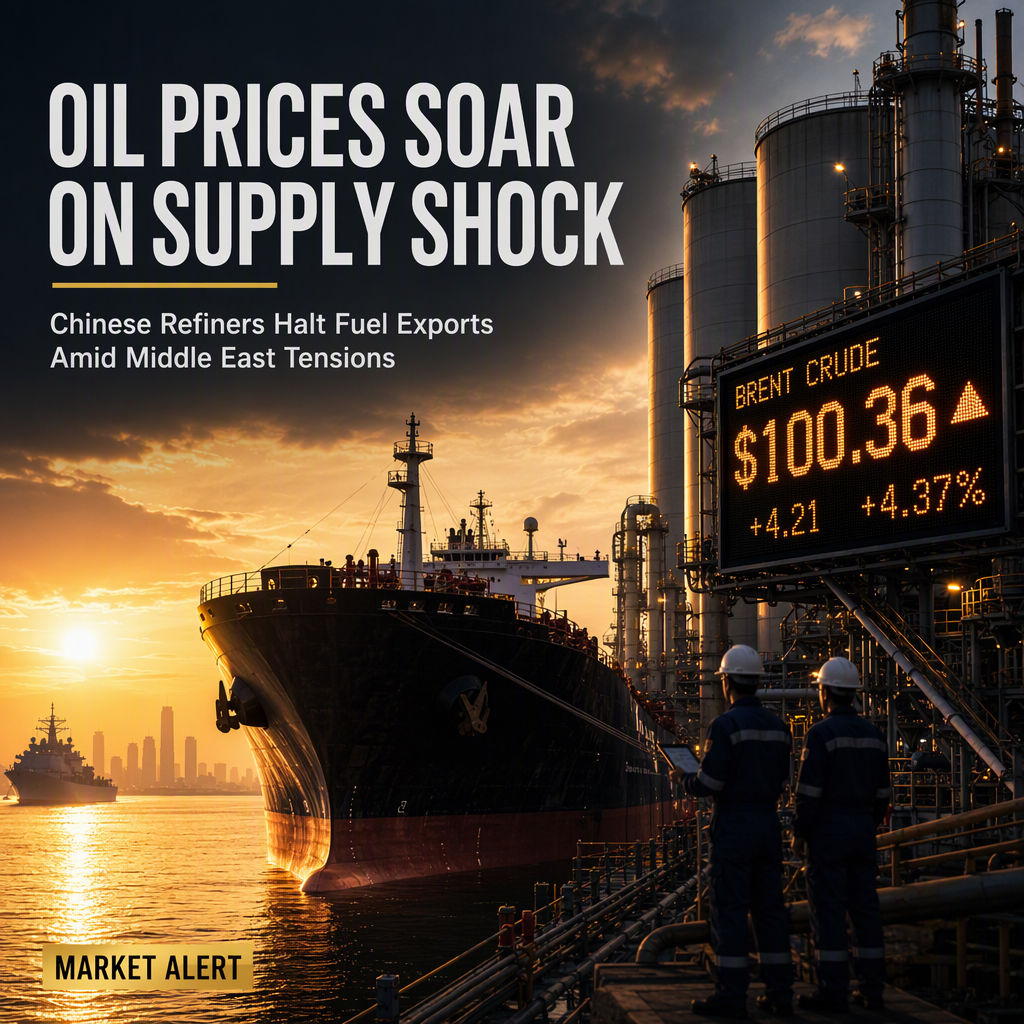
Oil prices jumped more than 2% on Thursday after reports emerged that Chinese refiners have suspended October fuel exports, intensifying supply concerns in already war-constrained energy markets [1]. Brent crude with December expiry traded 2.4% higher at $100.36 per barrel, reversing earlier losses, while U.S. West Texas Intermediate futures with November expiry rose 2.5% to $92.70 [1]. According to Reuters, China's state oil major PetroChina canceled several gasoline and jet fuel shipments planned for October, aiming to safeguard domestic supplies, though CNBC could not independently verify this report [1].
Global energy markets have been grappling with disruptions stemming from the ongoing U.S.-Iran war in the Middle East and Russia's invasion of Ukraine [1][2]. The third quarter saw heightened volatility across stocks and bonds, with oil prices surging as the Strait of Hormuz remained blocked, fueling inflation fears [2]. Despite these disruptions, crude flows from the Middle East were reportedly nearing pre-war levels, but gasoline supplies lagged behind, according to UOB [1]. Saudi Arabia resumed oil tanker loadings from its Red Sea port of Yanbu after restarting operations on its East-West Pipeline, providing some relief to crude supply concerns, though analysts noted the pipeline was not running at full capacity [1].
Market reactions were mixed: while oil prices surged, Wall Street's major averages ended the third quarter in mixed territory, with the S&P 500 index up 2.03%, Dow Jones Industrial Average down 1.9%, and Nasdaq Composite up 2.2% [2]. The average change across these indexes was just 0.6%, marking a slowdown from the previous quarter's double-digit gains [2]. Outside the U.S., major European indexes posted marginal gains, while Asian markets saw significant declines, including South Korea's Kospi falling 19.3% and China's CSI 300 shedding 12.5% [2].
Traders continue to monitor developments in the Middle East, as a lasting resolution to the Iran conflict remains uncertain. U.S. Secretary of State Marco Rubio ordered the Iranian delegation to leave America after the UN General Assembly, and indirect talks between U.S. and Iranian officials reportedly took place with mediators [1]. Bullish sentiment persisted among some investors, as optimism around AI and corporate earnings outweighed headwinds for many [2].
CONCLUSION
The suspension of October fuel exports by Chinese refiners has driven oil prices sharply higher, exacerbating supply concerns amid ongoing Middle East tensions. While crude supply disruptions have eased somewhat, gasoline supplies remain tight, and broader market volatility persists. Investors remain cautious, closely watching geopolitical developments and their impact on energy and equity markets.