
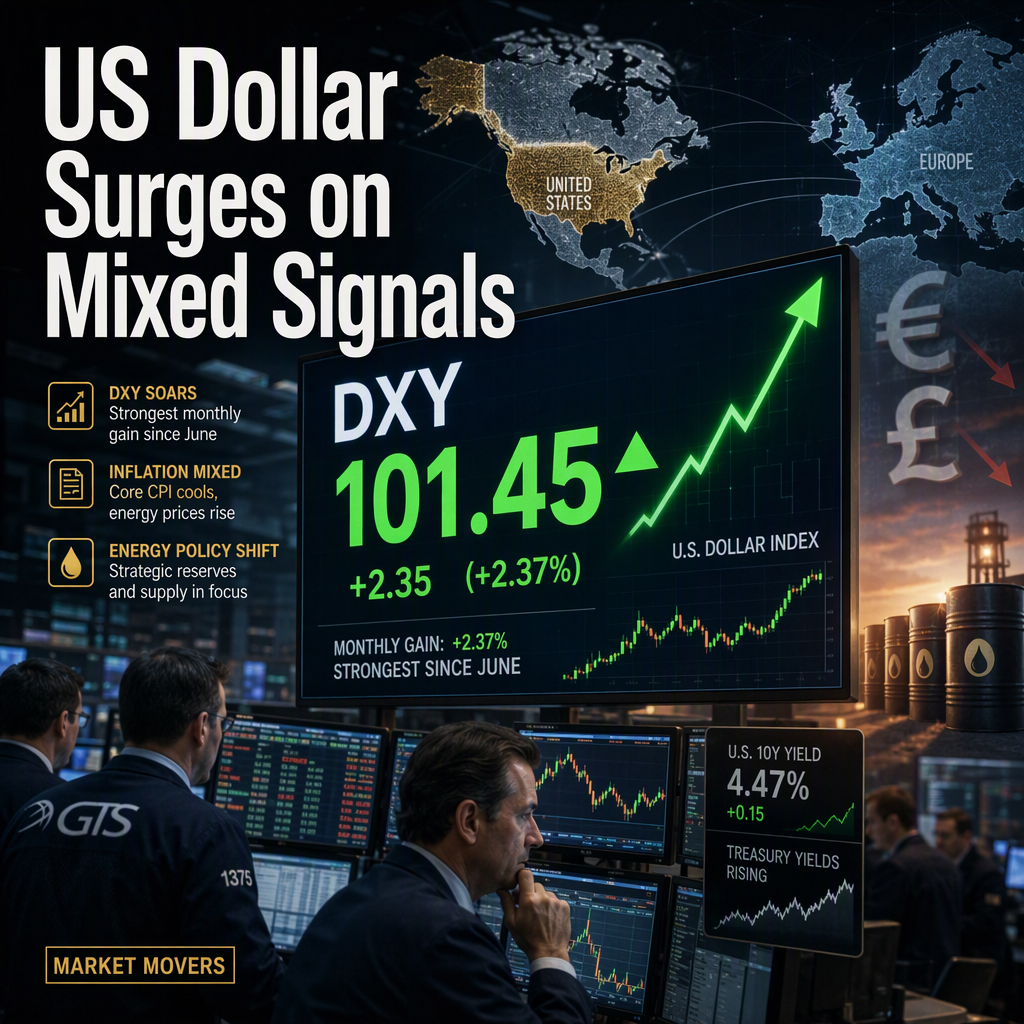
The US Dollar Index (DXY) closed at 101.45 on Wednesday, marking its best monthly gain since June with a 2.0% rise in September, according to UOB Global Economics & Markets Research [1]. Intraday dollar strength was briefly tempered by softer US Personal Consumption Expenditures (PCE) data, but the index recovered into the close. Major currency pairs such as EUR/USD, GBP/USD, and AUD/USD remained steady, while USD/JPY finished flat [1]. Asian currencies broadly strengthened against the USD ahead of the US PCE data release, with the Indonesian rupiah (USD/IDR) closing down 0.6% to 17,870, supported by Bank Indonesia's FX intervention [1].
Despite recent data showing a deceleration in core PCE inflation, the US Dollar continued to display underlying strength, with the DXY touching its June year-to-date high near 101.80 [2]. TD Securities analysts Oscar Munoz and Eli Nir upgraded their Q3 GDP forecast to 3.0% annualized, citing resilient consumer demand, firm corporate profits, and sticky price pressures as factors keeping an October Federal Reserve rate hike on the table [2]. They expect core PCE inflation to close 2026 at 3.0% Q4/Q4 and at 2.5% next year [2]. MUFG's Lee Hardman noted that softer inflation data and dovish central bank messaging are easing expectations for rapid monetary tightening, with the three-month annualized core PCE slowing to 2.1% and the six-month rate at 2.7% [2]. This reduces the likelihood of aggressive Fed rate hikes, placing greater emphasis on upcoming Nonfarm Payrolls (NFP) and Consumer Price Index (CPI) releases [2].
Societe Generale's Kit Juckes highlighted that a proposed US diesel export ban could push up European diesel prices, weighing on the Euro and other European currencies [3]. Rising bond yields and oil prices are cited as additional headwinds for Europe, with questions raised about whether consensus Eurozone growth forecasts, which ticked up to 1.3% in September, will be revised lower if these pressures persist [3]. Juckes asserts that the dollar is the only major winner from such a policy, as the US may not benefit economically, but the euro and most other European currencies would suffer [3].
Overall, the US Dollar's resilience is attributed to robust economic activity and expectations of continued Fed hawkishness, despite softer inflation readings. The proposed US diesel export ban and rising energy prices are seen as further supporting dollar strength relative to European currencies, with analysts closely watching upcoming US labor and inflation data for further direction [2][3].
CONCLUSION
The US Dollar Index has posted its strongest monthly gain since June, buoyed by robust economic data and expectations of continued Federal Reserve hawkishness, even as inflation metrics show signs of cooling [1][2]. Energy policy developments and rising bond yields are adding pressure to European currencies, with the euro particularly vulnerable [3]. Market participants are now focused on upcoming US labor and inflation releases, which will be key to determining the next phase of dollar strength.