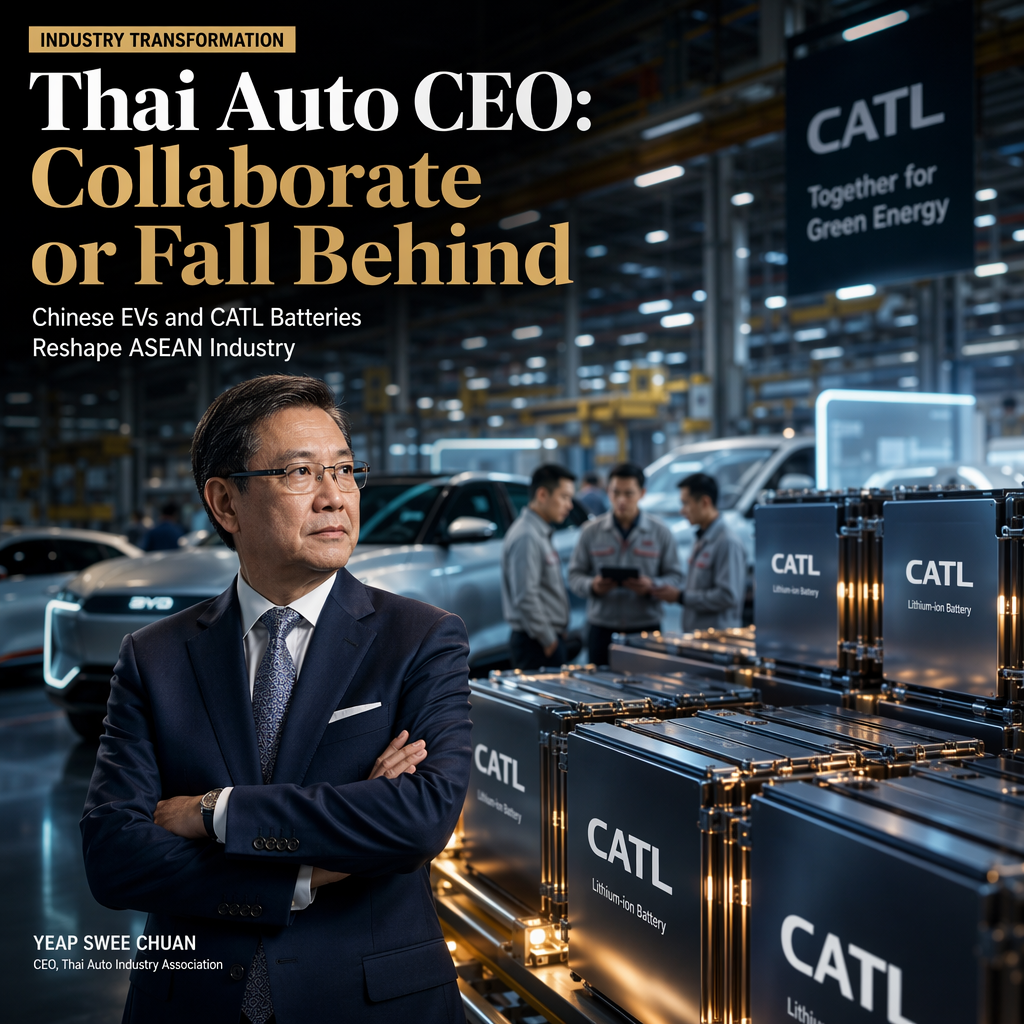
The automotive industry is undergoing rapid transformation driven by the rise of Chinese electric vehicle (EV) manufacturers, according to Yeap Swee Chuan, founder and CEO of Aapico, Thailand's largest listed parts supplier. Yeap warned that collaboration with Chinese rivals is essential for survival, citing their lower costs and superior technology. He emphasized, 'If you don't collaborate with the Chinese, you will suffer,' predicting that Chinese automakers are poised to 'win the war' in the EV sector due to their cost advantages and advanced technology [1]. Aapico has expanded across Asia and is positioning itself for a future dominated by electrification and the influence of Chinese automakers, as local players face increasing pressure from the growing presence of Chinese EV makers in the ASEAN market [1].
Meanwhile, Chinese battery giant CATL has reported strong earnings this year, driven by expanded battery capacity and its ability to pass on higher costs to customers. CATL's product range includes batteries for longer ranges and low-cost models with long lifespans and short charging times. The company has managed to boost profitability by negotiating favorable terms with suppliers and customers, allowing it to weather volatility in raw material prices more effectively than its automaker clients [2].
In contrast, Chinese EV manufacturers are struggling with tightening margins, increased competition, supply chain disruptions, and weak consumer demand. Industry observers highlight CATL's resilience as a battery supplier, noting its strategic importance in the EV ecosystem, while automakers face falling prices and sluggish market conditions [2].
Yeap Swee Chuan's call for regional suppliers and automakers to embrace partnerships with Chinese firms underscores the urgency for adaptation as the market evolves toward electrification and new competitive dynamics. The juxtaposition of CATL's thriving performance against the challenges faced by Chinese EV makers further illustrates the shifting landscape and the critical role of battery suppliers in the sector [1][2].
CONCLUSION
The rise of Chinese EV manufacturers and battery suppliers like CATL is reshaping the automotive industry, pressuring regional players to collaborate or risk falling behind. While CATL enjoys robust earnings and strategic leverage, Chinese automakers face mounting challenges from supply chain issues and weak demand. The market takeaway is clear: adaptation and partnership with Chinese firms are increasingly vital for survival and competitiveness in the evolving EV landscape.