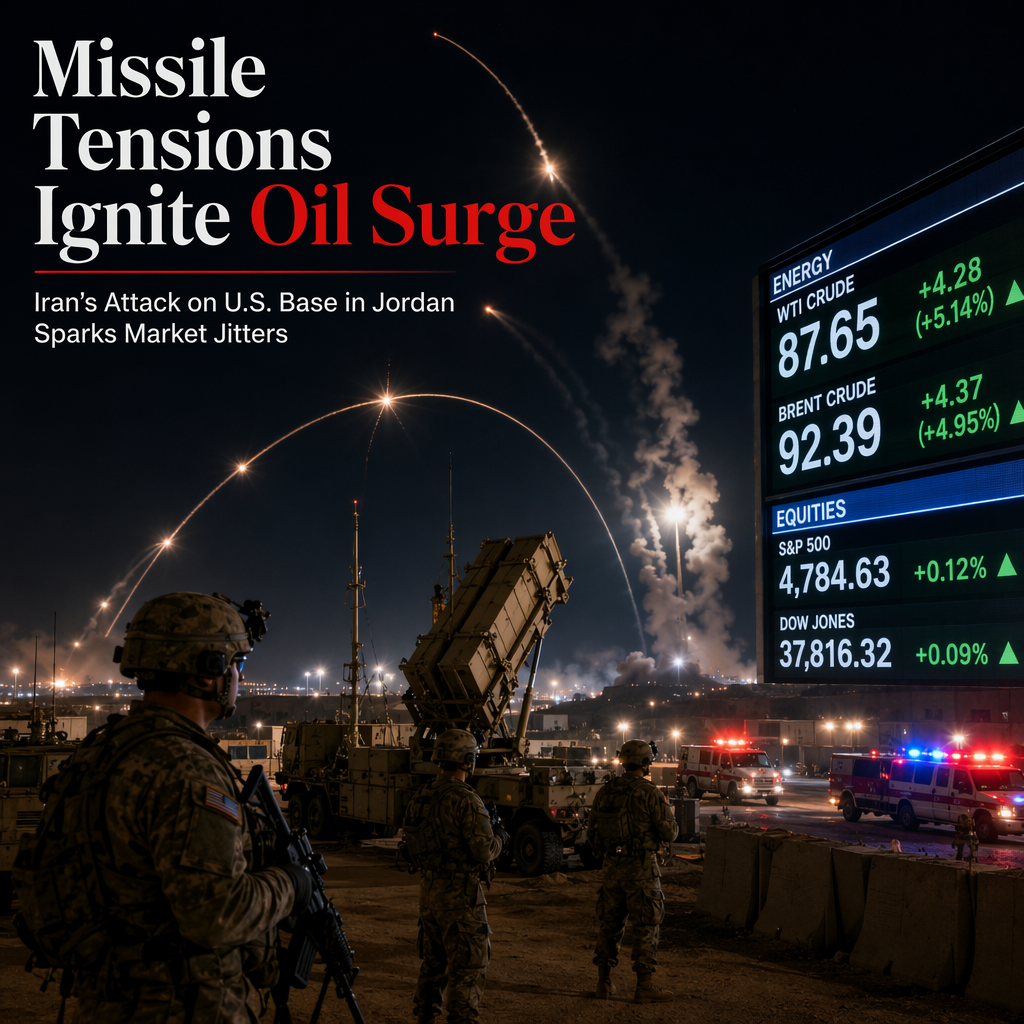
Iranian military forces launched multiple ballistic missiles in an attempted surprise attack against U.S. forces, specifically targeting a U.S. base in Jordan, according to U.S. Centcom and U.S. officials cited by Axios. All missiles were intercepted, preventing casualties or damage to U.S. assets [1]. This renewed attack reignited tensions in the Middle East that had recently paused [1].
The immediate market reaction was a sharp move in oil prices. U.S. West Texas Intermediate (WTI) oil futures surged 3.7% to around $82.20 a barrel, recovering from the previous day's drop. In contrast, Brent crude fell 4.8% to close at $84.09 [1]. Despite the escalation in geopolitical risk, Wall Street equities remained relatively stable: S&P 500 futures were marginally higher, Nasdaq 100 futures traded near the flat line, and Dow Jones Industrial Average futures shed 38 points, or about 0.1% [1].
On the geopolitical front, the article notes that U.S. President Donald Trump has paused airstrikes against Iran to give diplomacy a chance, following a meeting with Ukrainian President Volodymyr Zelenskyy at the White House to discuss continued support for Kyiv amid converging conflicts in Ukraine and Iran [1].
No analyst opinions or forward-looking statements regarding the oil market or equities were provided in the article. The focus remains on the immediate aftermath of the missile attack and the market's initial response [1].
CONCLUSION
Iran's attempted missile strike on a U.S. base in Jordan heightened Middle East tensions and triggered a notable spike in oil prices, though equity markets showed resilience. The situation remains fluid, with diplomatic efforts underway and no further escalation reported at this time.