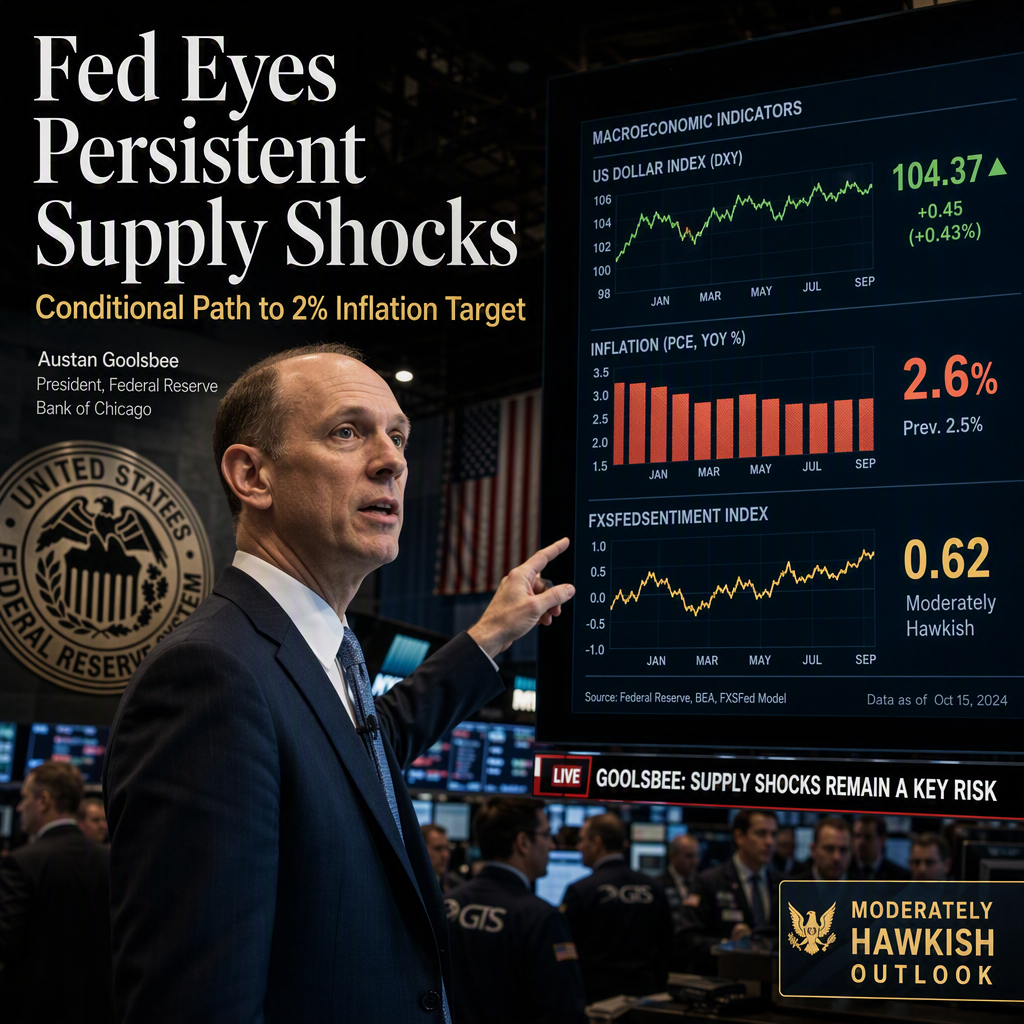
Chicago Federal Reserve Bank President Austan Goolsbee stated at an Official Monetary and Financial Institutions Forum event that multiple factors, including strong demand, tariffs, energy, and supply shocks, are contributing to ongoing inflationary pressures in the United States [1]. Goolsbee emphasized that there is 'no ambiguity' regarding the Federal Reserve's response if demand is found to be overheating, indicating a clear willingness to tighten policy or resist premature easing if necessary [1].
He highlighted that supply shocks are having a persistent impact on inflation and must be considered when setting monetary policy. Goolsbee noted the need for evidence that supply-driven inflation is fading, otherwise it will be difficult to see a 'credible path' back to the Fed's 2% inflation target [1]. He expressed conditional optimism about returning to 2% inflation, contingent on the absence of further demand overheating [1].
The market reaction to Goolsbee's remarks was muted, with the US Dollar Index (DXY) trading slightly higher at around 100.30 and no immediate significant movement in the US Dollar observed following his comments [1]. The FXSFedSentiment Index slipped by 1.07 points to 149.54, indicating a modest pullback in perceived hawkishness, though the level remains well above the neutral 100 mark, reflecting that the Fed is still seen as operating in hawkish territory [1]. Goolsbee's speech received a 7.4/10 FXS Speechtracker score, above the 6.4/10 historical average, underscoring a firmer stance relative to the established baseline [1].
Overall, Goolsbee's remarks suggest a cautious, data-dependent approach from the Fed, with a focus on persistent supply shocks and a conditional path to achieving the 2% inflation target. The tone remains moderately hawkish, but with an emphasis on the need for further evidence before any policy shifts [1].
CONCLUSION
Fed President Goolsbee's comments reinforce a cautious but moderately hawkish stance, with policy decisions remaining data-dependent and contingent on both demand and supply-side developments. The market response was limited, reflecting the Fed's ongoing conditional optimism about reaching its inflation target. Persistent supply shocks and the need for clear evidence of fading inflationary pressures will continue to shape the Fed's policy outlook.