
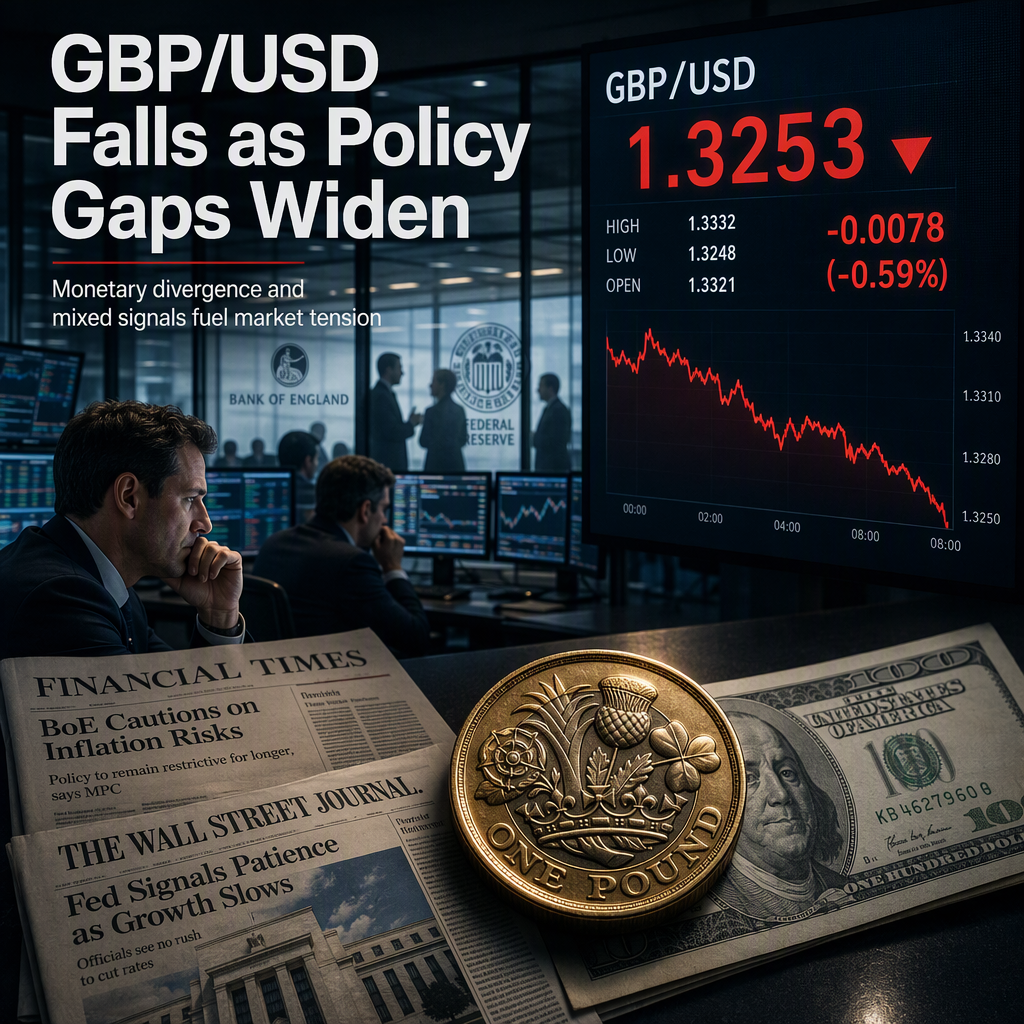
The GBP/USD currency pair declined to near 1.3250 during early European trading hours on Thursday, reflecting persistent bearish sentiment as it remains below the 100-day moving average [1]. The British Pound weakened against the US Dollar, driven by a widening monetary policy divergence between the Bank of England (BoE) and the US Federal Reserve (Fed) [1]. Market participants are closely watching the upcoming US weekly Initial Jobless Claims report and further commentary from Fed officials later in the day [1].
BoE policymaker Alan Taylor remarked on Tuesday that it was unclear whether a single rate hike would be practical for the central bank, as it could fuel unwarranted market speculation about further increases [1]. According to LSEG-compiled data, traders are pricing in nearly 33 basis points of monetary tightening from the BoE by year-end and more than 100 basis points by the end of 2027, though analysts generally expect more limited action [1].
On the US side, softer-than-expected Personal Consumption Expenditures (PCE) inflation data have weighed on the US Dollar, providing some support for GBP/USD. The probability of a Fed rate hike in October has dropped to about 38.2%, down from 45% prior to the PCE release, as per the CME FedWatch Tool [1]. However, Fed official Kashkari delivered a hawkish message, emphasizing that inflation near 3% remains 'too high' and suggesting the Fed may not consider current policy settings sufficiently restrictive. Kashkari indicated the possibility of one more rate hike this year and another in 2027, while the FXS Fed Sentiment Index slipped by 0.42 points to 143.28, signaling a modest pullback in perceived policy tightness [1].
Analysts at MUFG highlighted a brighter outlook for the Pound, noting improved UK growth prospects and raising their Q3 growth forecast to 0.4% from 0.1% previously. They argue that stronger growth could prompt the BoE to tighten policy if higher energy prices persist, and point to a senior BoE official who sees inflation risks as 'more tilted to the upside.' MUFG also referenced the evolving UK political landscape, suggesting that increased openness to closer EU ties could open the door for a 'reverse-Brexit' trade for the Pound in the future [1].
CONCLUSION
GBP/USD remains under pressure amid diverging central bank outlooks and mixed economic data. While the Fed maintains a hawkish stance, the BoE faces uncertainty over the pace of tightening, though improved UK growth prospects offer some optimism for the Pound. Market participants are watching upcoming US data and central bank commentary for further direction.