
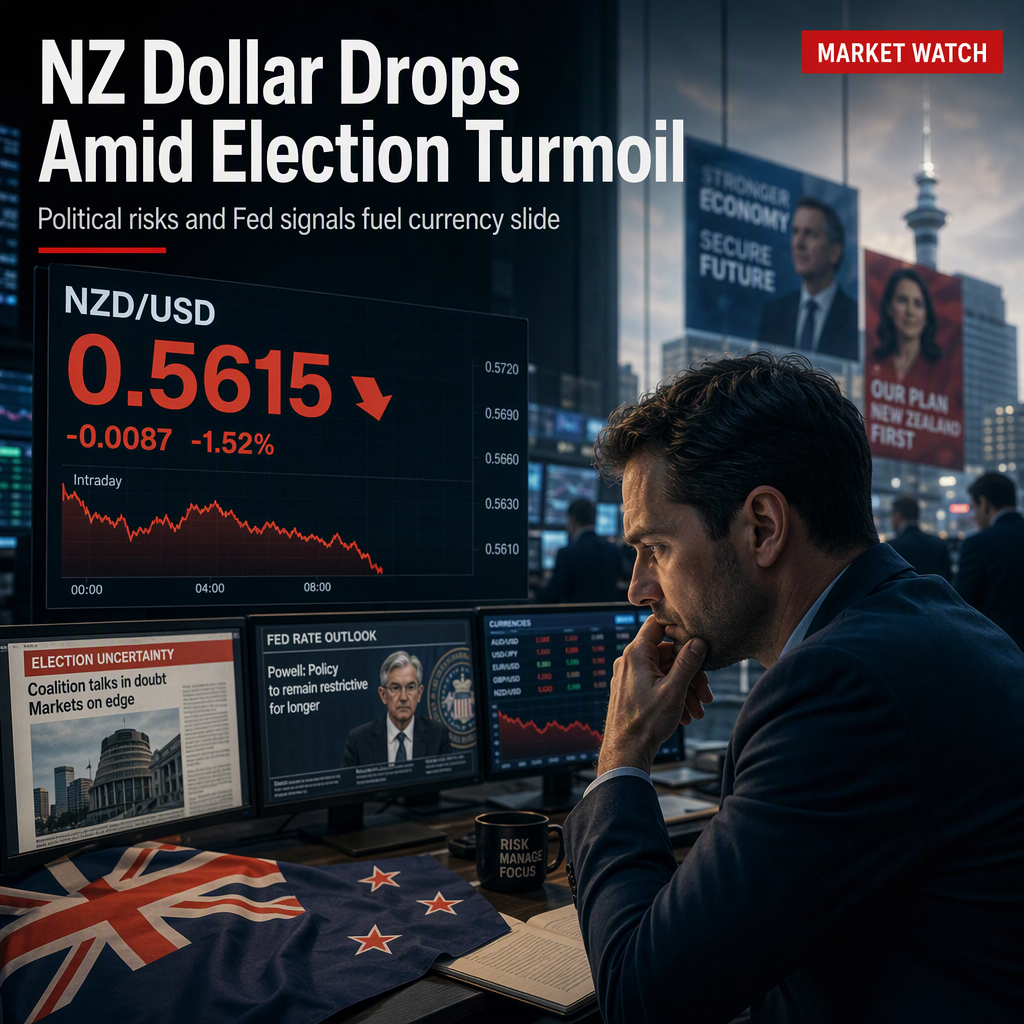
The New Zealand Dollar (NZD) weakened against the US Dollar (USD), with the NZD/USD pair losing momentum and trading near 0.5615 during early European hours on Thursday [1]. This decline comes as New Zealand approaches a tightly contested election scheduled for November 7, with opinion polls suggesting that Prime Minister Christopher Luxon's coalition could lose power. The prospect of a change in government has raised investor concerns about potential policy reversals, including Labour's signal to restore the dual mandate, contributing to policy uncertainty and weighing on the NZD [1].
In addition to domestic political risks, global factors are also influencing the NZD/USD pair. Market participants are awaiting the release of US weekly Initial Jobless Claims data and comments from Federal Reserve officials later in the day [1]. Recent remarks from Fed policymaker John Williams indicated no urgency for further rate hikes following the September meeting, leading traders to favor a potential rate hike in December rather than October. According to the CME Group's FedWatch Tool, markets are pricing in a 37.6% chance of a Fed rate hike in October and a 90.6% probability of an increase in December [1].
Federal Reserve official Neel Kashkari's recent comments, which scored 7.1 on the FXS Speechtracker (above the 6.2 historical average), emphasized that inflation near 3% remains 'too high' and highlighted the resilience of the US economy. Kashkari's remarks suggest limited urgency for rate cuts and openness to further tightening, reinforcing expectations for a higher-for-longer US Dollar rate environment. The FXS Fed Sentiment Index slipped slightly by 0.42 points to 143.28, but remains well above the neutral mark of 100, indicating continued hawkish sentiment [1].
From a technical perspective, the NZD/USD pair retains a bearish bias, trading below both the 100-day Simple Moving Average and the Bollinger middle band, with price action only slightly above the Bollinger lower band support. This technical setup underscores the heavy downside tone for the currency pair [1].
CONCLUSION
The New Zealand Dollar is under pressure due to heightened political uncertainty ahead of the national election and persistent hawkish signals from the US Federal Reserve. Market sentiment remains cautious, with traders closely monitoring both domestic political developments and upcoming US economic data for further direction.