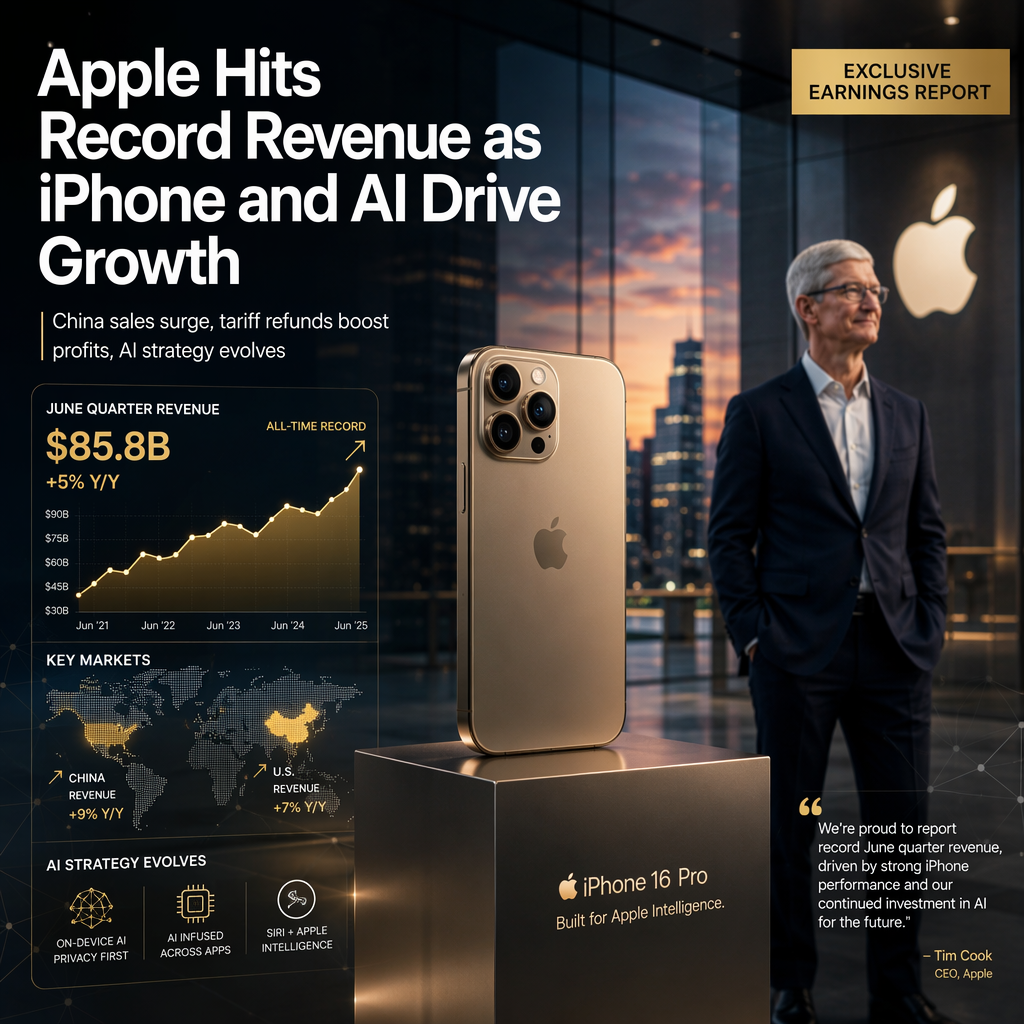
Apple reported its strongest June quarter on record, posting $109.4 billion in revenue and surpassing analysts' estimates of $108.65 billion in the company's final earnings report before CEO Tim Cook steps down [1]. The results were driven by a 22% increase in iPhone sales and record spring quarter Mac revenue [1]. Tariff refunds also contributed to Apple's performance, adding approximately 5% to profit during the period [1].
In a post-earnings interview, Tim Cook discussed Apple's approach to open-source artificial intelligence, stating he has 'nothing negative' to say about open-source AI models and describing them as 'useful' [1]. Cook's comments come amid industry debate over proprietary versus open-source AI, especially following the launch of the Kimi K3 model by Chinese AI company Moonshot, which has drawn comparisons to leading systems from Anthropic and OpenAI [1]. Apple is preparing to launch its AI-powered Siri this fall using Google's Gemini, signaling a pragmatic approach to integrating external AI technologies [1].
China remains a critical market for Apple, both for AI and broader business strategy. Apple's China sales rose 22% during the spring quarter to $18.81 billion, though this figure fell short of analysts' expectations of more than $19.5 billion for the region [1]. Apple Intelligence was recently approved in China after a nearly two-year delay compared to its U.S. launch, which could enhance Apple's competitiveness against domestic smartphone makers rapidly adopting generative AI features [1].
Tariff refunds provided an additional boost to the quarter, and Cook stated that Apple is reinvesting these funds into advanced manufacturing in the United States [1]. The company has already committed to spending $600 billion over four years on the U.S. economy, positioning the tariff refunds as a means to further support domestic production [1].
CONCLUSION
Apple's record June quarter was fueled by strong iPhone and Mac sales, tariff refunds, and strategic moves in AI and China. While China sales grew significantly, they did not meet analyst expectations. The company's ongoing investments in AI and U.S. manufacturing, alongside leadership transition, signal continued evolution and market relevance.