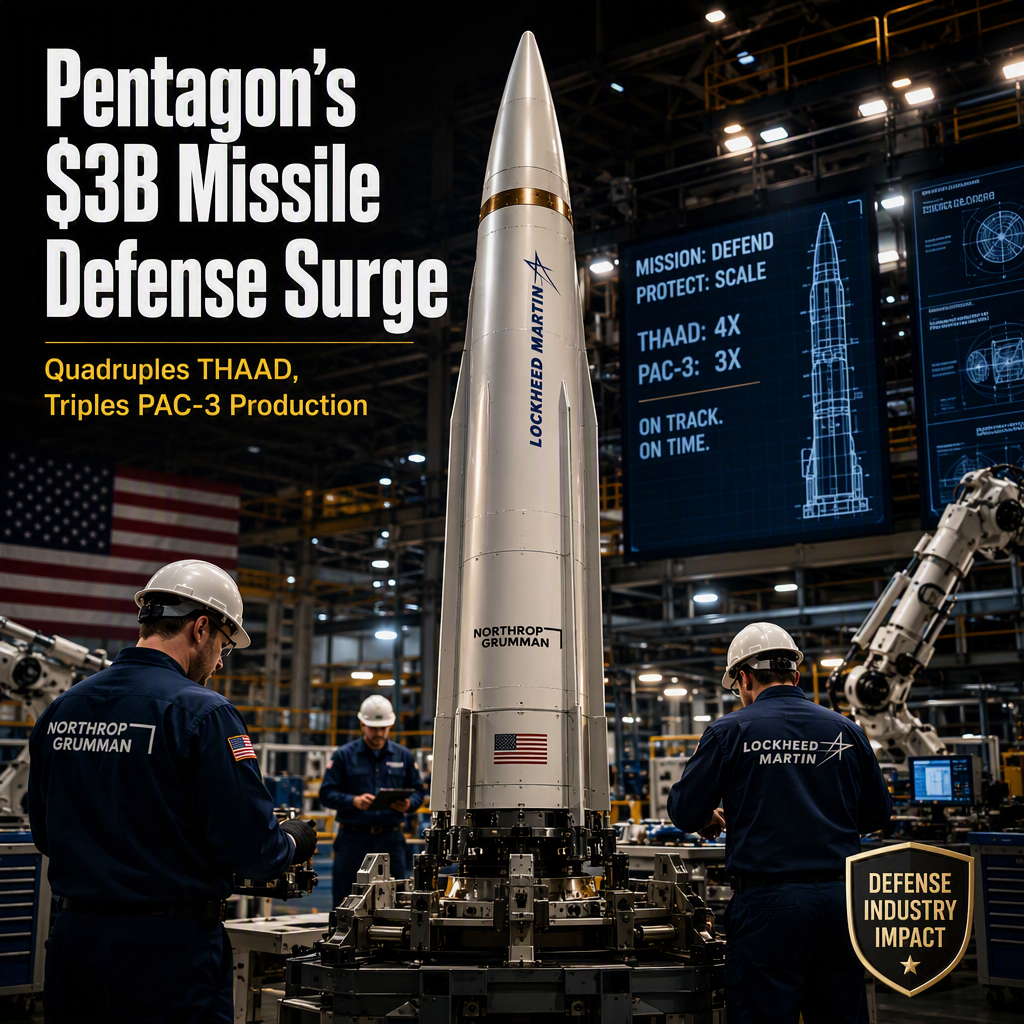
The Pentagon has announced new framework agreements with Lockheed Martin and Northrop Grumman aimed at significantly boosting the production of missile-defense systems, specifically the Terminal High Altitude Area Defense (THAAD) interceptors and Patriot Advanced Capability-3 (PAC-3) components [1]. According to a War Department release, the deals are designed to quadruple the output of THAAD interceptor structural components and support a threefold increase in PAC-3 production [1].
Northrop Grumman stated that the agreements are worth a combined $3 billion, including a $2 billion contract to supply rocket motors and safety devices and a $1 billion contract to increase deliveries of THAAD components [1]. The agreements provide suppliers with longer-term demand commitments, enabling investments in tooling, facility upgrades, and workforce development [1].
Northrop Grumman Vice President Ben Davies emphasized the company's ability to rapidly scale production, citing ongoing investments in manufacturing technologies and resilient supply chains [1]. Northrop plans to raise PAC-3 solid rocket motor production at its Allegany Ballistics Laboratory in West Virginia, where tactical motor capacity has already doubled since 2021, with expectations to triple production capability by 2027 [1]. This expansion will support the U.S. Army's goal to increase annual PAC-3 MSE missile production from about 600 units to thousands for both U.S. forces and allied countries [1].
The Pentagon highlighted that the deal establishes a second source for solid rocket motors, increasing competition and reducing supply-chain risks [1]. Northrop is also doubling solid rocket motor capacity at its Utah facilities and increasing capacity by 25% at its Elkton, Maryland, plant [1]. Under the THAAD agreement, Northrop will increase monthly deliveries of key structural components such as interceptor shell cores, aft bulkheads, and heat-shield assemblies [1].
CONCLUSION
The Pentagon's $3 billion agreements with Northrop Grumman and Lockheed Martin mark a significant expansion in U.S. missile-defense production capacity. By quadrupling THAAD and tripling PAC-3 output, the deals aim to strengthen supply chains and support both domestic and allied defense needs. The market impact is high, with positive sentiment for the involved defense contractors.