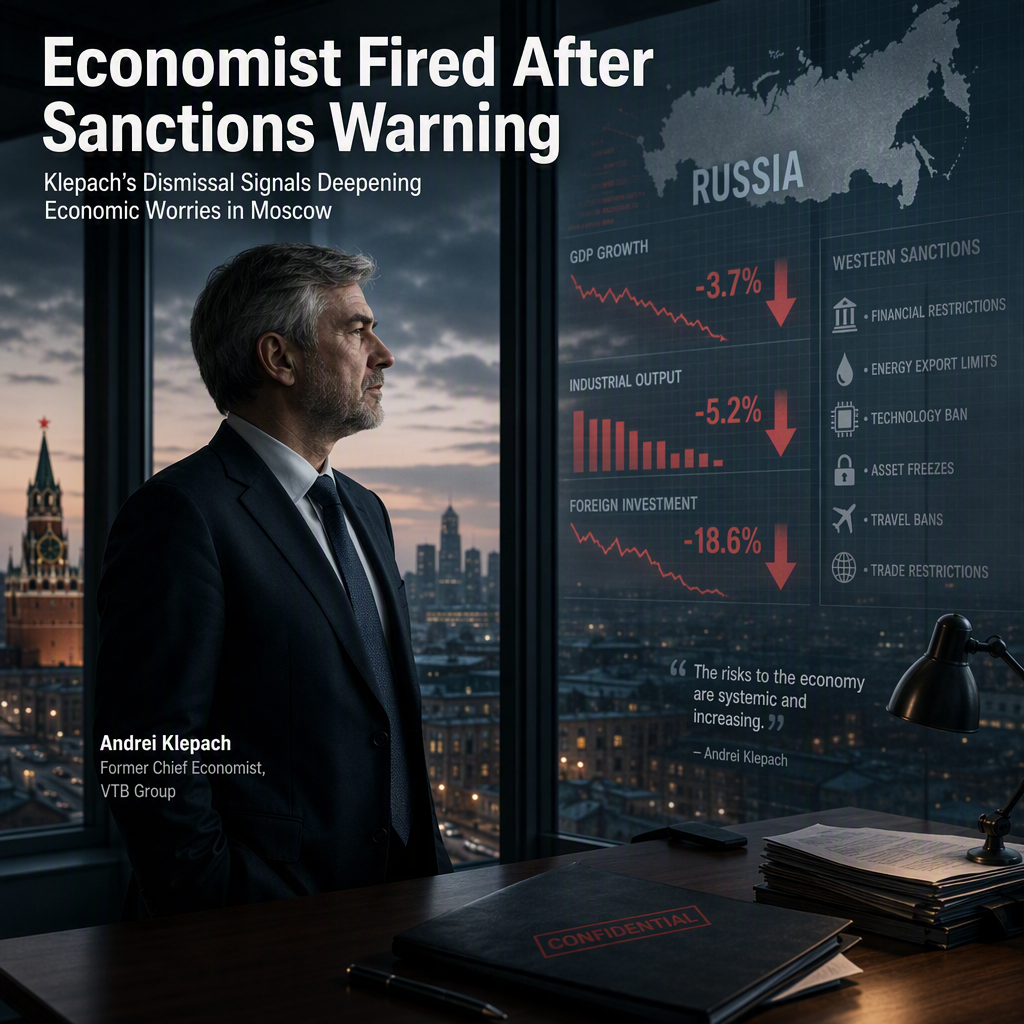
Andrei Klepach, the chief economist at Russian state development bank VEB.RF, was dismissed following public remarks in which he warned that Russia is losing an economic 'war of attrition' with the West and could eventually face a social crisis. Klepach, who had served as chief economist since 2014 and previously spent a decade at Russia’s Economy Ministry, made these comments in a May speech to the Nikitsky Club, a forum of economists, academics, and government officials. His remarks only recently gained attention in Russian media, leading to his dismissal, which was confirmed by VEB and Klepach himself, though no official reason was provided for his departure [1].
In his speech, Klepach stated, 'We are falling behind. We are losing both the technological and economic competition in the world,' and noted that Russia is not only lagging behind China and the United States, but in some ways, even Ukraine, attributing Ukraine’s resilience to continued Western financial support. He further warned, 'We will not win the competition in this war of attrition,' and highlighted that Russia’s mounting costs and the illusion that Ukraine would collapse have not materialized. Klepach acknowledged Russia’s resilience to Western sanctions but cautioned that Ukrainian attacks on energy and logistics infrastructure are creating additional economic pressure [1].
According to Reuters, Russia’s central bank stated in July that economic growth could fall as low as zero this year, with repeated Ukrainian strikes on Russian refineries and other facilities causing supply disruptions and adding to inflation risks. Klepach predicted that Russia could face a social crisis 'precisely when nobody is particularly expecting it,' emphasizing the long-term risks of continued economic lag [1].
A European intelligence source told Fox News Digital that Russia’s deeper economic problems should not be confused with immediate financial pressure on President Putin. The source noted that higher oil prices have helped Moscow cover more of its budget deficit, potentially giving the Kremlin additional time before economic constraints begin to force difficult decisions [1].
CONCLUSION
The firing of Andrei Klepach underscores growing concerns within Russia about the long-term impact of Western sanctions and the war in Ukraine on the country’s economic future. While immediate financial pressures may be mitigated by higher oil prices, the warnings of technological and economic lag, as well as the risk of a future social crisis, highlight significant challenges ahead for Moscow.