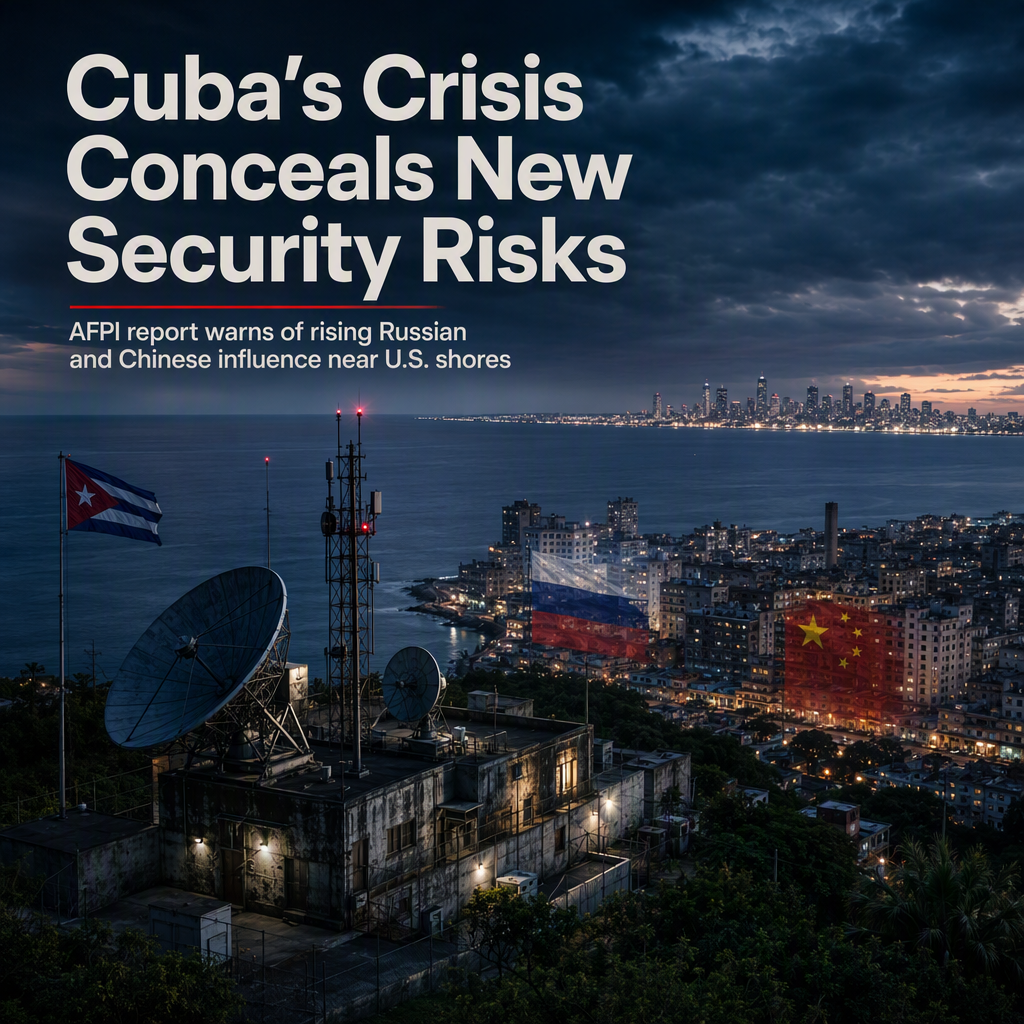
A new report from the America First Policy Institute (AFPI) highlights that Cuba's deepening economic crisis is not diminishing its potential as a national security threat to the United States, but rather may be concealing growing risks stemming from its relationships with Russia, China, and Iran [1]. The report, titled 'The Dictatorship Next Door: Cuba and the Fight for the Western Hemisphere,' argues that U.S. policymakers have focused too narrowly on Cuba's human rights, migration, and economic issues, overlooking the strategic implications of Havana's partnerships with America's adversaries [1].
The AFPI report points to opportunities for intelligence collection, military cooperation, cyber operations, and political influence close to the U.S. homeland as a result of these partnerships [1]. The most immediate concern centers on China, with a June 18, 2026 analysis by the Center for Strategic and International Studies (CSIS) identifying ongoing activity at Cuban sites capable of supporting signals intelligence collection. CSIS previously identified four such sites, several with possible links to China [1]. Melissa Ford Maldonado, director of AFPI’s Western Hemisphere Initiative, stated there is credible evidence of Chinese intelligence bases and spying activities in Cuba, leveraging the island's proximity to the U.S. for monitoring purposes [1].
Russia's relationship with Cuba is described as longstanding and increasingly close, involving diplomatic and military cooperation. The report notes that Cuban nationals have joined Russian forces fighting in Ukraine, with a U.S. State Department cable estimating between 1,000 and 5,000 Cubans fighting alongside Russian forces, a figure also cited by Ukrainian officials in discussions with U.S. lawmakers [1]. However, Cuba has denied sending troops to Ukraine, stating in an October 11 statement that it is not participating in the conflict with military personnel and has prosecuted 40 individuals for mercenary activity [1].
The report underscores that Cuba's economic instability does not necessarily reduce its threat level to the U.S., but may instead provide opportunities for adversarial powers to expand their influence and intelligence operations in the region [1].
CONCLUSION
The AFPI report warns that Cuba's economic crisis may be obscuring significant national security risks for the United States, particularly through its deepening ties with China and Russia. The presence of suspected intelligence facilities and reports of Cuban nationals fighting in Ukraine highlight the need for U.S. policymakers to consider the broader strategic implications of Cuba's alliances.