
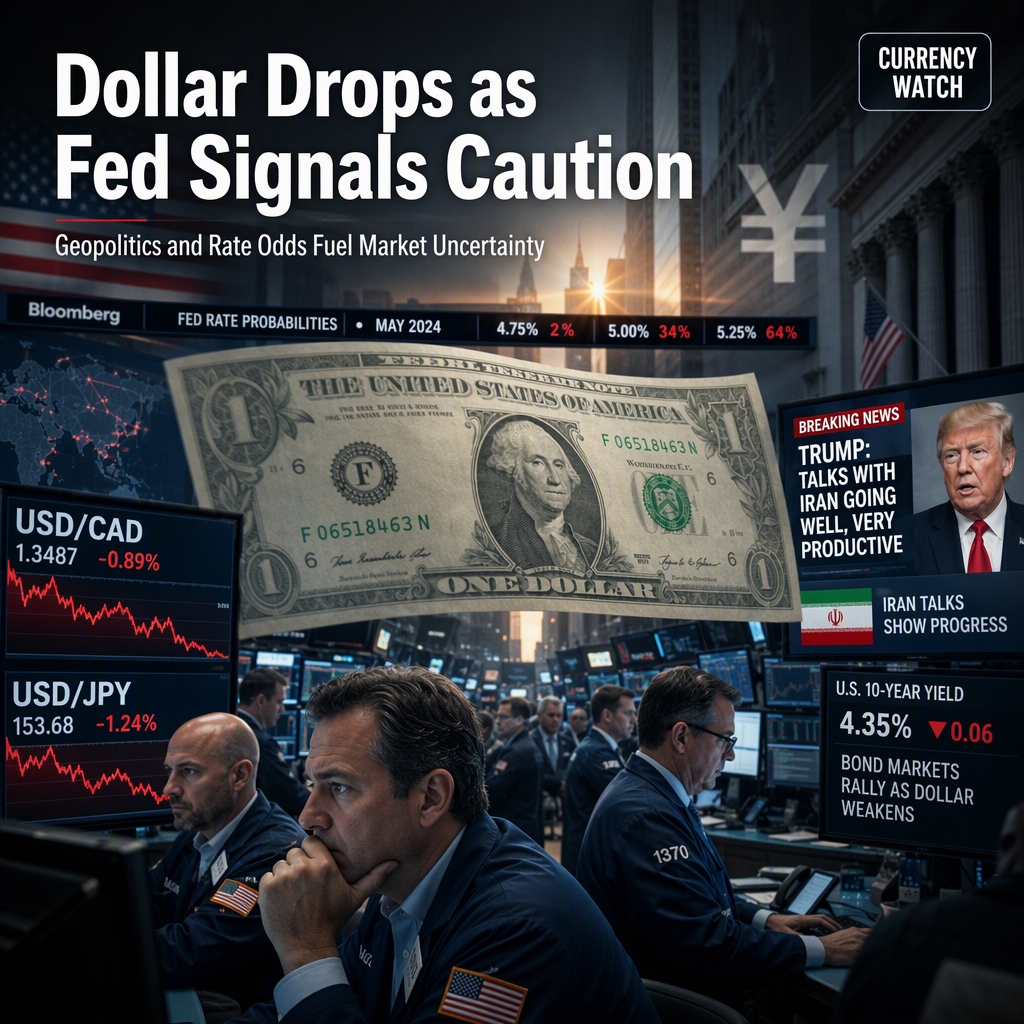
The US Dollar (USD) experienced broad-based weakness on Friday, influenced by shifting risk sentiment and evolving expectations regarding Federal Reserve (Fed) policy. The USD/CAD pair extended its losses for a second consecutive day, trading around 1.4210 during Asian hours, as the US Dollar lost safe-haven demand following US President Donald Trump's announcement that the US was engaged in 'productive discussions' with Iran and would refrain from military action prior to the midterm elections [1]. Similarly, the USD/JPY pair struggled to maintain gains, trading below the 158.00 mark, as the softer US Dollar limited the Yen's intraday slide [2].
Market expectations for a Fed rate hike at the upcoming policy meeting have diminished, with the CME FedWatch tool indicating a 17.7% probability of at least a 25 basis point increase, down from 38% a week earlier. However, the likelihood of a December hike remains high at 83% [1][2]. Fed officials, including Musalem and Waller, delivered hawkish messages, emphasizing the need for further tightening to address persistent inflation, with Musalem highlighting strong demand and Waller noting that more hikes may be needed, though not necessarily at consecutive meetings [1]. Despite these hawkish tones, the FXS Fed Sentiment Index slipped by 0.25 points to 138.33, signaling a modest pullback in perceived hawkishness, though the index remains well above the neutral line [1].
In Japan, household spending data showed a ninth consecutive monthly decline in August, though the contraction was less severe than expected. Real wages increased for the eighth month in a row, reinforcing expectations for further Bank of Japan (BoJ) tightening [2]. Rabobank strategists noted that while the BoJ's recent rate hike met expectations, its guidance was less hawkish than anticipated. Nonetheless, the gradual tightening is eroding the Yen's appeal as a funding currency for carry trades [2].
Geopolitical developments also played a role in market sentiment. President Trump's statement about refraining from military action against Iran helped ease concerns over oil prices and inflation, while a strong 30-year US bond auction led to a decline in Treasury yields and further pressured the US Dollar [2]. Persistent geopolitical uncertainties, particularly regarding Iran's nuclear program, continue to support a risk premium for the Dollar, though the overall mixed fundamental backdrop has resulted in range-bound trading for the USD/JPY pair [2].
Market participants are now awaiting the release of the Preliminary University of Michigan US Consumer Sentiment and Inflation Expectations Index, as well as further comments from FOMC members and geopolitical headlines, for additional direction [2].
CONCLUSION
The US Dollar's recent weakness is driven by reduced expectations for near-term Fed rate hikes and easing geopolitical tensions, particularly regarding US-Iran relations. While Fed officials maintain a hawkish stance, market sentiment has moderated, leading to range-bound trading in major currency pairs. Investors remain cautious, awaiting further economic data and central bank commentary for clearer direction.