
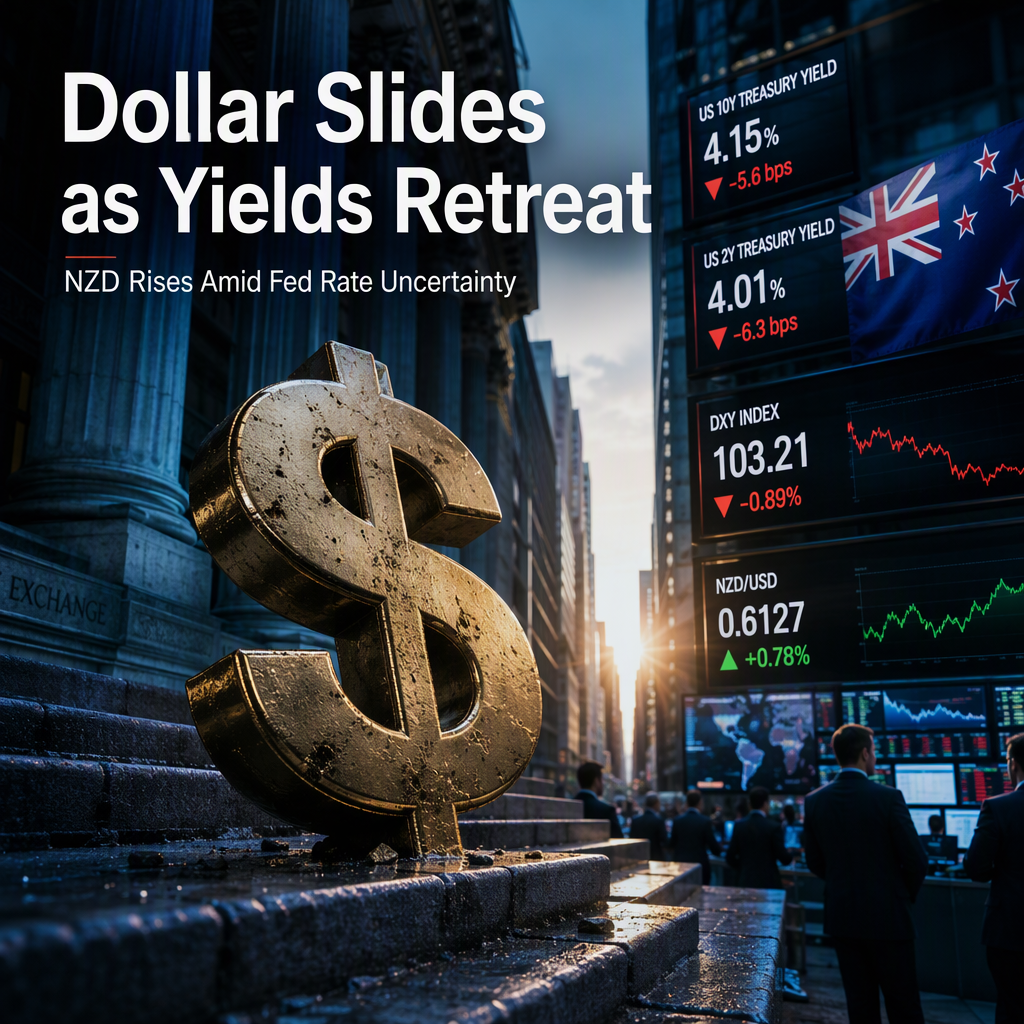
The US Dollar Index (DXY) continued its decline on Friday, trading 0.1% lower near 102.02 during Asian hours, following a retreat in US Treasury yields after the index failed to extend its rally beyond the yearly high of 102.54 posted earlier this year [1]. The 10-year US Treasury yield dropped to approximately 5.23% from Thursday’s high of 5.35% [1][2]. The US Dollar was notably weakest against the Australian Dollar (-0.24%) and the New Zealand Dollar (-0.24%) on the day [1].
The NZD/USD pair gained traction, rising to near 0.5615 during early Asian trading, as the US Dollar softened and Treasury yields eased [2]. The 30-year Treasury bond yield also fell more than 5 basis points to 5.602% after recently trading around a 24-year high [2]. Market participants are closely watching inflation data and the Federal Reserve's (Fed) interest rate outlook, with the US Consumer Price Index (CPI) for September set to be released on Wednesday, a key trigger for the US Dollar [1].
Fed officials provided mixed signals: St. Louis Fed President Alberto Musalem indicated another rate hike may be needed to bring inflation to the 2% target but did not specify timing, while Fed Governor Christopher Waller suggested further hikes are likely but left open the possibility of a pause at the upcoming October meeting [2]. The CME FedWatch tool shows markets have priced in at least one more rate hike this year, with a 17.7% probability for October and 83% for December [1][2].
Strategists at Scotiabank noted that the USD had shown broad strength entering Thursday’s North American session, gaining against all G10 currencies, but underlying rate expectations remained contained [2]. They highlighted that geopolitical developments were impacting oil prices and global bond yields, with WTI crude up $4 per barrel and trading above $90, while the US 10-year yield threatened multi-decade highs [2]. Despite these moves, Fed pricing for further tightening remained muted, with only 5 basis points of tightening priced for October and a cumulative 26 basis points by December [2].
Looking ahead, Westpac analysts expect the Reserve Bank of New Zealand to keep its Official Cash Rate steady at 2.75% this month, with a 25 basis point rise in December and two further increases in early 2027 [2].
CONCLUSION
The US Dollar weakened further as Treasury yields retreated and market participants weighed mixed signals from Fed officials regarding future rate hikes. The New Zealand Dollar benefited from the softer USD and easing yields. Upcoming US inflation data and Fed policy decisions remain key drivers for currency and bond markets.