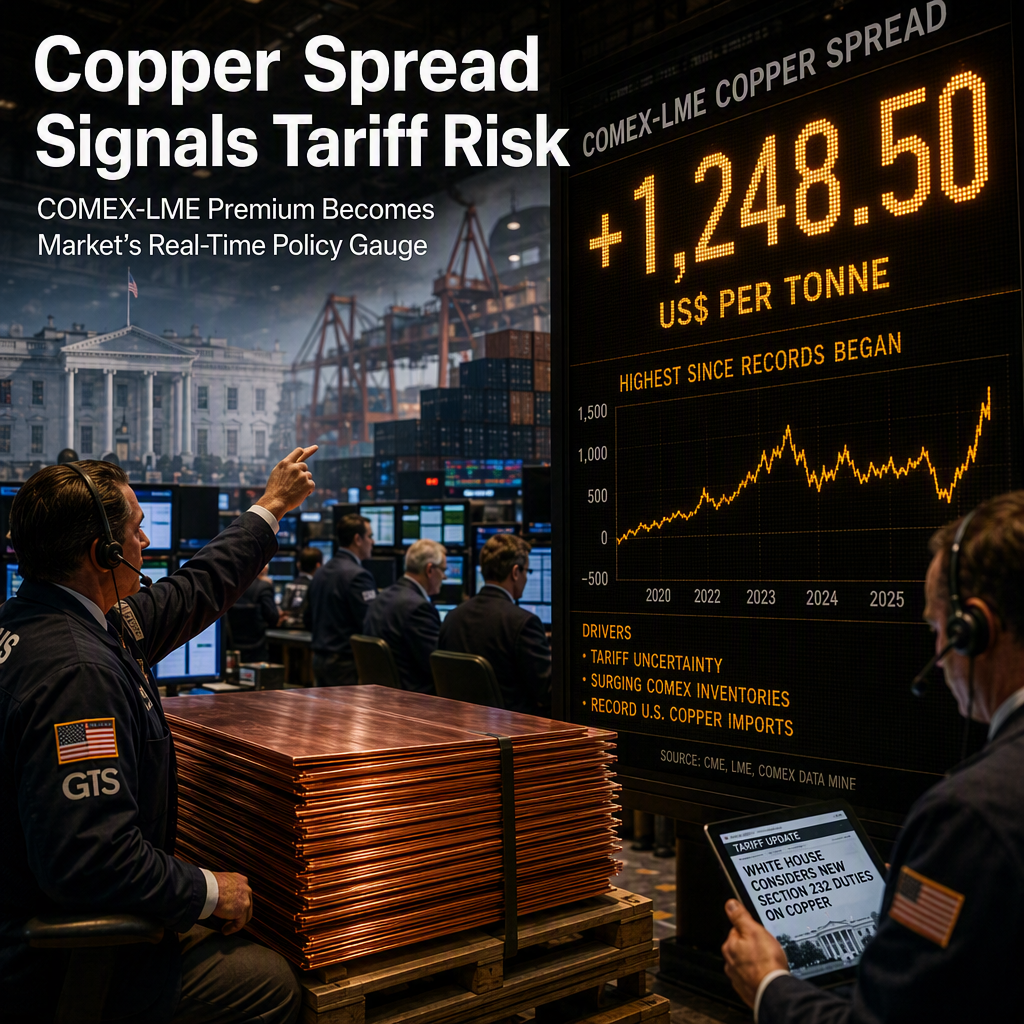
The price premium between U.S. COMEX copper futures and London Metal Exchange (LME) prices has evolved into a real-time indicator of potential U.S. tariffs on refined copper, as the White House considers new duties. According to Societe Generale, the current premium suggests a 14.6% probability of a 15% tariff being implemented in January 2027 and a 37% probability of a 30% duty in January 2028 [1]. This shift in the arbitrage trade reflects growing market sensitivity to U.S. tariff policy, with the spread now serving as a proxy for tariff risk rather than being driven solely by traditional factors such as Chinese demand or South American supply disruptions [1].
The U.S. Commerce Department has recommended a phased universal tariff on refined copper, starting at 15% from January 1, 2027, and increasing to 30% from January 1, 2028 [1]. The U.S. already imposes a 50% levy on imports of semi-finished copper products and certain other copper-containing goods [1]. The anticipation of further tariffs has contributed to a surge in U.S. copper imports, which reached over 200,000 metric tons in July—the highest level in 12 years [1]. This influx has supported copper prices, with futures hitting a record high of nearly $6.90 per pound last week [1].
Market participants—including physical traders, banks, hedge funds, producers, and consumers—have historically used the COMEX-LME spread for arbitrage and hedging. However, Societe Generale analysts note that the trade is now dominated by tariff speculation, as investors use the COMEX premium to gauge the likelihood of new duties [1]. Ewa Manthey, commodities strategist at ING, stated that a wider COMEX-LME premium signals greater perceived tariff risk and continues to attract metal into the U.S. market [1].
SocGen analysts, led by Mike Haigh, highlighted that U.S. policymakers are increasingly concerned about the nation's reliance on imported refined copper, especially as demand is driven higher by AI infrastructure, grid modernization, and defense spending. The ongoing Section 232 investigation is part of a broader effort to secure access to copper, which is considered critical for both economic growth and national security [1].
CONCLUSION
The evolving COMEX-LME copper spread now serves as a real-time gauge of U.S. tariff risk, reflecting heightened market sensitivity to potential policy changes. With record imports and futures prices, the market is closely watching the White House's next move, as tariff expectations continue to drive trading strategies and price dynamics.