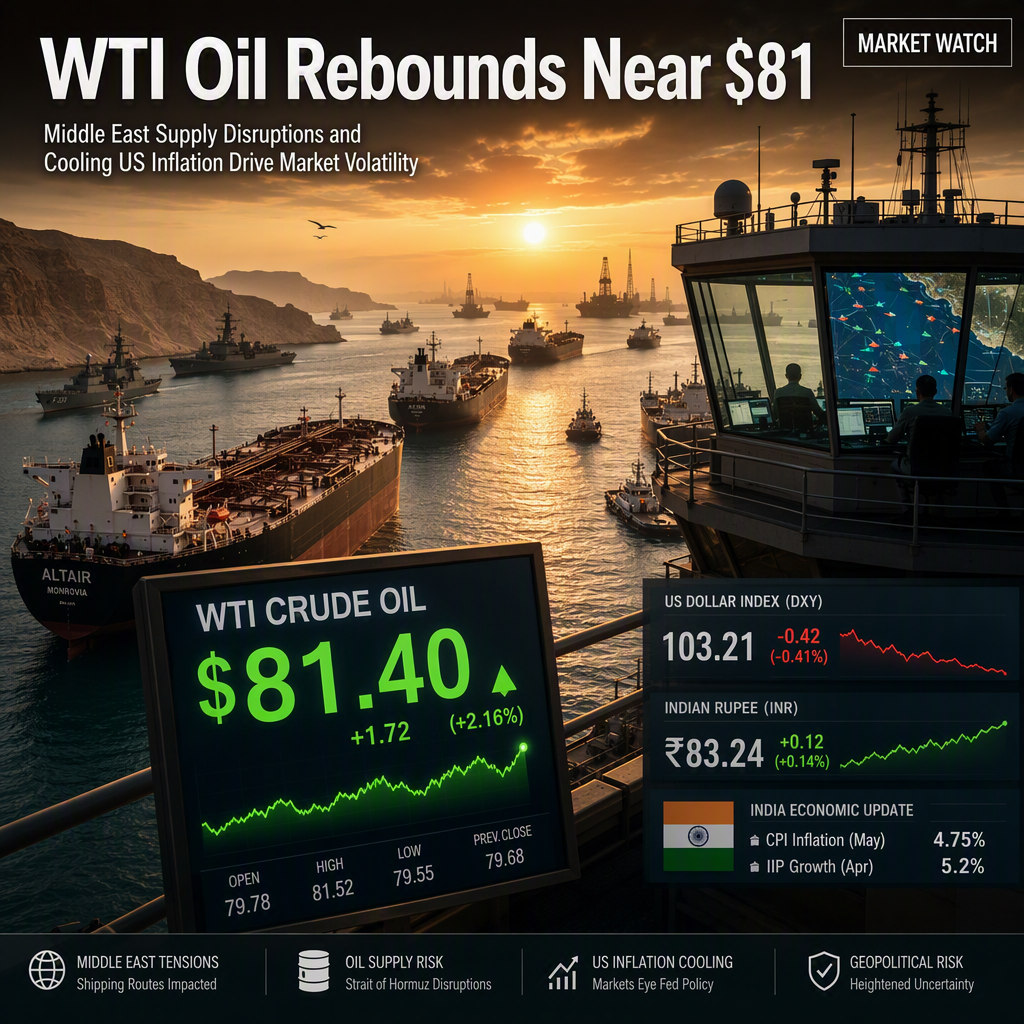
West Texas Intermediate (WTI) crude oil futures on NYMEX rose 0.4% to around $81.40 during early European trading on Friday, recovering after a two-day correction as markets remained concerned about the closure of key energy supply routes in the Middle East [1]. The closures of the Strait of Hormuz and the Bab al-Mandab Strait, which together account for 27% of global energy supply, have led to a significant reduction in commodity vessel transits—down from pre-war levels of 130-140 ships daily to well below the August daily average of 12, according to Kpler data cited by Reuters [1][2]. Iran has stated it is not in discussions with the US about reopening Hormuz but is in final talks with Oman on managing navigation through the strait [1].
OPEC has revised its global oil demand forecast for 2026 downward to 580,000 barrels per day from a previous estimate of 780,000 bpd [1]. Despite recent selling pressure and a slight cooling in oil price momentum, analysts at TD Securities maintain that 'fundamental tightness across crude and product markets should ultimately support further upside,' viewing the recent dip as a temporary setback within a constructive medium-term outlook [1][2]. Technical analysis shows WTI trading at $80.76, above its 20-day EMA of $80.04, indicating underlying demand and a constructive near-term bias [1].
In India, the Rupee opened flat at around 95.40 against the US Dollar, with the USD/INR pair trading sideways as investors awaited developments regarding the reopening of the Strait of Hormuz [2]. The MCX Crude Oil contract expiring August 19 traded 0.85% lower at Rs. 7,755 after reaching a weekly high of Rs. 8,075 on Tuesday [2]. Analysts warn that persistently high oil prices could negatively impact India's economic growth, government investment, and inflation [2]. Standard Chartered has removed its previous assumption of a retail fuel price cut in FY27, citing ongoing geopolitical uncertainty, crude price volatility, and mounting losses for public-sector oil companies and the government, which could reach 0.4-0.5% of GDP by H1-FY27 if crude remains at $85-90/bbl [2].
Meanwhile, the US Dollar Index (DXY) weakened for a second day, trading around 99.90, as softer-than-expected US inflation data reduced the probability of a Federal Reserve rate hike in September to 34.8%, down from 40% after the PPI release [3]. The Bureau of Labor Statistics reported flat US wholesale costs for July, below the expected 0.2% growth, and a core PPI increase of 0.2%, also below consensus [3]. Rabobank’s Jane Foley noted that fading Fed rate hike speculation opens the prospect of further dollar weakness, but cautioned that renewed oil price spikes could restore support for the greenback [3].
CONCLUSION
WTI oil prices have rebounded near $81 amid ongoing supply disruptions in the Middle East, with analysts maintaining a constructive outlook despite recent volatility. The situation is contributing to economic uncertainty in major importers like India and influencing global currency markets, as cooling US inflation tempers Fed rate hike expectations. Market participants remain alert to further developments in energy supply and geopolitical risks, which could drive additional volatility in both oil and currency markets.