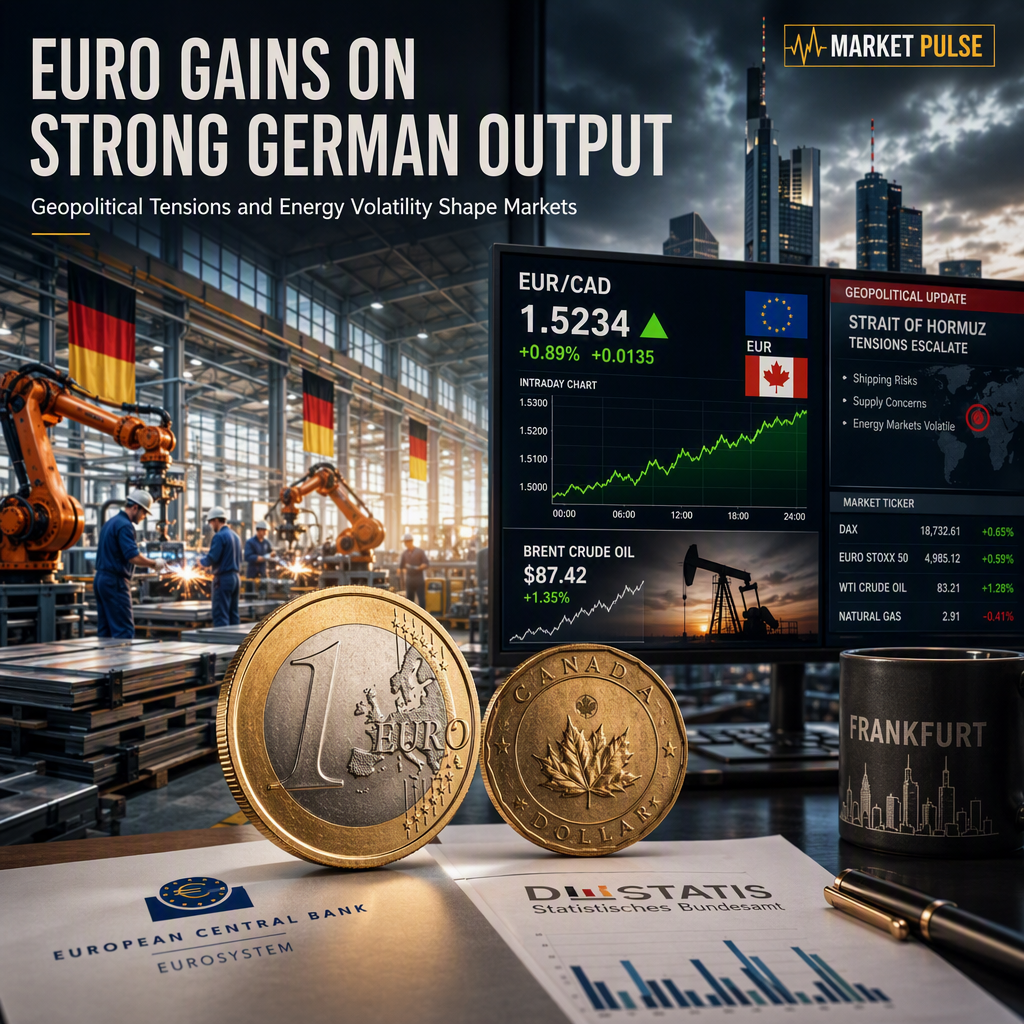
The Euro (EUR) maintained its strength against the Canadian Dollar (CAD), with the EUR/CAD currency pair trading around 1.6160 during European hours on Friday, following two days of losses. This resilience was supported by the latest data from Destatis, which showed that German Industrial Production rose by 0.2% month-on-month in June, surpassing market expectations of a 0.1% increase. However, this growth represented a slowdown from May's revised figure of 0.7% (down from an initial 0.9%). On a year-on-year basis, industrial output declined by 0.1% in June after remaining flat in May [1].
The European Central Bank (ECB) recently decided to keep interest rates unchanged. Market pricing currently indicates expectations for only one additional ECB rate hike before the end of the year, with a roughly 40% probability of a second increase [1].
Geopolitical developments also influenced market sentiment. Analysts at Commerzbank noted that tight German Bund ranges are being tested as oil and gas prices rise, driven by initial details about the Iran-Oman deal. Despite these developments, a direct agreement between the US and Iran has not yet been reached, leaving markets to contend with rising energy benchmarks amid ongoing geopolitical uncertainty. The Canadian Dollar found support from a rebound in energy markets, with West Texas Intermediate (WTI) oil prices holding steady around $77.00 per barrel after a surge of over 4% the previous day. Crude prices face further upward pressure due to intensifying supply risks, particularly concerns about the reopening of the strategic Strait of Hormuz. Additional tensions stem from Saudi Arabia's extension of military operations against Iran-aligned Houthis and Iran's parliament considering measures to restrict the maritime corridor [1].
Analysts at Deutsche Bank observed that markets have become more cautious toward the end of the week as investors digest preliminary details on the finalized Iran-Oman deal to reopen the Strait of Hormuz. This evolving agreement has introduced a more cautious tone across trading conditions, with participants increasingly focused on the geopolitical and transit implications as the deal moves toward implementation [1].
CONCLUSION
The Euro's gains against the Canadian Dollar were underpinned by stronger-than-expected German industrial output and steady ECB policy, while energy market volatility and geopolitical risks contributed to a cautious market tone. The evolving situation around the Strait of Hormuz and related geopolitical tensions are likely to remain key factors influencing both currency and commodity markets in the near term.