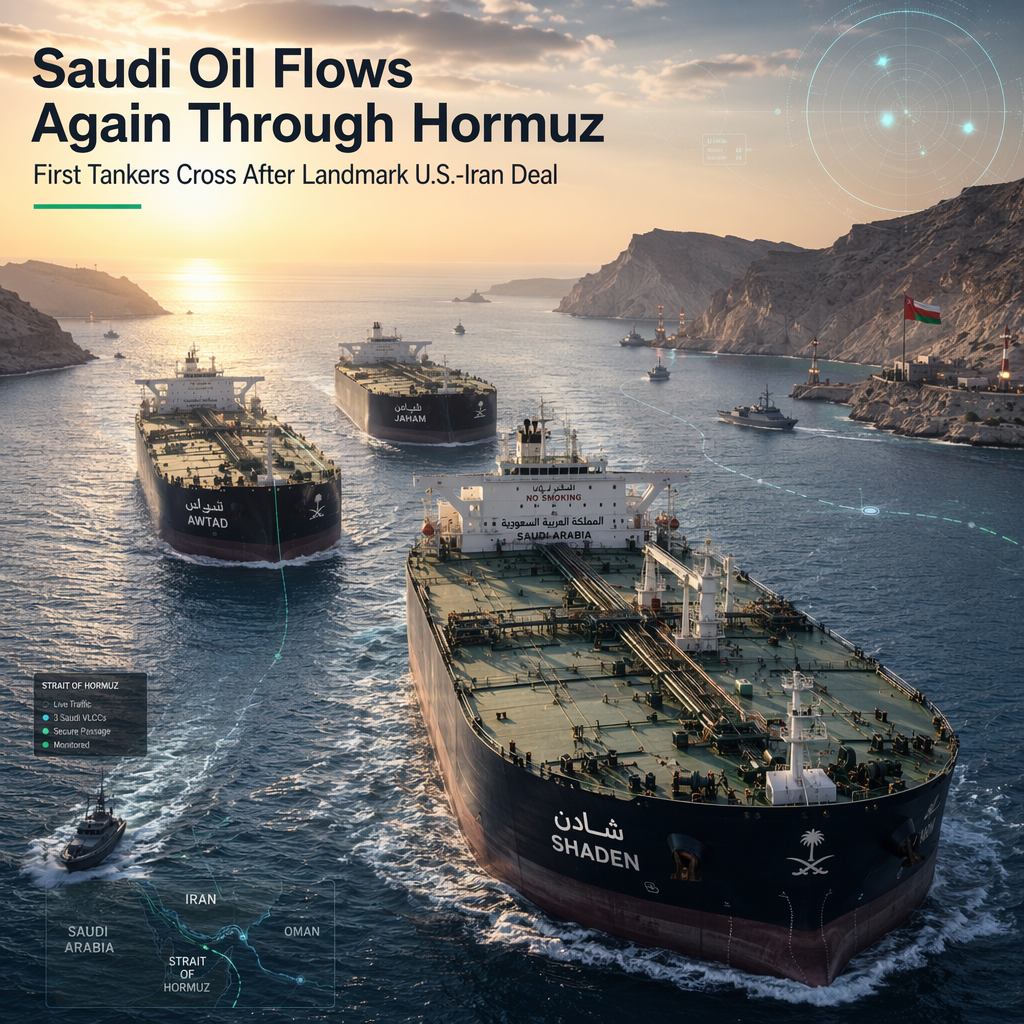
Three Saudi Arabian supertankers, each classified as a Very Large Crude Carrier (VLCC), have crossed the Strait of Hormuz carrying a combined total of 6 million barrels of oil, according to data from Kpler [1]. This marks the first time in months that Saudi oil tankers have transited the strait, following a newly signed agreement between U.S. President Donald Trump and Iranian President Masoud Pezeshkian on Wednesday, which is intended to reopen the critical shipping lane [1].
The Saudi tankers, named Shaden, Awtad, and Jaham, switched on their transponders in the Gulf of Oman on Thursday after more than two months of concealing their locations [1]. The Shaden is currently en route to Kiire, Japan, while the Awtad is headed to Ulsan, South Korea; the destination of the Jaham remains unclear [1].
Despite the reopening, ship traffic through the Strait of Hormuz has not yet returned to pre-conflict levels. Before the Iran war, more than 100 ships, including dozens of tankers, transited the strait daily [1]. "The floodgates haven't opened, there is no mass exodus as yet," said Matt Smith, director of commodity research at Kpler, noting that shippers remain hesitant to cross Hormuz [1].
In addition to the Saudi tankers, at least five Iranian ships have crossed the U.S. blockade line since June 16, including three state-owned oil tankers that exited the Gulf of Oman, according to Lloyd's List Intelligence [1]. The situation remains fluid, with further updates expected as the market reacts to the reopening of this vital oil transit route [1].
CONCLUSION
The passage of Saudi oil tankers through the Strait of Hormuz signals a tentative reopening of a key global oil artery following the recent U.S.-Iran agreement. While this development could ease supply concerns, market participants remain cautious as shipping activity has not yet normalized. Ongoing updates will be crucial for assessing the full market impact.