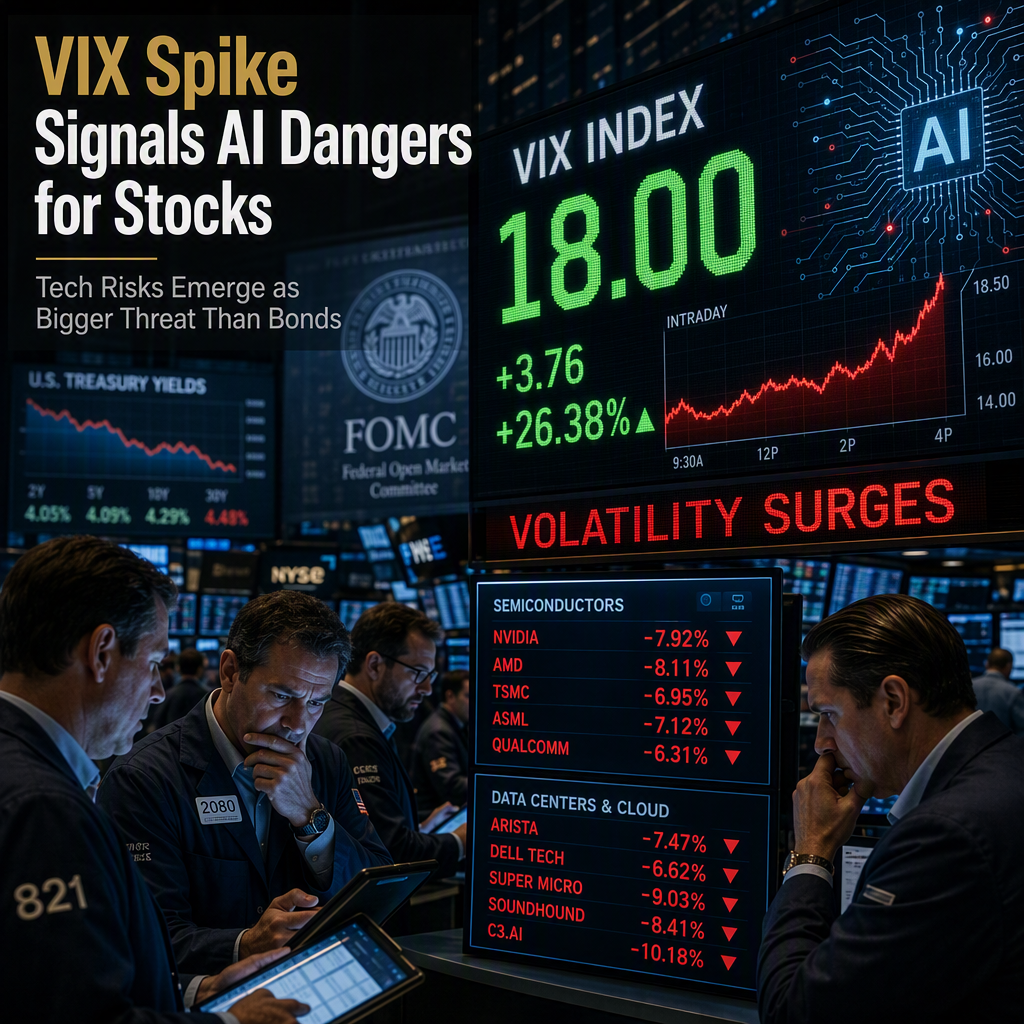
On Monday, the Cboe VIX Index, a key measure of U.S. stock market volatility, jumped to 18, with options trading on the gauge surging to more than double the 30-day average volume as semiconductors and data-center stocks weighed on the S&P 500 Index. This market action followed renewed debate among tech leaders and politicians about whether the artificial intelligence (AI) buildout is progressing too rapidly, highlighting AI risks as a primary concern for traders over bond market volatility [1].
By midday, three of the top five VIX contracts were calls, and the largest trade was a purchase of at least $3.6 million in 31-strike calls expiring mid-November, indicating expectations for further volatility. The VIX had touched a year-to-date low below 14 earlier this month, even as the odds of a Federal Reserve interest-rate hike steadily increased. After inflation data on Friday, the VIX erased two days of gains, suggesting the market is becoming more comfortable with higher rates. John Marshall of Carrick Lane noted that "people in the equity market think FOMC is decided and care a lot more about AI," emphasizing that tech risks are currently perceived as more immediate than interest-rate risks [1].
Interest-rate volatility remains present in the broader market, with the Merrill Lynch Option Volatility Estimate (MOVE) Index rising 10 points last week to a 92nd percentile high. Options pricing for volatility in rate-sensitive ETFs like the iShares 7-10 Year Treasury Bond ETF (IEF) and the Vanguard Real Estate Index Fund ETF (VNQ) are also in the upper 90th and 80th percentiles, respectively. However, this bond market volatility does not appear to be significantly impacting stocks, as equity prices remained firm and the odds of a rate hike at Wednesday's Federal Reserve meeting extended above 91 percent by midday [1].
Analysis from Carrick Lane further indicated that options on the S&P 500 were pricing a swing of 0.8% into weekly contracts expiring September 18, which is below the 50th percentile of volatility typically expected during weeks with a Federal Open Market Committee (FOMC) meeting [1].
CONCLUSION
Recent market activity suggests that traders are more concerned about AI-related risks than bond market volatility, as evidenced by the surge in VIX and options activity. Despite elevated volatility in the bond market, equity prices have remained resilient, and the market appears increasingly comfortable with the prospect of higher interest rates.