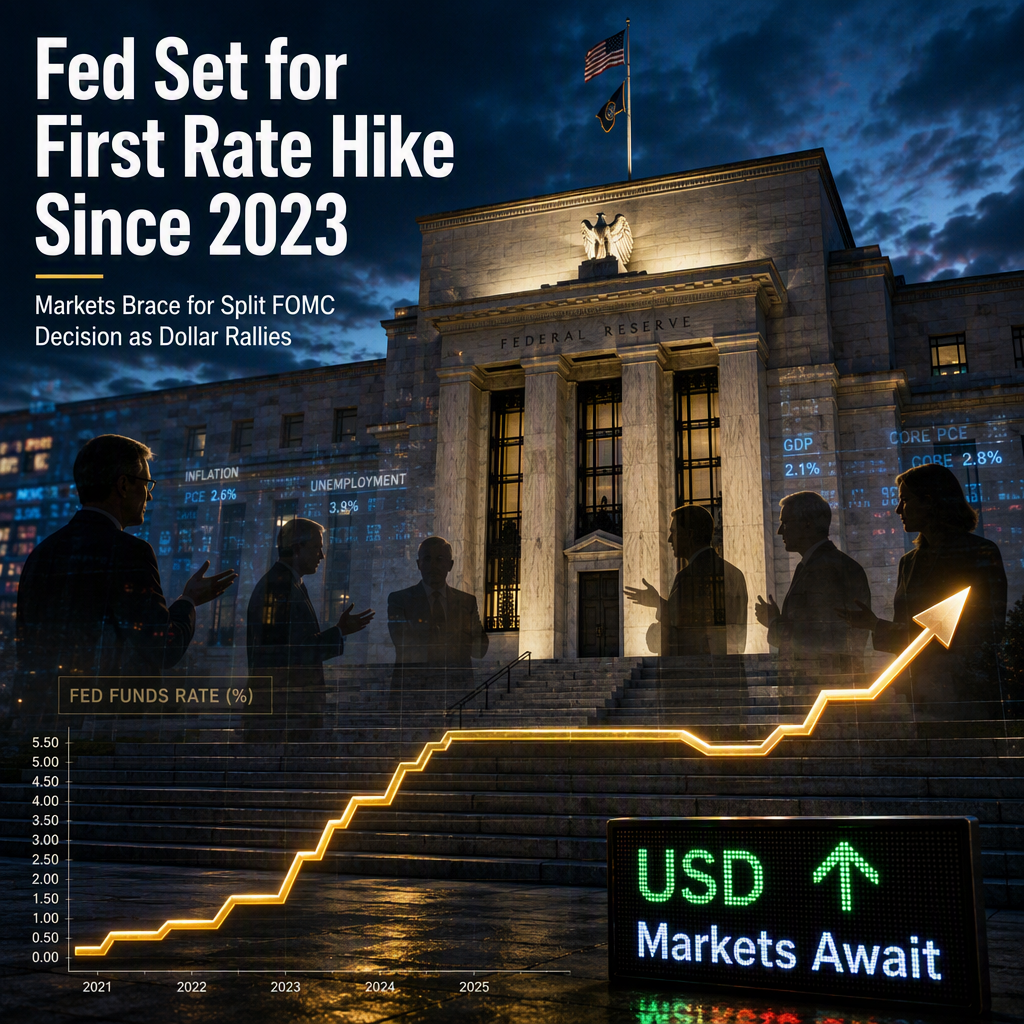
The US Federal Reserve is widely expected to raise its benchmark interest rate by 25 basis points to a target range of 3.75%-4.00% at its upcoming policy meeting, marking its first hike since July 2023 after five consecutive holds [2][4]. Market pricing reflects strong conviction, with swaps indicating an 85% chance of tightening and futures traders assigning a 92.7% probability to a rate increase, according to the CME FedWatch Tool [1][3][4]. The anticipation follows recent US inflation data and a run-up in fuel prices, which have reinforced expectations for Fed action [1][4].
The FOMC vote is expected to be closely watched, especially after a 9-3 split in July, highlighting divisions among policymakers regarding the persistence of inflation and the need for further tightening [4]. Brown Brothers Harriman (BBH) notes that the vote split, updated Summary of Economic Projections, and Fed Chair Kevin Warsh’s guidance will be key to market reaction, with a unanimous or near-unanimous vote and hawkish signals likely to support the US Dollar, while a split vote or dovish messaging could weigh on the currency [2][4]. Scotiabank strategists emphasize that the US Dollar Index (DXY) is fairly valued for current front-end spreads, and further gains above 100 would require a significant move in yield differentials, which they doubt the Fed is ready to deliver [1].
Technical analysis of USD/CAD shows the pair trading around 1.3898, near a two-week high, as Fed rate hike expectations lift the US Dollar. The Canadian Dollar has seen limited support from rising oil prices, and the interest rate gap between the Fed and the Bank of Canada (BoC), which held its policy rate at 2.25% earlier this month, could widen further if the Fed delivers a hawkish outcome [3]. Economists at Royal Bank of Canada expect the BoC to hold rates through 2026, with gradual increases in 2027 as the economy strengthens [3].
Analyst opinions diverge on the necessity and impact of further tightening. BBH suggests the US economy does not warrant an aggressive tightening cycle, citing disinflationary wage growth and already restrictive policy relative to a nominal neutral rate of 3.00% [2]. Goldman Sachs, while previously skeptical, has shifted its forecast to a hike this week, though it maintains that much of the inflation overshoot is due to one-time factors such as tariffs and energy supply shocks, whose effects may fade [4]. Scotiabank warns that an unchanged Fed decision would shock markets and be negative for the USD, while a 'dovish' hike without commitment to further moves could also weigh on the currency [1].
CONCLUSION
Markets are overwhelmingly positioned for a 25bps Fed rate hike, with the US Dollar buoyed by high expectations and recent inflation data. However, the FOMC remains divided, and the ultimate market reaction will hinge on the vote split and Chair Warsh’s guidance. While a hawkish outcome could offer limited gains for the USD, a dovish surprise poses greater downside risk, and analysts caution against aggressive tightening given current economic conditions.