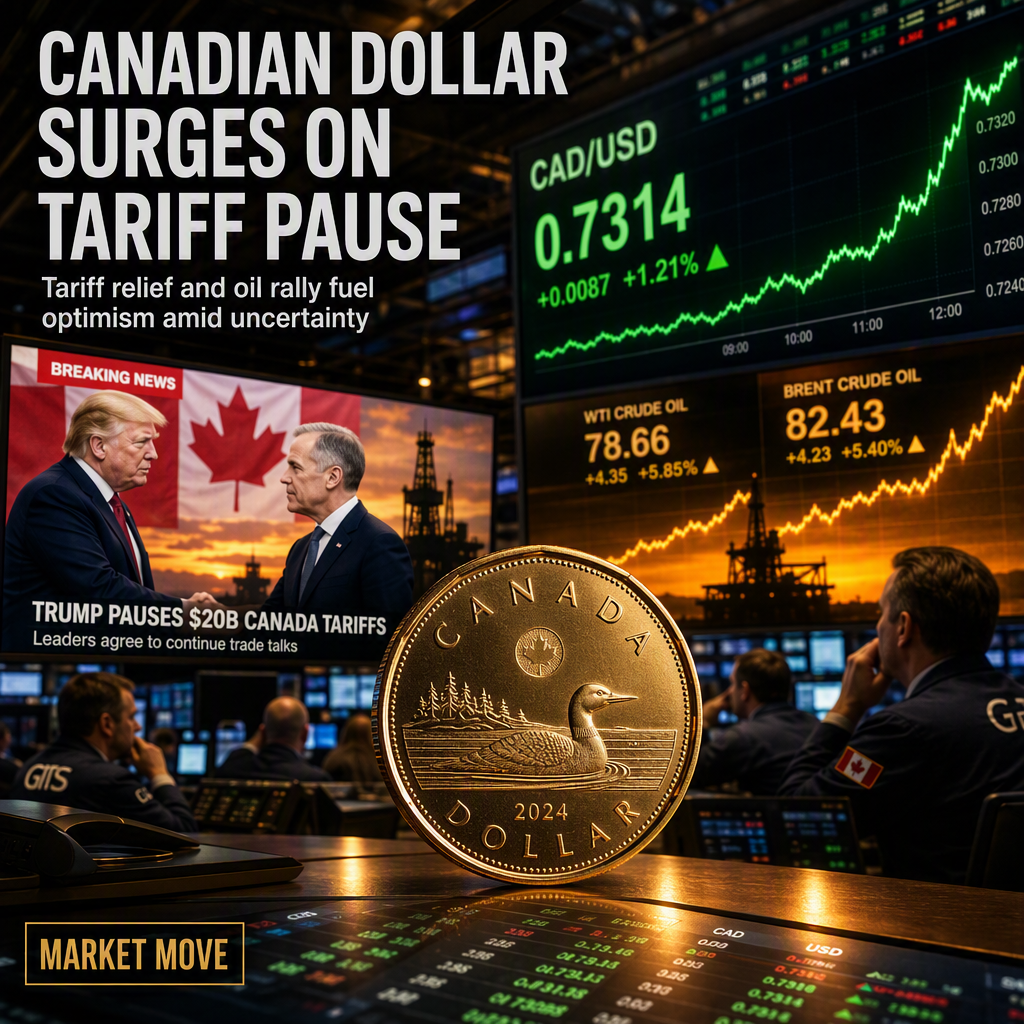
The Canadian Dollar (CAD) strengthened on Wednesday, with the USD/CAD pair declining by 0.62% to trade around 1.3810, following US President Donald Trump's decision to pause the implementation of 50% tariffs against Canada for three days [1]. The pause, announced after negotiations with Canadian Prime Minister Mark Carney, temporarily eases concerns over US-Canada trade relations, although the short duration of the suspension maintains significant uncertainty regarding the final outcome of the negotiations [1]. The tariffs, originally scheduled to affect roughly $20 billion of Canadian goods, including hockey sticks, were announced last month and are now subject to final documentation as the two countries reportedly 'have a deal,' according to President Trump [1].
Rising Oil prices also provided additional support to the Canadian Dollar, with crude Oil reaching a nearly three-week high amid heightened tensions between Washington and Tehran over the Strait of Hormuz, reinforcing concerns about global supply [1]. Given Canada's role as a major energy supplier to the United States, higher Oil prices generally bolster the CAD [1].
Meanwhile, the US Dollar (USD) struggled to recover after hitting a two-month low on Monday. Recent US economic data indicated cooling inflation and slowing consumer spending, prompting investors to scale back expectations for immediate monetary policy tightening by the Federal Reserve (Fed) [1]. However, inflation risks from higher energy prices could encourage the Fed to maintain a restrictive stance, keeping US Treasury yields elevated and potentially limiting the Greenback's decline [1].
Market participants are now focused on the Federal Open Market Committee (FOMC) Minutes, due later on Wednesday. According to the CME Group FedWatch Tool, there is a 68% chance of a Fed rate hike by the end of the year. The Minutes will be closely scrutinized for insights into policymakers' concerns about inflation risks and the outlook for US monetary policy [1]. In the near term, USD/CAD remains influenced by improving sentiment toward the Canadian Dollar, supported by the tariff pause and higher Oil prices, as well as investor caution ahead of the Fed Minutes. A more hawkish-than-expected message from the Fed could support the USD, while signs of greater caution over rate hikes could increase bearish pressure on the pair [1].
CONCLUSION
The Canadian Dollar has gained strength due to the temporary pause of US tariffs and rising Oil prices, while uncertainty persists over the final trade deal and US monetary policy. Market attention now shifts to the FOMC Minutes, which could influence the USD/CAD pair depending on the Fed's stance. Overall, sentiment is cautiously optimistic for the CAD, but significant uncertainty remains.