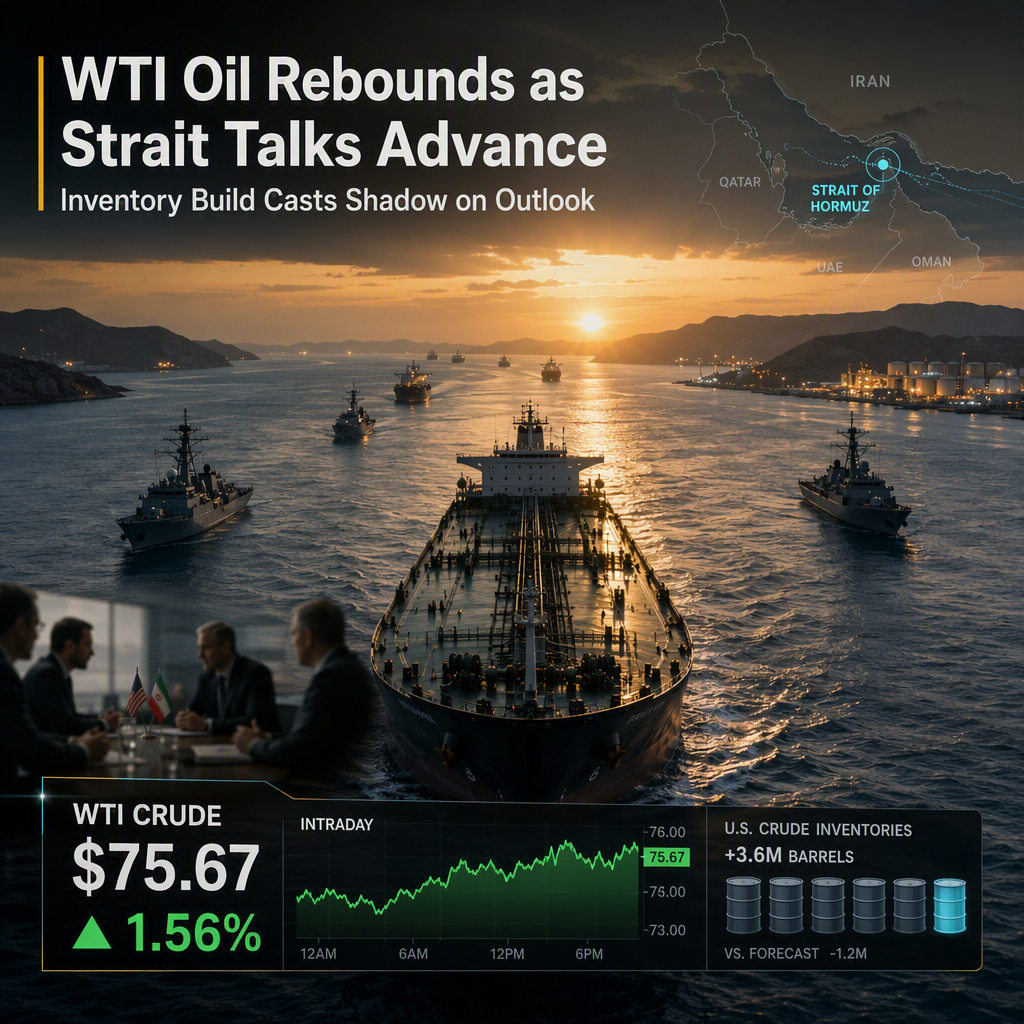
West Texas Intermediate (WTI) crude oil recovered part of its recent losses on Wednesday, trading around $75.50 and up 1.56% on the day, following a technical rebound after a more than 5% decline in the previous session [1]. The recovery was limited by ongoing diplomatic progress between the United States and Iran, which has raised hopes for the reopening of the Strait of Hormuz and eased concerns about global oil supply disruptions [1]. Qatari officials indicated that an interim agreement had been drafted to restore navigation through the strategic waterway, and US President Donald Trump paused planned military strikes against Iran to allow negotiations to proceed, reiterating his call for the strait to reopen as soon as possible [1].
Broader regional efforts are also underway, with Iran reviewing a proposal for European participation in mine-clearing operations in the Strait of Hormuz and discussions with Oman to safeguard trade routes. Additionally, Saudi Arabia is holding indirect talks with Yemen's Houthi rebels to prevent further escalation in the Red Sea [1].
Market participants are closely monitoring fundamentals, as the American Petroleum Institute (API) reported an unexpected increase in US crude oil inventories, shifting attention to the upcoming official Energy Information Administration (EIA) report. Another inventory build could reinforce the view that supply and demand dynamics remain a key driver of oil prices, despite ongoing geopolitical tensions [1].
From a technical perspective, WTI trades at $75.67 with a bearish near-term bias, remaining below the 100-period simple moving average (SMA) at $79.55 and the 200-period SMA at $81.62. The Relative Strength Index (RSI) is near neutral at 49, indicating indecisive momentum. Resistance is seen at $77.40, with further barriers at $79.55 and $81.62, while support lies at $73.51; a break below this level could signal deeper losses [1].
CONCLUSION
WTI's partial recovery reflects a cautious market balancing technical rebounds with ongoing diplomatic efforts to reopen the Strait of Hormuz. However, bearish technical signals and rising US inventories suggest that oil prices remain vulnerable to further downside if supply concerns persist.