
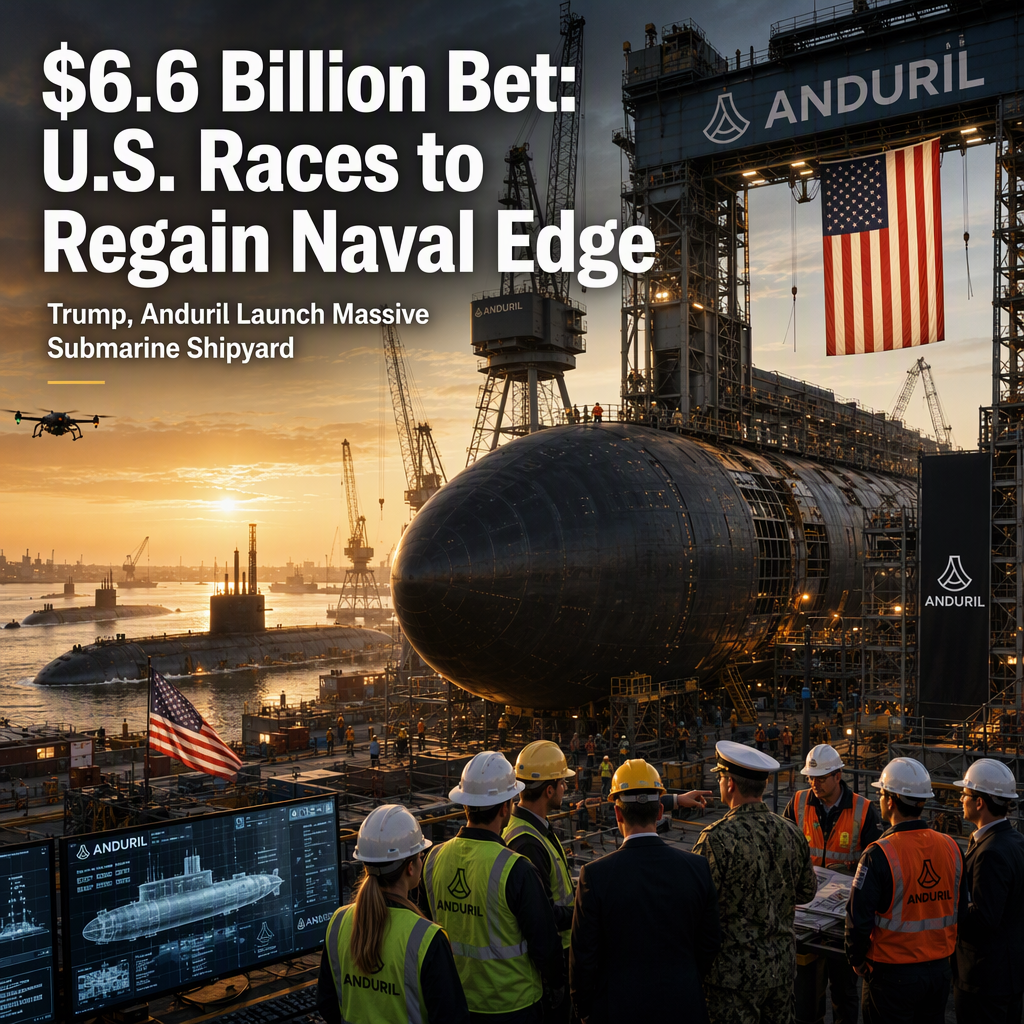
The Trump administration has announced a $6.6 billion initiative aimed at accelerating the production of submarines in the United States, in response to concerns about lagging behind China's shipbuilding capacity [1]. The plan involves partnering with Anduril, a defense technology company, which will construct a more than 2-million-square-foot shipyard at Sparrows Point near Baltimore to manufacture critical submarine components and eventually large sections of the vessels [1].
A senior administration official stated that the new facility could add approximately 9 million labor hours annually, representing about a 15% increase in submarine production capacity [1]. Currently, U.S. shipyards are delivering around 1.3 Virginia-class submarines per year, falling short of the Navy's goal of two per year. The Navy projects reaching this target around 2032 and currently operates 26 Virginia-class submarines, with two more expected to be added in the spring [1].
Anduril plans to invest $3.7 billion of its own capital into building the facility, workforce, and manufacturing capacity, while the Navy could spend up to an additional $2.9 billion to purchase the resulting production [1]. This arrangement is notable for its commercial model, with Anduril taking on significant financial risk and the Navy paying only for successful production outcomes. An industry official emphasized, "I wouldn't say that the government's paying us back. We feel the government [is] buying the results of what we're able to produce" [1].
The deal also strengthens Anduril's relationship with the Pentagon, following the recent appointment of company founder Palmer Luckey to Project Meridian—a 120-day study on future military technologies—alongside Elon Musk and Newt Gingrich [1]. While Project Meridian does not have procurement authority, the Pentagon has stated that appropriate safeguards will be implemented to address potential conflicts of interest [1].
CONCLUSION
The Trump administration's partnership with Anduril marks a significant investment in U.S. submarine production capacity, leveraging private capital and innovative manufacturing approaches to address longstanding industrial challenges. The initiative is expected to boost output and deepen ties between emerging tech firms and the Pentagon, with potential implications for future defense procurement and technology strategies.