
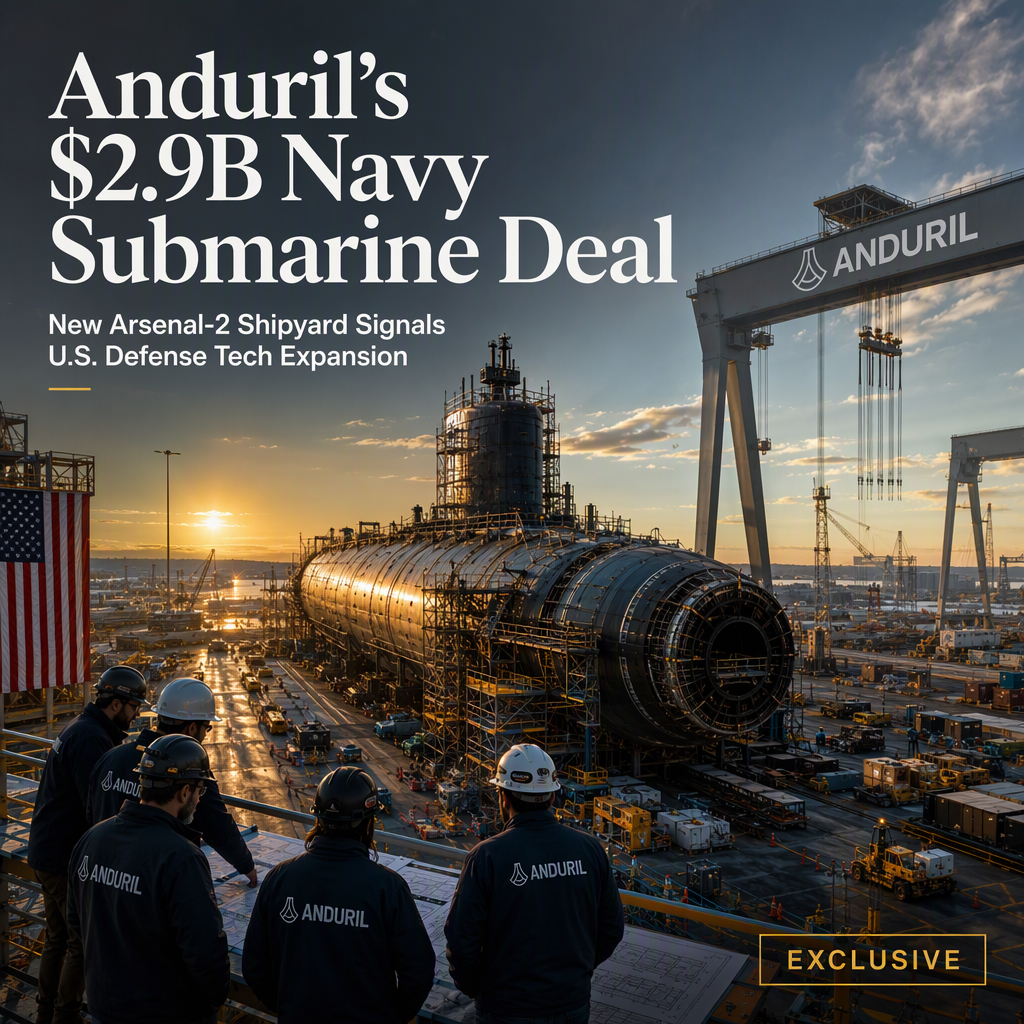
Anduril Industries has been awarded a contract worth up to $2.9 billion by the U.S. Navy to support submarine production, specifically for building components for the Virginia-class submarine fleet [1]. The announcement comes just days after Anduril's CEO, Palmer Luckey, was named to the Pentagon's Project Meridian, a new task force focused on identifying and developing capabilities for future U.S. conflicts [1]. Other notable members of this initiative include former House Speaker Newt Gingrich and SpaceX CEO Elon Musk, highlighting the growing influence of defense technology leaders in Washington [1].
As part of the contract, Anduril will invest $3.7 billion in private capital to scale a new shipyard in Baltimore County, Maryland, called Arsenal-2, which is expected to begin operations in 2030 [1]. The facility will span more than 2 million square feet and is projected to generate $2 billion in annual economic output and create 3,100 jobs [1]. Additionally, some submarine components will be manufactured at a 160,000-square-foot facility in Orange County, California [1].
Anduril President and Chief Strategy Officer Chris Brose emphasized the importance of the deal, stating, "This is about putting more food on the table and being able to meet the requirements that our country has to produce more submarines" [1]. The contract and associated investments are part of a broader trend of increased defense technology engagement with the U.S. government, as President Donald Trump seeks to strengthen military capabilities, including shipbuilding [1].
The Virginia-class submarines are primarily constructed by General Dynamics Electric Boat and Huntington Ingalls Industries, with General Dynamics having secured a $76.6 billion Navy award earlier this year to build submarines [1]. The involvement of venture capital firms such as Andreessen Horowitz, which has invested billions in defense tech firms including Anduril, further underscores the sector's growing prominence [1].
CONCLUSION
Anduril's $2.9 billion contract with the U.S. Navy and its $3.7 billion shipyard investment mark a significant expansion in U.S. submarine production capacity. The deal highlights the increasing influence of defense technology firms in government procurement and policy, with substantial economic and employment impacts anticipated.