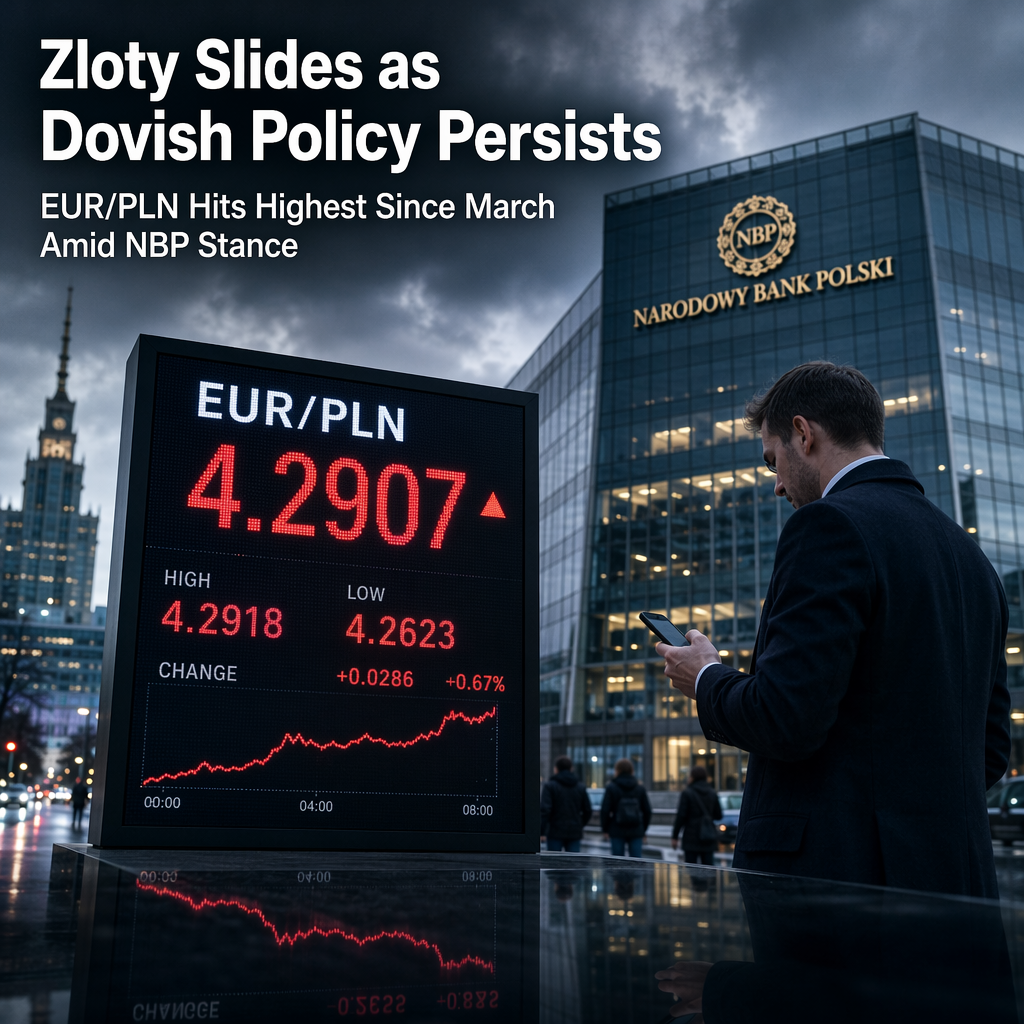
The Polish Zloty has continued to underperform its Central and Eastern European (CEE) peers, with the EUR/PLN exchange rate breaking above its previous 4.230-4.260 range and reaching levels above 4.290 yesterday. This marks the highest point since the onset of the US-Iran conflict in March [1]. ING’s Frantisek Taborsky attributes this vulnerability to the dovish tone of the National Bank of Poland (NBP), as well as global risk-off conditions, including a stronger US dollar and weaker risk sentiment [1].
According to ING’s models, the current EUR/PLN level around 4.290 is considered fair, as it closes the gap between rates and FX that had been widening since mid-June [1]. The market has largely priced out any rate hikes, expecting rates to remain broadly unchanged over the next six months, with only about a 50% probability of one hike over the following year. This is significantly less than for comparable peers such as the Czech Republic or the broader emerging market space, excluding outliers like Hungary or Israel [1].
Looking ahead, ING notes that the NBP’s dovish tone is unlikely to change in the near term. The next potential trigger for a shift could be the June inflation print, scheduled for next Tuesday. However, forecasts do not anticipate a significant upside surprise, and recent data, particularly weaker wages, should keep the central bank comfortable with its current stance [1]. ING continues to see risks skewed towards a higher EUR/PLN, although 4.300 is flagged as strong resistance, which may help contain further moves. If the zloty weakens further, it could prompt the NBP to reassess its policy stance [1].
CONCLUSION
The Polish Zloty remains pressured against the Euro due to the National Bank of Poland's dovish stance and unfavorable global conditions. With rate hikes largely priced out and no significant inflation surprises expected, risks remain tilted toward further zloty weakness, though resistance at 4.300 may limit the move. Market participants should monitor upcoming inflation data for any signs of a policy shift.