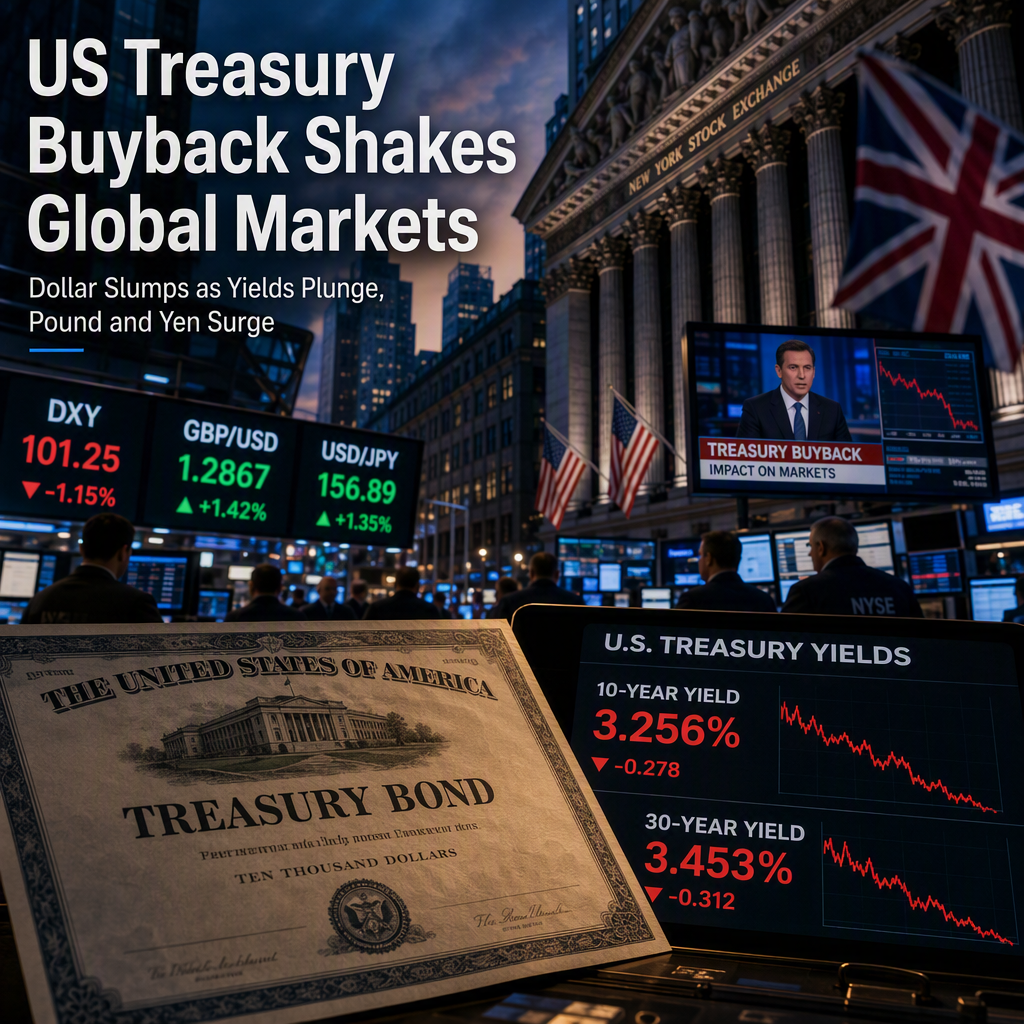
On Wednesday, the US Treasury announced a significant increase in its buyback operations for longer-dated government bonds, doubling the size from $2 billion to at least $4 billion per operation in both the 10-to-20-year and 20-to-30-year maturity sectors. These expanded buybacks will take effect from September 9 through November 4, aiming to improve liquidity in the long-term government bond market [2][3]. This intervention follows a sharp rise in long-term borrowing costs, with the US 30-year yield reaching its highest level since 2007 on Tuesday before falling nearly 10 basis points to around 5.18% after the announcement. The 10-year yield also dropped by more than 5 basis points to around 4.64% [2][3].
The US Dollar weakened notably as yields fell, with the US Dollar Index (DXY) down 0.84% to 98.80, its lowest since late May [1], and 0.72% to 98.94, touching its lowest since May 29 [3]. This decline in the Dollar triggered rallies in major currencies: the British Pound (GBP/USD) climbed to a daily high of 1.3630, its highest since May 11, and the Japanese Yen (USD/JPY) strengthened to 158.47, its lowest level in more than a week [1][3]. The GBP/USD pair held a bullish near-term bias, supported by technical factors, with the Relative Strength Index (14) at 68.2, nearing overbought territory [1].
Market participants are closely watching the Federal Reserve's monetary policy outlook. The absence of communication from new Fed Chair Kevin Warsh has heightened anticipation for the release of the FOMC meeting minutes, which could provide clues about the Fed's next move. There were three dissenters at the last meeting: Cleveland Fed's Beth Hammack, Dallas Fed's Lorie Logan, and Minneapolis Fed's Neel Kashkari [1][2]. Recent US employment and inflation data have reduced expectations of an imminent rate hike, but energy-driven inflation concerns persist due to the unresolved US-Iran conflict [1][3].
Analysts offered mixed views on the Treasury's intervention. Gennadiy Goldberg of TD Securities suggested this could be the first of several measures, with a more permanent solution possibly involving reduced long-dated bond auctions [2]. Jeremy Stretch of CIBC noted the Treasury's willingness to adjust policy to contain bond market pressures [2]. Meanwhile, traders are monitoring the upcoming 20-year US Treasury auction, as strong demand could reinforce the decline in yields, while weak demand might revive concerns about investor appetite for US debt [2].
In the UK, July inflation data showed headline CPI rising from 2.6% to 2.9% YoY, while core CPI steadied at 2.6% YoY, slightly above expectations. Money markets currently price an 80% chance of a hold and a 20% chance of a 25-basis-point rate hike at the Bank of England's September 17 meeting [1].
CONCLUSION
The US Treasury's expanded buyback operations triggered a sharp drop in yields and a broad weakening of the US Dollar, fueling gains in the British Pound and Japanese Yen. While analysts see the intervention as a positive step for market liquidity, uncertainty remains regarding its longer-term impact and the Federal Reserve's policy direction. Investors are now focused on the FOMC minutes and upcoming Treasury auctions for further guidance.