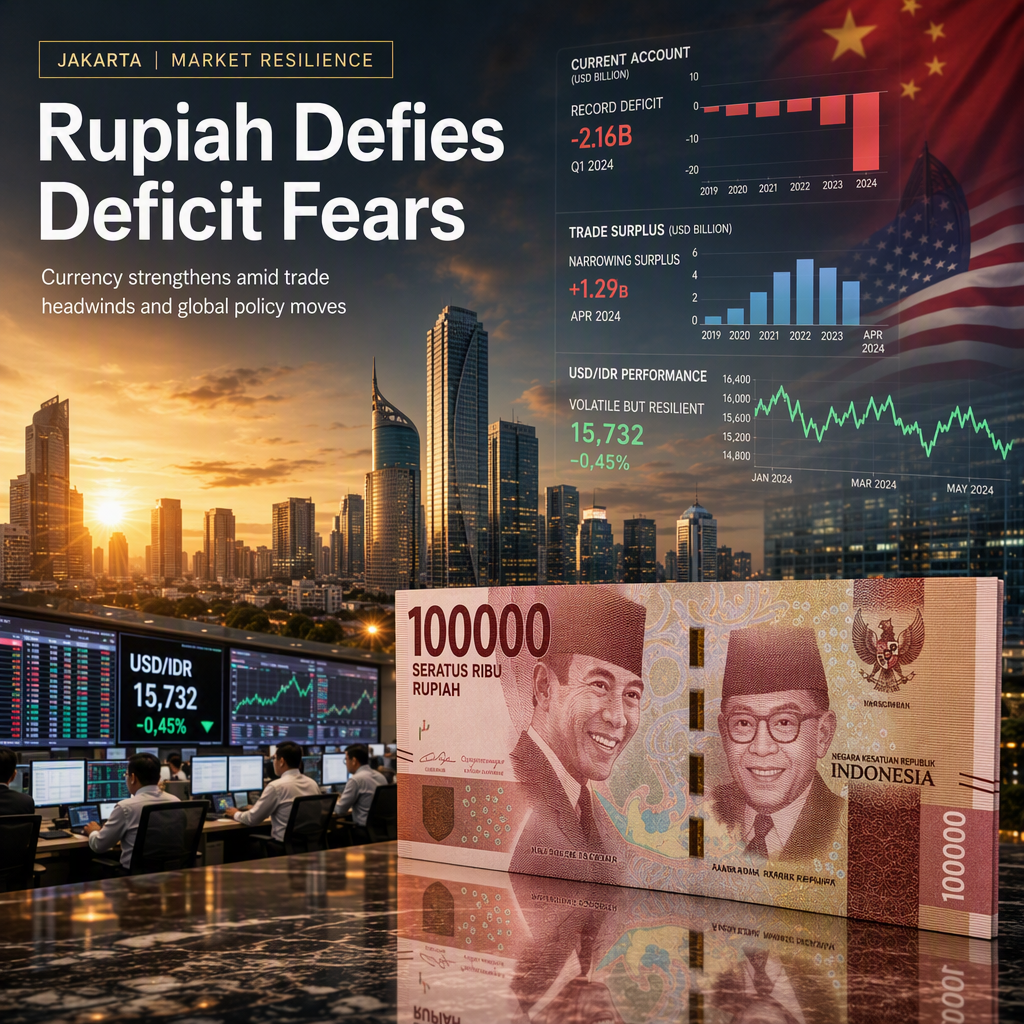
The Indonesian Rupiah (IDR) continued to advance against the US Dollar (USD), with the USD/IDR pair extending losses for the third consecutive day and trading around 17,760 during Asian hours on Friday [1]. This currency strength comes despite Indonesia reporting a record current account deficit of USD 12.49 billion in Q2 2026, equivalent to 3.3% of GDP, a sharp increase from USD 2.89 billion a year earlier [1]. The widening deficit was primarily driven by a drastic narrowing of the trade surplus to USD 1.32 billion, down from USD 10.52 billion in Q2 2025, largely due to an import surge fueled by rising oil prices amid conflict in the Middle East [1].
Market sentiment toward the Rupiah was bolstered by Indonesia's deepening economic partnership with China. Chinese Vice Finance Minister Liao Min pledged on Friday to introduce timely additional fiscal policy measures based on emerging economic trends, while maintaining policy continuity and allocating resources over a longer cycle [1]. This commitment from China provided reassurance to investors and supported the Rupiah despite domestic trade challenges.
Bank Indonesia reinforced currency stability by holding its key interest rate steady at 5.75% for the second consecutive month during its first policy meeting under acting Governor Destry Damayanti, following the abrupt exit of Perry Warjiyo [1]. The central bank emphasized continuity after 100 basis points of cumulative hikes since May, reaffirming its policy mix to safeguard the Rupiah against imported inflation and support broader economic growth through liquidity tools [1].
Additional downside pressure on the USD/IDR pair was attributed to a softening US Dollar, which weakened alongside subdued US Treasury yields. This was in response to Washington's efforts to curb elevated yields through a long-end bond buyback program. Strategists at Scotiabank noted that the US Treasury’s decision to double its bond buybacks—from USD 2 billion to USD 4 billion between September 9th and November 4th—was modest in scope and primarily aimed at calming Treasury markets after a recent ramp-up in term rates [1].
CONCLUSION
Despite a record current account deficit and narrowing trade surplus, the Indonesian Rupiah has shown resilience, supported by strong economic ties with China and stable domestic monetary policy. The softening US Dollar and targeted US Treasury actions have further contributed to the Rupiah's strength. Market sentiment remains cautiously optimistic, with policy continuity and external support underpinning currency stability.