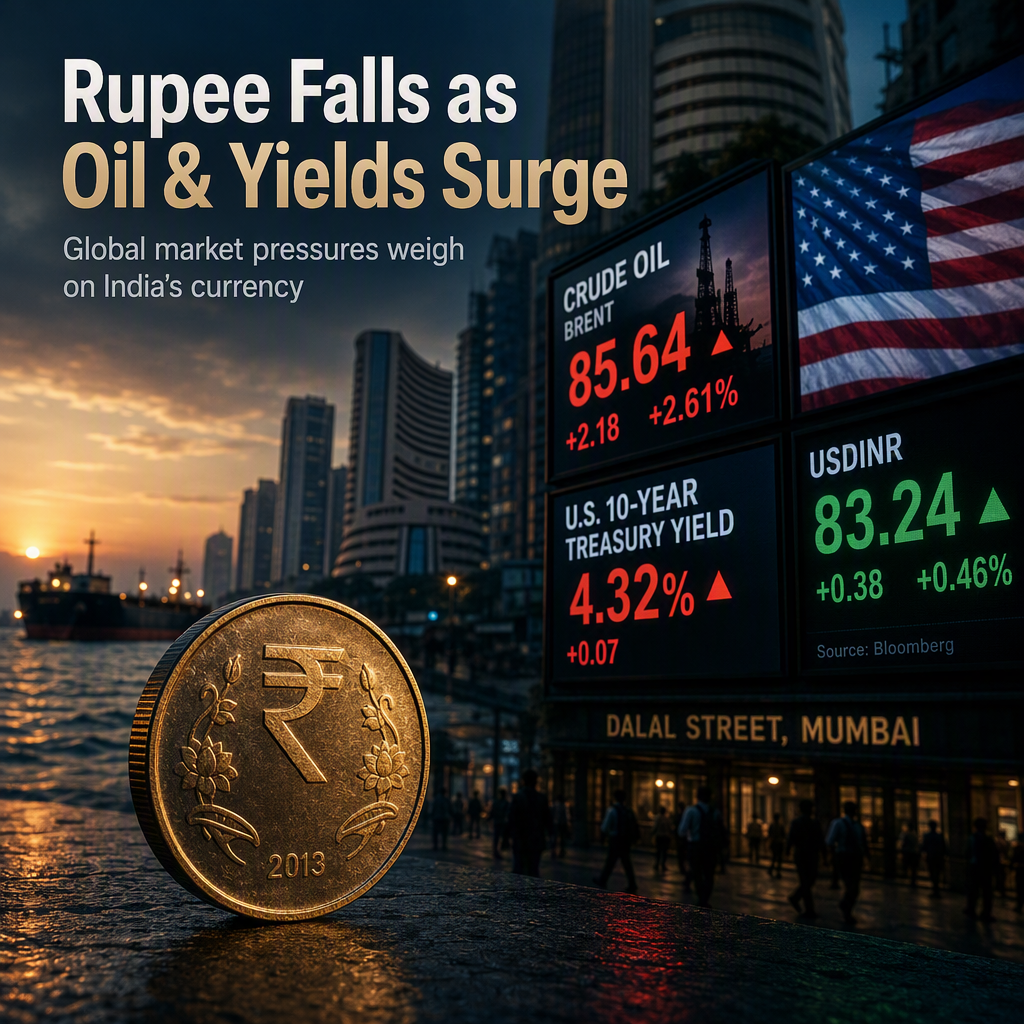
The Indian Rupee (INR) edged lower against the US Dollar (USD) in Friday's opening session, with the USD/INR pair ticking up to near 95.72. This movement was attributed to elevated oil prices and a sharp recovery in United States (US) Treasury Yields, both of which weighed on the Indian currency [1]. The MCX Crude Oil contract expiring on September 21 traded marginally lower at around Rs. 8,285, but remained close to its over three-week high of Rs. 8,404 posted on Thursday. High oil prices tend to negatively impact currencies of economies like India that rely heavily on oil imports [1].
As of the report, 30-year US Treasury Yields held onto Thursday’s recovery move at around 5.25%. Higher US bond yields reduce the appeal of riskier currencies such as the Indian Rupee, contributing further to its weakness [1]. The elevated oil prices were linked to ongoing geopolitical tensions, particularly the lack of progress in US-Iran talks regarding the reopening of the Strait of Hormuz, a critical chokepoint for nearly 20% of global energy supply. US President Donald Trump issued a warning on Wednesday, threatening severe economic consequences for any nation supporting Iran, emphasizing the need to halt oil smuggling and financial support to Iran [1].
Analysts at TD Securities noted that 'energy market tightness persists,' with stalled diplomacy and mounting geopolitical frictions keeping supply risks elevated. They warned that negotiations have been on hold for weeks, and the shift toward economic pressure suggests crude flows will remain critically tight, with Iranian aggression in the Oman lane likely to continue, reinforcing concerns over constrained seaborne exports [1].
On the US bond market side, Brown Brothers Harriman’s Elias Haddad explained that US long-term Treasury yields had retraced most of the previous day's drop, which was triggered by the US Treasury’s buyback announcement. The buyback is described as a debt-management swap, shifting the composition of US debt toward newer, more liquid securities without changing the total debt. BBH further noted that the additional buyback size would likely be financed through greater bill issuance, which, combined with long-bond purchases, points to a flatter yield curve [1].
CONCLUSION
The Indian Rupee's decline was driven by elevated oil prices and a rebound in US Treasury yields, both of which are unfavorable for the currency. Persistent geopolitical tensions and tight energy markets suggest continued pressure on the Rupee, while US debt management strategies are influencing global yield curves. Market participants are likely to remain cautious amid these ongoing risks.