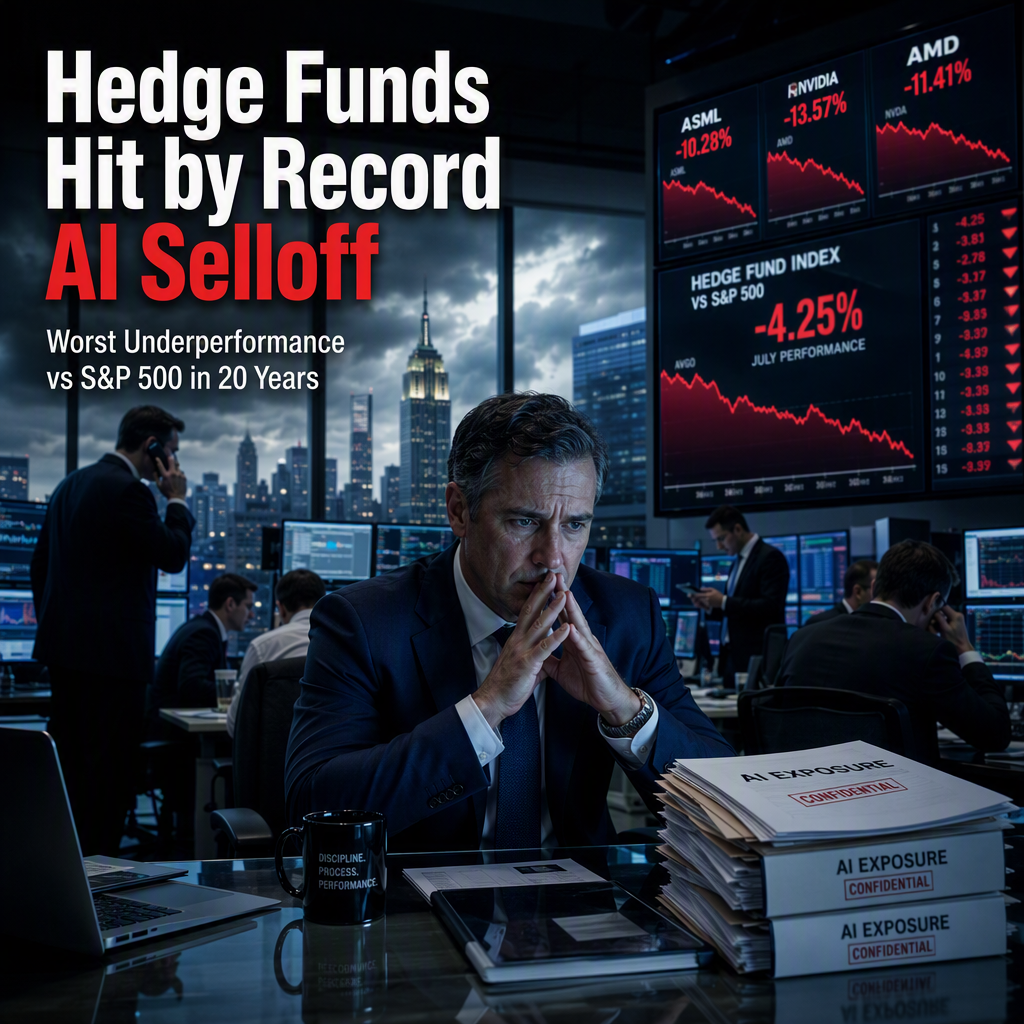
Goldman Sachs reported that hedge funds experienced their worst underperformance against the S&P 500 in July in more than 20 years of data, as the momentum behind artificial intelligence (AI) stocks unwound sharply [1]. According to Goldman strategists led by Ben Snider, the firm's Hedge Fund VIP list, which tracks the most popular long positions, saw its largest one-month lag relative to the S&P 500 on record, and July was marked by one of the sharpest hedge fund de-grossing episodes of the past decade [1].
The report highlighted that hedge funds trimmed positions in numerous AI-related stocks, including many semiconductor companies and most mega-cap names, signaling a diversification away from AI after entering the previous quarter heavily concentrated in the sector. Portfolio turnover reached its highest level since 2021 as funds adjusted their exposures [1].
Goldman noted that hedge fund performance, leverage, and the popularity of long positions have been highly sensitive to the AI trade in recent months. In the second quarter, hedge funds posted strong gains as AI stocks fueled market rallies, leading to record levels of hedge fund crowding. Technology stocks made up 14 of the 20 'Rising Stars' with the largest increases in hedge fund popularity during that period [1].
Despite the recent volatility and reductions in gross leverage, net leverage, and AI exposure from their Q2 peaks, these metrics remain above longer-term averages. As of mid-August, US equity long/short hedge funds have returned 10% year-to-date, according to Goldman Sachs [1].
CONCLUSION
Hedge funds faced a historic setback in July as the unwinding of AI trades led to record underperformance versus the S&P 500. While leverage and AI exposure have moderated, they remain elevated, and hedge funds have still managed a 10% return through mid-August. The episode underscores the sector's sensitivity to shifts in AI-related sentiment and positioning.